Table of Contents
Khanom is a beautiful and historically rich name that carries centuries of cultural significance. Originating from Persian and Turkic traditions, this name means ‘Lady’ or ‘Noble Woman’ and has been used both as an honorific title and a personal name. While popular in Muslim communities, it transcends religious boundaries and appears in various cultures across Central Asia, the Middle East, and South Asia. Today, Khanom remains a timeless choice that embodies dignity, respect, and noble heritage.
Meaning of Khanom
Khanom (also spelled Khanum) derives from the Turkic and Mongolic title ‘Khan’, meaning ruler or leader, combined with the Persian feminine suffix ‘-om’ or ‘-um’. This creates the literal meaning ‘female Khan’ or ‘wife of a Khan’. Historically, it was used to address women of high social status, particularly in Persianate courts and Turkic tribal structures. Over time, it evolved into a general term of respect meaning ‘lady’, ‘noblewoman’, or ‘mistress of the household’. In modern Persian, Turkish, Azerbaijani, and Urdu, it functions as a polite equivalent to ‘Mrs.’ or ‘Madam’. The name’s etymology reflects a blend of Central Asian nomadic leadership traditions with Persian linguistic refinement.
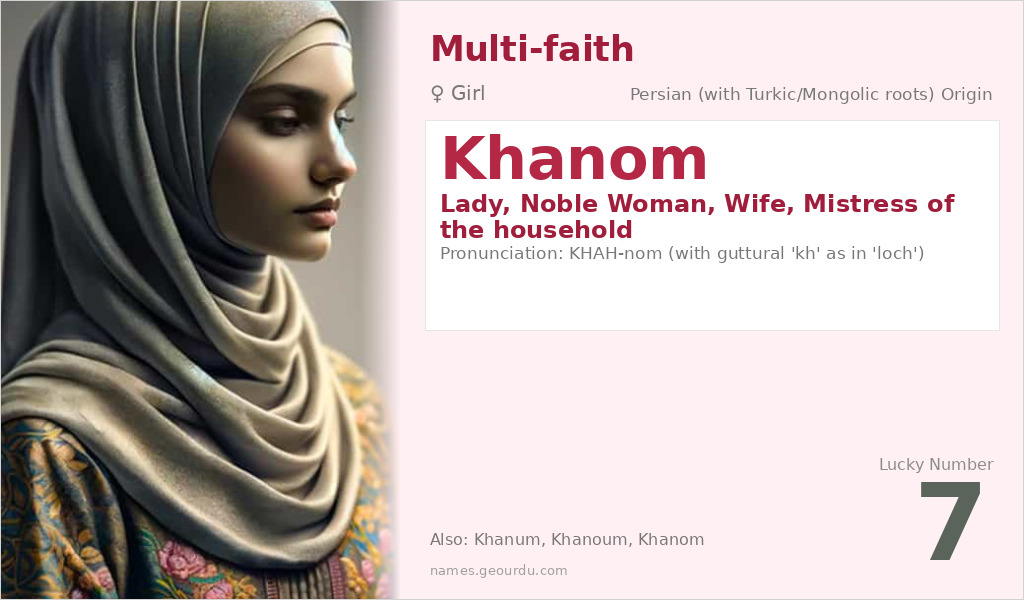
| 📛 Name | Khanom |
| 💎 Meaning | Lady, Noble Woman, Wife, Mistress of the household |
| 👤 Gender | Girl |
| 🕌 Religion | Multi-faith |
| 🌍 Origin | Persian (with Turkic/Mongolic roots) |
| 🗣 Pronunciation | KHAH-nom (with guttural 'kh' as in 'loch') |
| ✍️ Urdu | خانم |
| ✍️ Arabic | خانم |
| 🔢 Numerology | 7 |
| ✨ Spellings | Khanum, Khanoum, Khanom, Xanım |
Origin & Cultural Significance
Khanom originates from the Persianate world, with roots in both Persian language and Turkic/Mongolic cultural titles. It emerged during the medieval period when Persian was the lingua franca of administration and culture across much of the Islamic world. The title spread through the Mongol Empire, Timurid dynasty, and later Ottoman, Safavid, and Mughal empires. While commonly used in Muslim-majority regions, it appears in Zoroastrian, Christian, and other communities within these cultural spheres. Today, it remains prevalent in Iran, Afghanistan, Turkey, Azerbaijan, Pakistan, and among diaspora communities worldwide, maintaining its dual role as both a respectful address and a given name.
Personality Traits
Those named Khanom often carry an air of natural authority and grace inherited from their name’s noble connotations. They tend to be respected figures in their social circles, known for their dignity, traditional values, and strong sense of responsibility. The name suggests someone who commands respect while maintaining warmth and approachability, balancing leadership with compassion. These traits make Khanom a name associated with both strength and elegance in personal character.
Similar Names
If you like Khanom, consider: Khan, Begum, Sultana, Malika, Shahzadi
Famous People Named Khanom
- Khanom Agha — 19th-century Persian princess and poet
- Khanum Jan — Afghan singer and cultural icon
Frequently Asked Questions About Khanom
What does Khanom mean?
Khanom means 'Lady', 'Noble Woman', or 'Mistress of the household'. It comes from Persian language with Turkic roots, combining 'Khan' (ruler) with a feminine suffix.
Is Khanom a boy or girl name?
Khanom is exclusively a feminine name. It contains the Persian feminine suffix '-om'/'-um' and has always been used for women, both as a title and personal name.
What is the origin of Khanom?
Khanom originates from Persian language with Turkic/Mongolic influences. It emerged in medieval Persianate societies and spread across Central Asia, the Middle East, and South Asia through historical empires.