
Table of Contents
Khosrau is a name that echoes through the corridors of ancient Persian history, carrying with it the weight of empire and the legacy of legendary rulers. This regal name, meaning ‘king’ or ‘monarch’, has transcended its Persian origins to become a cherished name in various cultures and religious communities. From the great Sassanian emperors to modern bearers, Khosrau represents leadership, wisdom, and cultural heritage that continues to inspire parents seeking a name with historical depth and noble significance.
Meaning of Khosrau
The name Khosrau originates from the Middle Persian ‘Husraw’, which evolved from the Old Persian ‘Haosravah’ meaning ‘of good fame’ or ‘famous ruler’. Linguistically, it combines elements suggesting excellence and renown, reflecting the qualities expected of monarchs in ancient Persian society. Through centuries of usage, particularly during the Sassanian Empire (224–651 CE), the name became synonymous with kingship itself. In modern Persian, the name is spelled خسرو (Khosrow) and unequivocally means ‘king’, maintaining its royal connotations across Persian-speaking regions including Iran, Afghanistan, Tajikistan, and among diaspora communities worldwide.
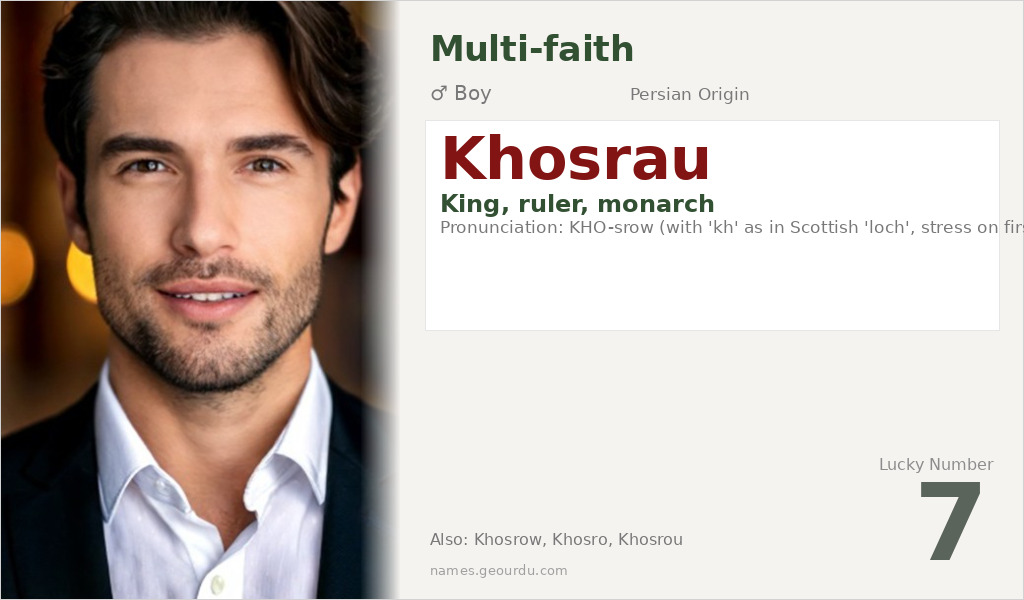
| 📛 Name | Khosrau |
| 💎 Meaning | King, ruler, monarch |
| 👤 Gender | Boy |
| 🕌 Religion | Multi-faith |
| 🌍 Origin | Persian |
| 🗣 Pronunciation | KHO-srow (with 'kh' as in Scottish 'loch', stress on first syllable) |
| ✍️ Urdu | خسرو |
| ✍️ Arabic | كسرى |
| 🔢 Numerology | 7 |
| ✨ Spellings | Khosrow, Khosro, Khosrou, Khusro, Khusrow, Khosrov, Xosrov |
Origin & Cultural Significance
Khosrau has its roots in pre-Islamic Persian civilization, specifically associated with Zoroastrian royal traditions of the Sassanian Empire. The most famous bearers were Khosrow I (Anushirvan, ‘the Immortal Soul’) and Khosrow II (Parviz, ‘the Victorious’), whose reigns represented the zenith of Persian imperial power and cultural achievement. After the Arab conquest of Persia, the name was adopted into Islamic culture through Persian influence and appears in Islamic historical texts referring to these pre-Islamic rulers. Today, the name is used by Muslims, Zoroastrians, Christians, and others in Persianate cultures, particularly in Iran, Afghanistan, Pakistan, and among Kurdish and Tajik communities, reflecting its cross-cultural appeal beyond religious boundaries.
Personality Traits
Those named Khosrau often embody leadership qualities, combining strategic vision with a sense of historical continuity. They tend to approach life with dignity and purpose, valuing both tradition and progress. The name’s royal heritage may inspire confidence and a natural authority, while its historical depth suggests an appreciation for culture, wisdom, and enduring values.
Similar Names
If you like Khosrau, consider: Shahryar, Farhad, Bahram, Jamshid, Darius
Famous People Named Khosrau
- Khosrow I (Anushirvan) — Sassanian emperor of Persia (531–579 CE) known for administrative reforms and cultural patronage
- Khosrow II (Parviz) — Last great Sassanian emperor (590–628 CE) whose reign marked the peak of Persian imperial power
- Khusro Khan — 14th century ruler of the Delhi Sultanate
- Khosrow Golesorkhi — Iranian poet and political activist (1944–1974)
Frequently Asked Questions About Khosrau
What does Khosrau mean?
Khosrau means 'king', 'ruler', or 'monarch'. It originates from the Persian language, specifically from the Old Persian 'Haosravah' meaning 'of good fame' or 'famous ruler'.
Is Khosrau a boy or girl name?
Khosrau is exclusively a masculine name. Throughout its history from ancient Persian times to modern usage, it has only been used for boys and men, reflecting its meaning of 'king' or 'ruler'.
What is the origin of Khosrau?
Khosrau originates from Persian language and culture, specifically from the pre-Islamic Sassanian Empire. It was the name of several Persian emperors before being adopted into Islamic and other cultural contexts through Persian influence across South and Central Asia.





