
Table of Contents
Khyber is a powerful masculine name with deep historical roots in South Asian geography and culture. Derived from the famous Khyber Pass that has connected civilizations for centuries, this name carries the weight of history and strategic importance. Used primarily among Pashtun communities but recognized across the region, Khyber represents strength, resilience, and cultural bridging. Its geographical origin makes it unique among traditional given names.
Meaning of Khyber
Khyber’s meaning is firmly rooted in geography and linguistics. The name originates from the Pashto language, where it refers specifically to the Khyber Pass (د خیبر دره), the mountain pass connecting modern-day Afghanistan and Pakistan. Etymologically, it derives from the Pashto ‘Kheibar’, meaning ‘fortress’ or ‘stronghold’, which itself comes from ancient Aramaic ‘Kheibar’ meaning ‘fortified place’. In Arabic, it’s written as خيبر and refers to the same geographical feature. Historically, the Khyber Pass has been a crucial trade and military route for millennia, mentioned in records from Alexander the Great’s campaigns to British colonial documents, giving the name connotations of strategic importance and historical significance.
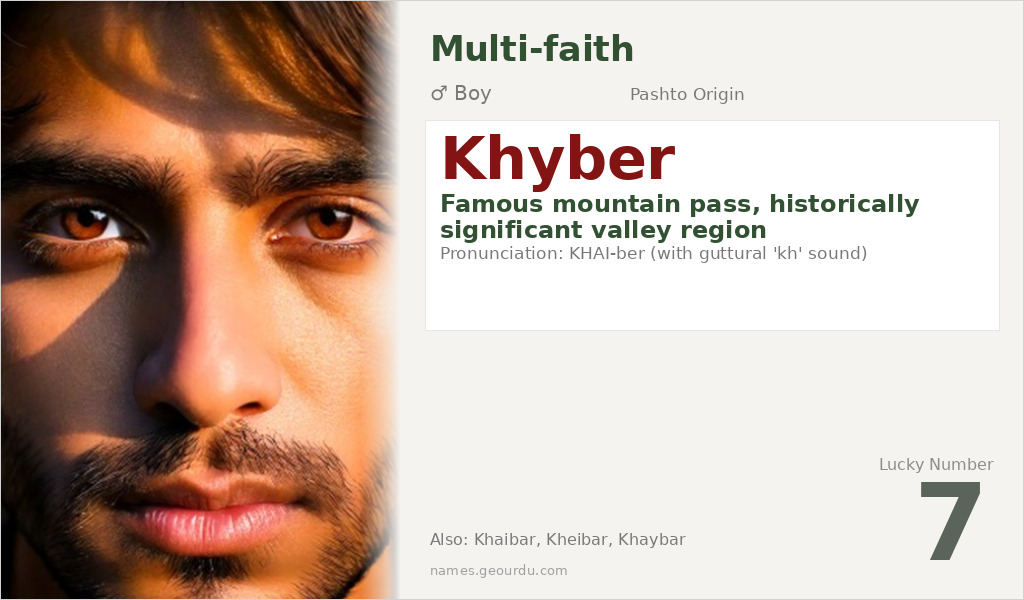
| 📛 Name | Khyber |
| 💎 Meaning | Famous mountain pass, historically significant valley region |
| 👤 Gender | Boy |
| 🕌 Religion | Multi-faith |
| 🌍 Origin | Pashto |
| 🗣 Pronunciation | KHAI-ber (with guttural 'kh' sound) |
| ✍️ Urdu | خیبر |
| ✍️ Arabic | خيبر |
| 🔢 Numerology | 7 |
| ✨ Spellings | Khaibar, Kheibar, Khaybar, Khaibar |
Origin & Cultural Significance
Khyber originates from the Pashto-speaking regions of modern-day Afghanistan and Pakistan, specifically named after the historic Khyber Pass that has served as a gateway between Central Asia and the Indian subcontinent for over 2,000 years. The name gained cultural significance through the region’s history, being used by various empires including the Mughals and British Raj. While commonly used among Pashtun and other ethnic groups in the region, it’s not tied to any specific religion but rather to geographical and cultural heritage. The name represents the rugged, mountainous terrain and strategic importance of the pass that has shaped regional history, migrations, and trade routes for centuries.
Personality Traits
Those named Khyber are often associated with strength, resilience, and historical consciousness. The name suggests someone who can navigate challenges like the mountainous terrain it represents, with strategic thinking and endurance. Cultural connections to the historic pass imply bridging abilities—connecting different perspectives or communities. There’s an inherent sense of heritage and geographical identity that may influence personality toward being grounded, historically aware, and culturally proud.
Similar Names
If you like Khyber, consider: Kabul, Hindukush, Sulaiman, Zamindawar, Tirah
Famous People Named Khyber
- Khyber Shinwari — Pakistani Pashto poet and writer from the Khyber region
- Khyber Pakhtunkhwa — The Pakistani province named after the Khyber Pass region
Frequently Asked Questions About Khyber
What does Khyber mean?
Khyber means 'famous mountain pass' or 'fortress' originating from Pashto, specifically referring to the historic Khyber Pass between Afghanistan and Pakistan. The name comes from Pashto 'Kheibar' with roots in ancient Aramaic meaning 'fortified place'.
Is Khyber a boy or girl name?
Khyber is exclusively a masculine name, used primarily for boys in Pashtun and other South Asian cultures. Its association with the rugged, historically significant Khyber Pass gives it strong masculine connotations in the regions where it's used.
What is the origin of Khyber?
Khyber originates from the Pashto language and culture of Afghanistan and Pakistan, named after the geographical Khyber Pass. It has historical significance dating back millennia as a crucial trade and military route, with linguistic roots extending to ancient Aramaic for 'fortified place'.





