
Table of Contents
The name King carries the weight of centuries of leadership and authority. Derived from Old English roots meaning ‘ruler’ or ‘monarch’, this powerful name has evolved from a royal title to a popular given name. While historically associated with nobility and sovereignty, modern usage celebrates its strong, commanding presence across diverse cultures worldwide.
Meaning of King
King originates from the Old English ‘cyning’, tracing back to Proto-Germanic ‘*kuningaz’, meaning ‘ruler’ or ‘leader of a people’. This etymology connects to related terms across Germanic languages including Old Norse ‘konungr’ and Old High German ‘kuning’. The name fundamentally denotes sovereignty, authority, and leadership, reflecting its historical use for monarchs and chieftains. As a given name, it carries these connotations of power, protection, and noble character, making it a strong choice that transcends specific cultural or religious boundaries.
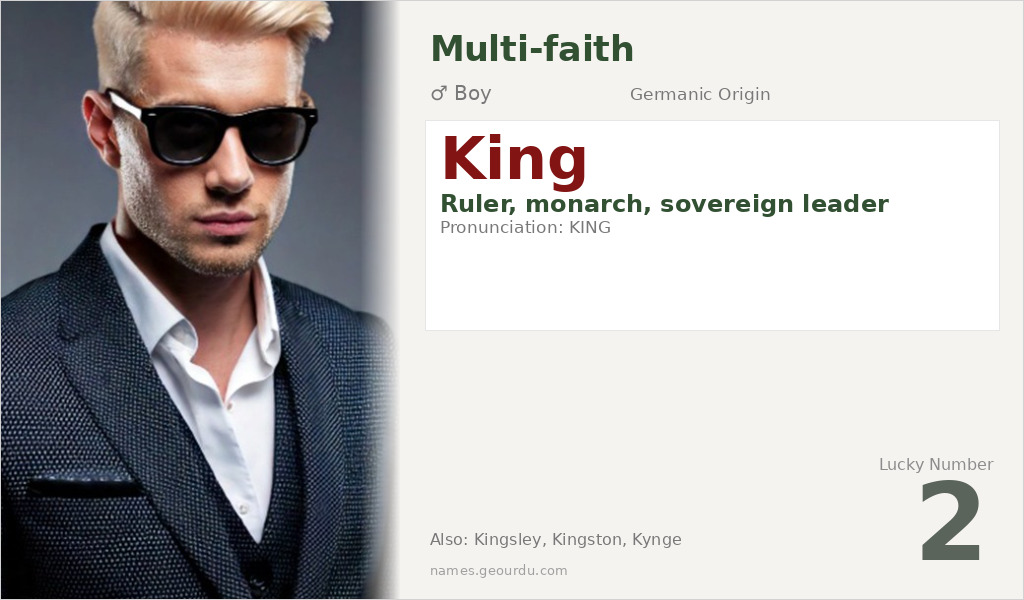
| 📛 Name | King |
| 💎 Meaning | Ruler, monarch, sovereign leader |
| 👤 Gender | Boy |
| 🕌 Religion | Multi-faith |
| 🌍 Origin | Germanic |
| 🗣 Pronunciation | KING |
| ✍️ Urdu | بادشاہ |
| ✍️ Arabic | ملك |
| 🔢 Numerology | 2 |
| ✨ Spellings | Kingsley, Kingston, Kynge |
Origin & Cultural Significance
The name King has its roots in Germanic languages, specifically emerging from Old English vocabulary for rulers and leaders. It began as an occupational surname in medieval England, describing someone who acted with kingly authority or served in a royal household. During the 19th century, it transitioned to use as a first name, particularly in English-speaking countries. While not tied to any specific religion, the name has been adopted by Christian, Muslim, Hindu, and secular families alike, valued for its universal connotations of strength and leadership rather than religious significance.
Personality Traits
Those named King often naturally embody leadership qualities, displaying confidence, decisiveness, and protective instincts. They tend to approach challenges with strategic thinking and maintain composure under pressure, much like historical monarchs navigating complex situations. While sometimes perceived as authoritative, they typically balance this with fairness and responsibility toward others in their personal and professional circles.
Similar Names
If you like King, consider: Rex, Roy, Regis, Kaiser, Sultan
Famous People Named King
- King Charles III — Current monarch of the United Kingdom and Commonwealth realms
- Martin Luther King Jr. — American Baptist minister and civil rights activist
Frequently Asked Questions About King
What does King mean?
King means 'ruler', 'monarch', or 'sovereign leader', originating from the Old English word 'cyning' with Proto-Germanic roots.
Is King a boy or girl name?
King is traditionally a masculine name, though like many names, it can occasionally be used creatively for girls. Historically and culturally, it remains predominantly male.
What is the origin of King?
King originates from Germanic languages, specifically Old English, evolving from an occupational surname into a given name with royal connotations.





