
Table of Contents
Kinshuk is a distinctive boy’s name rooted in ancient Sanskrit, evoking the vivid imagery of India’s natural landscapes. Unlike generic floral names, it specifically refers to the Butea monosperma tree, celebrated for its stunning orange-red blossoms that light up forests each spring. This name carries deep cultural and literary resonance, appearing in classical Indian texts and symbolizing beauty, passion, and renewal. Choosing Kinshuk connects a child to a rich botanical and poetic heritage, making it a meaningful choice for parents seeking a name with both elegance and substance.
Meaning of Kinshuk
Kinshuk originates from the Sanskrit word ‘किंशुक’ (kiṃśuka), which denotes the Butea monosperma tree, commonly called the flame of the forest or Palash tree. This tree is iconic in South Asia for its bright, fiery flowers that bloom in dry seasons, often referenced in poetry and mythology for their vibrant color and symbolism. In Sanskrit literature, such as the Mahabharata and works by poet Kalidasa, Kinshuk is used metaphorically to represent beauty, desire, and the transient nature of life, akin to the tree’s brief but brilliant flowering period. The name’s meaning is precise and well-documented, distinguishing it from mere generic terms for flowers and highlighting its specific botanical and cultural importance in Indian traditions.
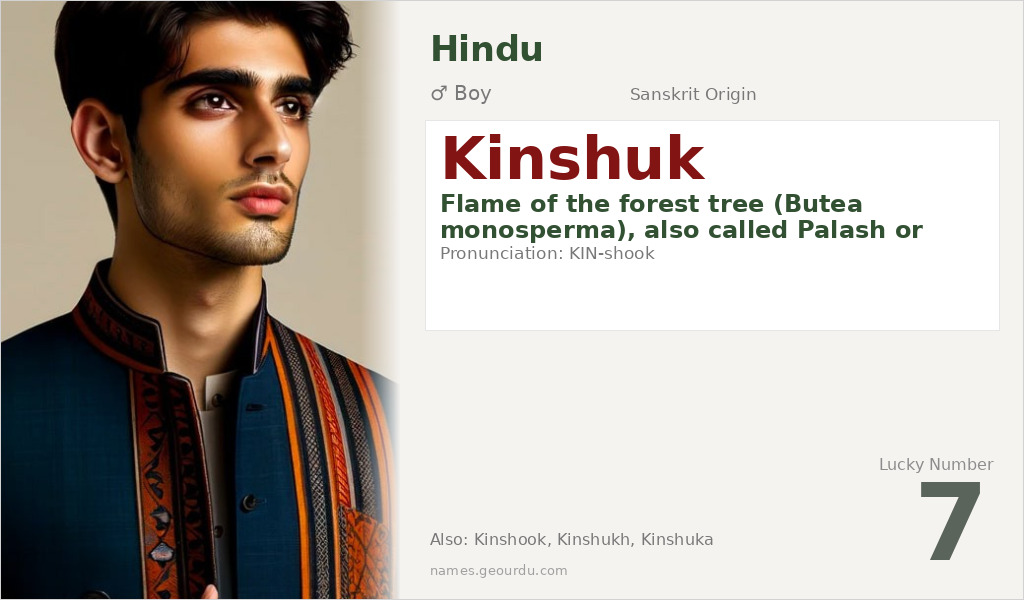
| 📛 Name | Kinshuk |
| 💎 Meaning | Flame of the forest tree (Butea monosperma), also called Palash or Dhak tree |
| 👤 Gender | Boy |
| 🕌 Religion | Hindu |
| 🌍 Origin | Sanskrit |
| 🗣 Pronunciation | KIN-shook |
| ✍️ Urdu | کنشک |
| ✍️ Arabic | كينشوك |
| 🔢 Numerology | 7 |
| ✨ Spellings | Kinshook, Kinshukh, Kinshuka, Kinsuk |
Origin & Cultural Significance
Kinshuk has its origins in Sanskrit, an ancient Indo-Aryan language that forms the basis of many Indian languages and Hindu scriptures. It is primarily used within Hindu communities, reflecting the cultural and religious significance of nature in Hinduism, where trees like the Butea monosperma are often revered in rituals and folklore. Historically, the name appears in classical Indian texts, emphasizing its longstanding presence in the subcontinent’s literary and cultural heritage. While it is most common in India, particularly in Hindi-speaking regions, its usage has spread to diaspora communities, maintaining its association with Hindu traditions and natural symbolism.
Personality Traits
People named Kinshuk are often perceived as dynamic and expressive, mirroring the fiery allure of the flame of the forest tree. They may exhibit creativity, a love for the arts, and a charismatic presence that draws others to them. Their personality is frequently associated with warmth, resilience, and a knack for standing out in a crowd, much like the tree’s striking blossoms in a forest. This name suggests an individual who embraces life with passion and inspires those around them through their vibrant energy and natural leadership qualities.
Similar Names
If you like Kinshuk, consider: Palash, Ashoka, Kesar, Arjun, Kiran
Famous People Named Kinshuk
- Kinshuk Vaidya — Indian television actor known for roles in shows like 'Pyaar Kii Ye Ek Kahaani'
- Kinshuk Mahajan — Indian actor featured in television series such as 'Sasural Genda Phool'
Frequently Asked Questions About Kinshuk
What does Kinshuk mean?
Kinshuk means 'flame of the forest tree' (Butea monosperma) in Sanskrit, referring to a specific tree known for its bright orange-red flowers, not just a generic flower.
Is Kinshuk a boy or girl name?
Kinshuk is traditionally a boy's name in Hindu culture, derived from masculine Sanskrit roots and commonly used for males in India and among Hindu communities.
What is the origin of Kinshuk?
Kinshuk originates from Sanskrit, an ancient Indian language, and is deeply rooted in Hindu traditions, with references in classical literature and botanical contexts.





