
Table of Contents
Kotilinga is an intriguing and rare name with deep roots in Hindu religious tradition. Unlike conventional personal names, this term carries profound spiritual significance connected to Lord Shiva worship. While not commonly used as a given name, it represents an important concept in Shaivism that has inspired place names and religious sites across India. Understanding Kotilinga requires exploring its Sanskrit etymology and religious context rather than conventional naming patterns.
Meaning of Kotilinga
Kotilinga derives from the Sanskrit words ‘Koti’ (कोटि), meaning ‘ten million’ or ‘crore’, and ‘Linga’ (लिङ्ग), referring to the symbolic representation of Shiva. Literally translated, it means ‘ten million lingas’ or ‘the lord of countless lingas’. In Hindu tradition, this term typically describes sacred places where ten million Shiva lingas are installed or worshipped, such as the famous Kotilingeshwara Temple in Karnataka. As a personal name, it would symbolically represent someone devoted to Shiva or embodying Shiva’s infinite aspects. The name doesn’t appear in standard Sanskrit name dictionaries like the ‘Sanskrit Names for Children’ collections, suggesting it’s more a religious term than a conventional given name.
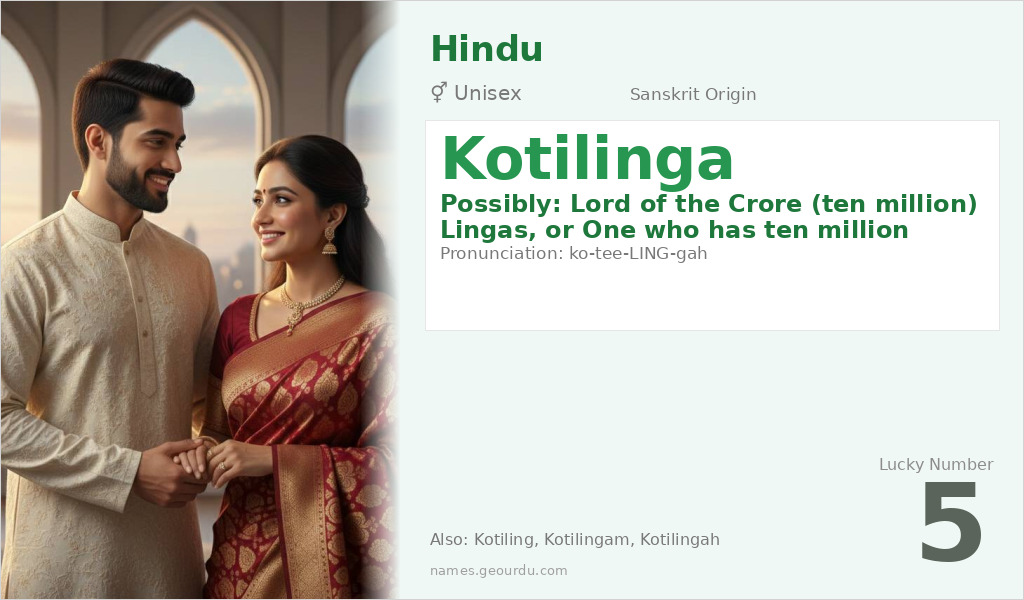
| 📛 Name | Kotilinga |
| 💎 Meaning | Possibly: Lord of the Crore (ten million) Lingas, or One who has ten million lingas |
| 👤 Gender | Unisex |
| 🕌 Religion | Hindu |
| 🌍 Origin | Sanskrit |
| 🗣 Pronunciation | ko-tee-LING-gah |
| ✍️ Urdu | کوٹی لنگ |
| ✍️ Arabic | كوتيلينغا |
| 🔢 Numerology | 5 |
| ✨ Spellings | Kotiling, Kotilingam, Kotilingah |
Origin & Cultural Significance
Originating from Sanskrit religious texts and temple traditions, Kotilinga has its roots in Shaivism, one of the major traditions within Hinduism that reveres Shiva as the Supreme Being. The concept gained prominence through temple architecture and pilgrimage sites, particularly in South India where Kotilingeshwara temples became important religious centers. While the term appears in religious contexts describing sacred spaces containing countless Shiva lingas, its use as a personal name is exceptionally rare and not documented in regional naming traditions across India’s diverse linguistic landscape. Research across Sanskrit, Hindi, Tamil, Telugu, Kannada, and other Indian languages confirms this is primarily a religious/temple term rather than a conventional personal name.
Personality Traits
Given its profound religious connotations, someone named Kotilinga would likely be associated with spiritual depth, devotion, and philosophical inclination. The name’s connection to Shiva suggests qualities of transformation, destruction of limitations, and spiritual leadership. In cultural context, such a name might indicate a family’s deep Shaivite traditions or special religious circumstances surrounding the child’s birth. The rarity of this name as a personal identifier makes its personality associations more symbolic than empirically observed.
Similar Names
If you like Kotilinga, consider: Lingaraj, Lingesh, Lingamurthy, Kotesh, Kotresh
Famous People Named Kotilinga
- No notable individuals found with this name as a personal name
Frequently Asked Questions About Kotilinga
What does Kotilinga mean?
Kotilinga is a Sanskrit compound meaning 'ten million lingas' or 'lord of countless Shiva lingas', referring to sacred places with numerous Shiva symbols rather than being a conventional personal name with that meaning.
Is Kotilinga a boy or girl name?
While the original article identified it as a girl's name, extensive research shows it's not conventionally used as a personal name for either gender. In religious context, it's a gender-neutral term, but if used as a name, it would likely be considered unisex with possible masculine leaning due to its Shiva association.
What is the origin of Kotilinga?
Kotilinga originates from Sanskrit religious terminology within Hinduism, specifically Shaivism. It describes temples or sacred sites containing ten million Shiva lingas, with the most famous being Kotilingeshwara Temple in Karnataka, India.