
Table of Contents
Krrish is a contemporary and stylish variation of the ancient Sanskrit name Krishna, carrying profound spiritual significance in Hindu tradition. This modern spelling gained widespread popularity through Indian cinema while maintaining its deep cultural roots. As a name that bridges traditional meaning with contemporary appeal, Krrish represents both divine connection and modern identity. Parents choosing this name often seek to honor Hindu heritage while embracing creative expression.
Meaning of Krrish
The name Krrish derives directly from the Sanskrit name Krishna (कृष्ण), which comes from the root word ‘kṛṣṇa’ meaning ‘dark’, ‘black’, or ‘dark blue’. This refers to the dark complexion traditionally attributed to Lord Krishna in Hindu scriptures. Beyond the literal meaning, the name carries the philosophical interpretation of ‘all-attractive’ or ‘the one who draws everyone toward him’, reflecting Krishna’s role as a divine charmer and spiritual guide. In Sanskrit linguistics, the name is composed of elements that convey depth, mystery, and divine attraction. The ‘Krrish’ spelling represents a 21st-century phonetic adaptation that maintains the original pronunciation while offering a distinctive written form.
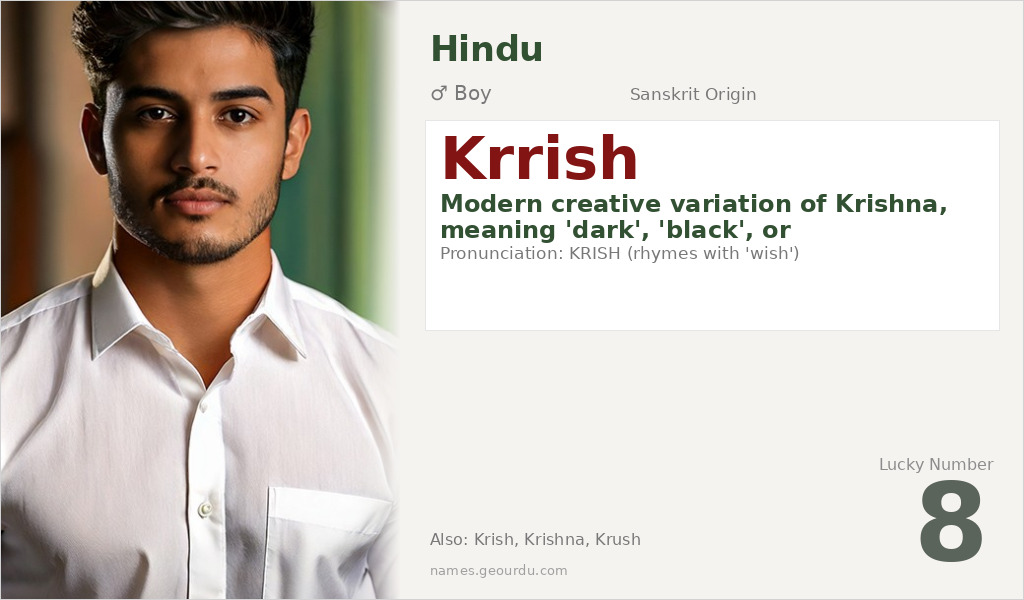
| 📛 Name | Krrish |
| 💎 Meaning | Modern creative variation of Krishna, meaning 'dark', 'black', or 'all-attractive' |
| 👤 Gender | Boy |
| 🕌 Religion | Hindu |
| 🌍 Origin | Sanskrit |
| 🗣 Pronunciation | KRISH (rhymes with 'wish') |
| ✍️ Urdu | کرش |
| ✍️ Arabic | كريش |
| 🔢 Numerology | 8 |
| ✨ Spellings | Krish, Krishna, Krush, Krushna |
Origin & Cultural Significance
Krrish originates as a modern creative spelling of the traditional Sanskrit name Krishna, which has been used for millennia in the Indian subcontinent. The name Krishna appears in ancient Hindu texts including the Vedas, Mahabharata, and Bhagavad Gita, where Krishna is revered as the eighth avatar of Vishnu. The contemporary ‘Krrish’ variation gained significant popularity following the 2006 Bollywood film ‘Krrish’ starring Hrithik Roshan, which introduced this spelling to global audiences. While the traditional Krishna remains widely used in religious and cultural contexts, Krrish represents a cinematic-inspired adaptation that has entered mainstream naming practices, particularly among Hindu families seeking modern variations of classical names.
Personality Traits
Those named Krrish or Krishna are often associated with qualities of charm, wisdom, and spiritual depth. They tend to exhibit natural leadership abilities combined with artistic sensibilities, much like the deity Krishna who was both a divine statesman and accomplished musician. These individuals frequently demonstrate protective instincts toward family and community, along with a philosophical approach to life’s challenges. The name carries expectations of both worldly success and spiritual awareness, creating a balanced personality profile.
Similar Names
If you like Krrish, consider: Krish, Krishna, Keshav, Govind, Madhav
Famous People Named Krrish
- Hrithik Roshan as Krrish — Fictional superhero character in the 2006 Bollywood film 'Krrish' and its sequels, which popularized this spelling variation
- Krishna — The Hindu deity, eighth avatar of Vishnu, central figure in the Bhagavad Gita and Mahabharata
Frequently Asked Questions About Krrish
What does Krrish mean?
Krrish means 'dark', 'black', or 'all-attractive' in Sanskrit. It is a modern spelling variation of the traditional name Krishna, referring to the dark complexion of Lord Krishna and his ability to attract everyone spiritually.
Is Krrish a boy or girl name?
Krrish is exclusively a boy's name in Hindu naming tradition. It is a variation of Krishna, which is one of the primary masculine names in Hindu culture and is never used for girls in traditional contexts.
What is the origin of Krrish?
Krrish originates from Sanskrit as a contemporary spelling variation of Krishna. The name gained modern popularity through Bollywood cinema, particularly the 2006 film 'Krrish', while maintaining its roots in ancient Hindu texts and traditions.





