Table of Contents
Kushaan is a powerful masculine name steeped in ancient history, evoking the grandeur of the Kushan Empire that once spanned Central Asia and the Indian subcontinent. Unlike many modern names, Kushaan carries direct historical weight, connecting its bearer to a dynasty that facilitated cultural exchange along the Silk Road. Today, it remains a distinctive choice for parents seeking a name with imperial resonance and cross-cultural heritage. This guide explores the true origins, meaning, and contemporary usage of this historically significant name.
Meaning of Kushaan
The meaning of Kushaan is intrinsically linked to the Kushan Empire (c. 30–375 CE), one of history’s great multicultural empires. Linguistically, the name derives from Persian and Pashto references to ‘Kushan,’ relating to the ruling dynasty rather than having a standalone dictionary meaning like ‘clever.’ The Kushans themselves were originally part of the Yuezhi confederation from the Central Asian steppes, and their name in historical records signifies imperial authority and governance. In modern naming contexts, Kushaan thus carries connotations of ‘ruler,’ ‘king,’ or ‘imperial leader,’ reflecting the empire’s historical prominence. While not found in classical Arabic or Sanskrit dictionaries with a specific lexical meaning, its historical significance in Persianate and South Asian contexts gives it substantial semantic weight as a regal name.
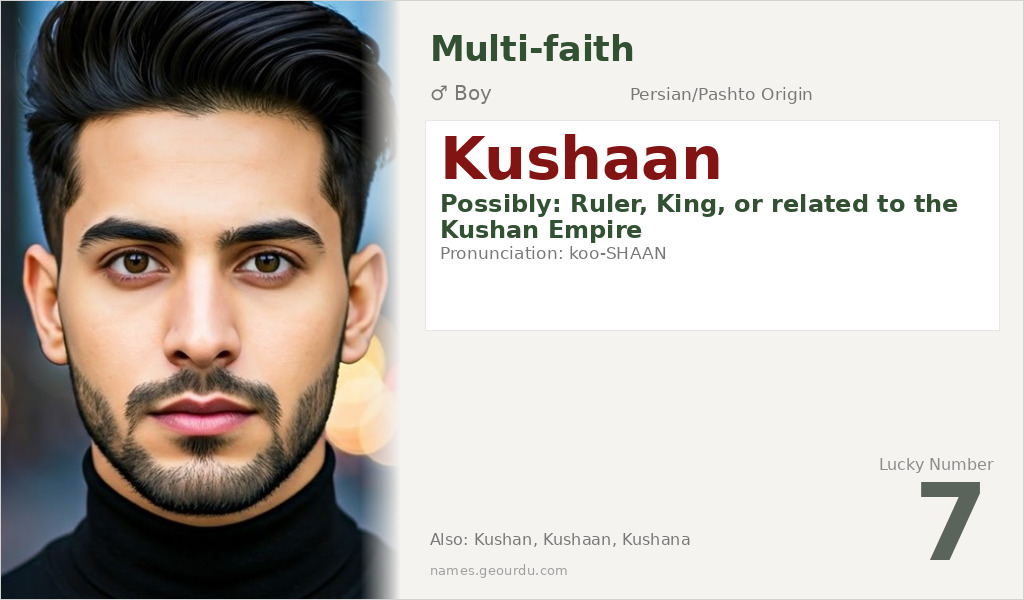
| 📛 Name | Kushaan |
| 💎 Meaning | Possibly: Ruler, King, or related to the Kushan Empire |
| 👤 Gender | Boy |
| 🕌 Religion | Multi-faith |
| 🌍 Origin | Persian/Pashto |
| 🗣 Pronunciation | koo-SHAAN |
| ✍️ Urdu | کشان |
| ✍️ Arabic | كوشان |
| 🔢 Numerology | 7 |
| ✨ Spellings | Kushan, Kushaan, Kushana, Kushaan |
Origin & Cultural Significance
Kushaan originates from the historical and cultural legacy of the Kushan Empire, which had its roots in Central Asia before expanding across modern-day Afghanistan, Pakistan, and northern India. The name is particularly prevalent in regions influenced by Persian and Pashto cultures, including Afghanistan, Pakistan, and northwestern India, where the Kushan historical presence remains part of cultural memory. Unlike names with purely religious origins, Kushaan transcends single faith boundaries—it’s used by Muslims, Hindus, and Sikhs in South Asia who appreciate its historical rather than theological significance. The Kushan period was marked by remarkable religious tolerance and artistic synthesis, making the name appealing to families valuing cultural heritage and pluralism.
Personality Traits
Those named Kushaan often embody traits associated with leadership, cultural adaptability, and strategic vision. Drawing from the historical empire’s legacy, they may demonstrate an ability to bridge different perspectives and navigate complex situations with grace. The name suggests someone with natural authority who values both tradition and innovation, much like the Kushan rulers who patronized both Buddhist art and Persian administration systems.
Similar Names
If you like Kushaan, consider: Kush, Kushal, Kushagra, Kushwant, Kanishka
Famous People Named Kushaan
- Kushan Empire rulers — Historical dynasty including Kanishka, Huvishka, and Vasudeva I who ruled from 30-375 CE
- Kushan art — Refers to the distinctive Gandhara art style that flourished under Kushan patronage blending Greek and Buddhist influences
Frequently Asked Questions About Kushaan
What does Kushaan mean?
Kushaan derives from the historical Kushan Empire and carries connotations of 'ruler' or 'king' in Persian/Pashto contexts, referencing the imperial dynasty rather than having a simple dictionary definition.
Is Kushaan a boy or girl name?
Kushaan is exclusively a masculine name, used for boys across South Asia and Central Asian diaspora communities, reflecting its origins as a dynastic and regal name.
What is the origin of Kushaan?
Kushaan originates from Persian and Pashto references to the Kushan Empire (1st-3rd centuries CE), a historically significant Central Asian dynasty that ruled parts of Afghanistan, Pakistan, and India.