Table of Contents
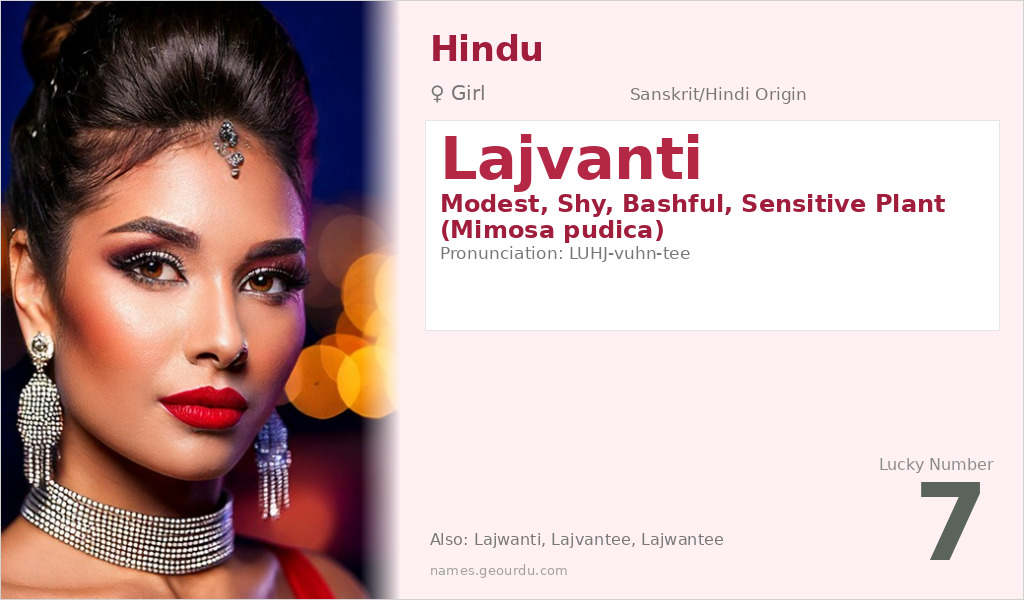
Lajvanti is a beautiful and meaningful name of Sanskrit origin that carries deep cultural significance in South Asian communities. Meaning ‘modest’ or ‘shy,’ this name evokes the image of the sensitive touch-me-not plant that symbolizes humility and grace. Primarily used as a feminine name in Hindu families, Lajvanti represents traditional values of modesty and sensitivity. The name has appeared in literature and film, adding to its cultural resonance.
Meaning of Lajvanti
Lajvanti derives from the Sanskrit root ‘लज्जा’ (lajjā), which means ‘modesty, shyness, or bashfulness.’ The suffix ‘-vanti’ indicates possession, making the complete meaning ‘one who possesses modesty’ or ‘the modest one.’ In botanical terms, Lajvanti specifically refers to Mimosa pudica, the sensitive plant that folds its leaves when touched, serving as a natural metaphor for modesty. This connection between the plant’s behavior and human modesty makes the name particularly poetic. The meaning remains consistent across Hindi, Urdu, Punjabi, and Bengali languages. Unlike generic plant names, Lajvanti carries specific cultural and linguistic significance tied to virtues valued in South Asian societies.
| 📛 Name | Lajvanti |
| 💎 Meaning | Modest, Shy, Bashful, Sensitive Plant (Mimosa pudica) |
| 👤 Gender | Girl |
| 🕌 Religion | Hindu |
| 🌍 Origin | Sanskrit/Hindi |
| 🗣 Pronunciation | LUHJ-vuhn-tee |
| ✍️ Urdu | لجونتی |
| ✍️ Arabic | لاجوانتي |
| 🔢 Numerology | 7 |
| ✨ Spellings | Lajwanti, Lajvantee, Lajwantee, Lajvanti |
Origin & Cultural Significance
Lajvanti originates from classical Sanskrit and has been used in Indian subcontinental languages for centuries. The name is deeply embedded in Hindu culture where modesty (lajjā) is considered an important feminine virtue. It appears in various regional forms across North India and Pakistan, particularly in Hindi, Urdu, and Punjabi-speaking communities. The name gained additional cultural prominence through Rajinder Singh Bedi’s 1951 Partition novel ‘Lajwanti’ and its subsequent film adaptation. While primarily associated with Hindu tradition, the name’s linguistic roots make it recognizable across South Asian cultures regardless of religious affiliation.
Personality Traits
Those named Lajvanti are often associated with gentle, sensitive personalities that reflect the name’s meaning. They tend to be thoughtful observers rather than bold initiators, with a natural reserve that can be mistaken for shyness. Their sensitivity makes them particularly attuned to others’ emotions and needs. Like the touch-me-not plant the name references, they may be protective of their inner selves while showing remarkable resilience.
Similar Names
If you like Lajvanti, consider: Lajja, Lajita, Vinaya, Sharmila, Mridula
Famous People Named Lajvanti
- Lajwanti — Character in famous Hindi novel 'Lajwanti' by Rajinder Singh Bedi about a woman's resilience during Partition
- Lajwanti — Character in 1958 Bollywood film 'Lajwanti' starring Nargis and Balraj Sahni
Frequently Asked Questions About Lajvanti
What does Lajvanti mean?
Lajvanti means 'modest,' 'shy,' or 'bashful' in Sanskrit/Hindi. It specifically refers to the sensitive plant (Mimosa pudica) that symbolizes modesty through its leaf-folding behavior.
Is Lajvanti a boy or girl name?
Lajvanti is exclusively a feminine name in Hindu and South Asian naming traditions. The name's meaning relating to modesty has traditionally been associated with feminine virtues in these cultures.
What is the origin of Lajvanti?
Lajvanti originates from Sanskrit, specifically from the root word 'lajjā' meaning modesty. It has been used for centuries in Hindi, Urdu, Punjabi, and other South Asian languages, primarily within Hindu cultural contexts.