
Table of Contents
Leyton is a distinctive boy’s name with deep roots in English geography and history. Originally a surname derived from a place name in East London, it has evolved into a modern given name with a strong, earthy feel. Its connection to the River Lea and ancient settlements gives it a timeless quality that appeals to parents seeking names with historical substance. Today, Leyton carries both traditional weight and contemporary appeal.
Meaning of Leyton
The name Leyton originates from the Old English place name ‘Lea-tun’, which combines two elements: ‘leah’ and ‘tun’. ‘Leah’ (pronounced ‘lay-ah’) means ‘clearing, meadow, or garden’ in Old English, often specifically referring to a clearing in a woodland. ‘Tun’ means ‘enclosure, settlement, or town’. Thus, Leyton literally translates to ‘settlement in the clearing’ or more specifically ‘town by the leek garden’, as ‘leah’ was sometimes associated with herb gardens including leeks. The name specifically refers to the area now known as Leyton in the London Borough of Waltham Forest, historically recorded in the Domesday Book as ‘Lea-tun’. This geographical origin distinguishes it from purely descriptive names, giving it a concrete historical foundation.
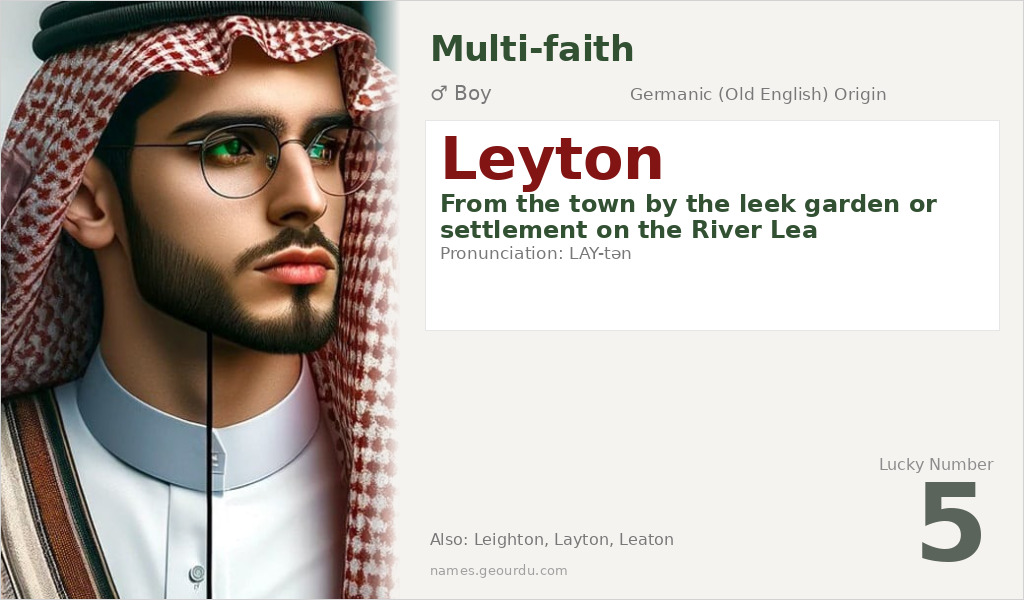
| 📛 Name | Leyton |
| 💎 Meaning | From the town by the leek garden or settlement on the River Lea |
| 👤 Gender | Boy |
| 🕌 Religion | Multi-faith |
| 🌍 Origin | Germanic (Old English) |
| 🗣 Pronunciation | LAY-tən |
| ✍️ Urdu | لیٹن |
| ✍️ Arabic | ليتون |
| 🔢 Numerology | 5 |
| ✨ Spellings | Leighton, Layton, Leaton |
Origin & Cultural Significance
Leyton has its origins in Germanic languages through Old English, specifically as a toponymic (place-derived) name from the London district of Leyton. The area was originally part of the ancient parish of Leyton in Essex, with records dating back to the 10th century. As a given name, Leyton gained popularity in the late 20th and early 21st centuries, particularly in English-speaking countries like the United Kingdom, United States, Australia, and Canada. Its transition from surname to first name follows a common pattern in English naming traditions, similar to names like Preston, Clayton, and Ashton. While not tied to any specific religion, it is used by families of various faiths and cultural backgrounds in English-speaking contexts.
Personality Traits
Those named Leyton are often associated with qualities of resilience and connection to nature, reflecting the name’s geographical roots. They may exhibit practical intelligence and a grounded demeanor, with an appreciation for history and tradition. The name suggests someone who is both stable and adaptable, capable of putting down roots while remaining open to new experiences and environments.
Similar Names
If you like Leyton, consider: Leighton, Layton, Clayton, Payton, Brayden
Famous People Named Leyton
- Leyton Orient Football Club — professional English football club based in Leyton, London
- Leyton Hewitt — Australian former professional tennis player (first name actually Lleyton, but phonetically similar)
Frequently Asked Questions About Leyton
What does Leyton mean?
Leyton means 'from the town by the leek garden' or 'settlement on the River Lea'. It comes from the Old English 'Lea-tun', combining 'leah' (clearing/meadow) and 'tun' (settlement/town).
Is Leyton a boy or girl name?
Leyton is primarily used as a boy's name, though like many surname-derived names, it could theoretically be used for any gender. Historically and currently, it is overwhelmingly masculine in usage across English-speaking cultures.
What is the origin of Leyton?
Leyton originates from Old English (Germanic language family) as a place name referring to the district of Leyton in East London. It evolved from the Old English 'Lea-tun' and became a surname before transitioning to a given name.





