
Table of Contents
Linton is a distinguished name with deep roots in English history and geography. Originally a surname derived from place names, it has evolved into a classic given name with a rich linguistic heritage. This name carries the legacy of medieval settlements where flax cultivation was central to community life. Today, Linton maintains its traditional appeal while offering a distinctive alternative to more common English names.
Meaning of Linton
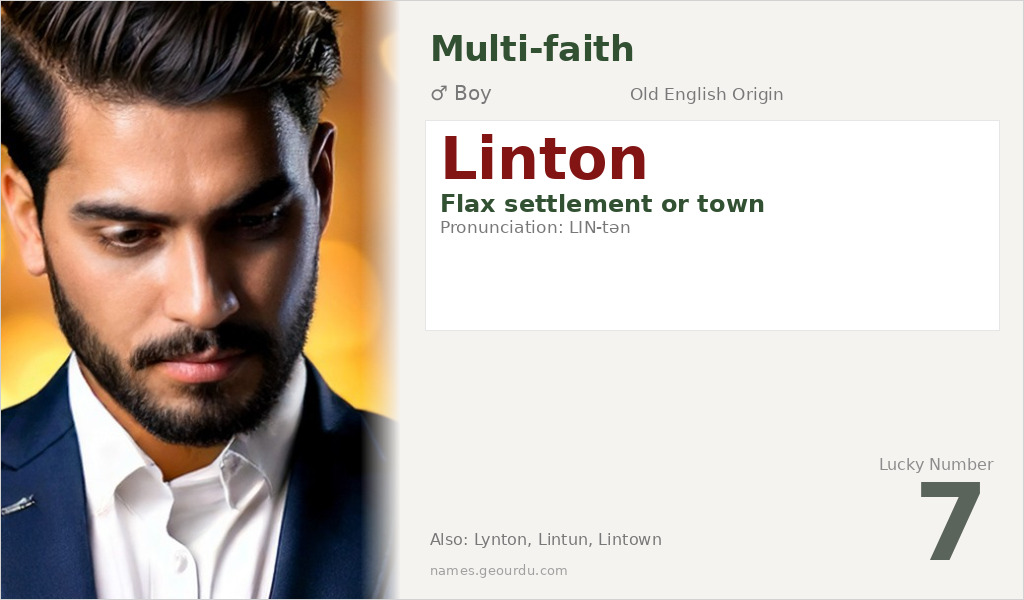
The name Linton has a precise and well-documented meaning in Old English etymology. It combines two elements: ‘lin,’ meaning ‘flax’ or ‘linen,’ and ‘tun,’ meaning ‘settlement,’ ‘enclosure,’ or ‘town.’ This compound structure was common in Old English place names, indicating settlements specifically associated with flax cultivation or linen production. The ‘lin’ element refers to the flax plant (Linum usitatissimum), which was crucial for producing linen fabric in medieval England. The ‘tun’ element evolved into the modern English ‘-ton’ suffix found in many place names. Thus, Linton literally means ‘flax settlement’ or ‘town where flax is grown,’ reflecting the agricultural and economic activities of the original communities that bore this name.
| 📛 Name | Linton |
| 💎 Meaning | Flax settlement or town |
| 👤 Gender | Boy |
| 🕌 Religion | Multi-faith |
| 🌍 Origin | Old English |
| 🗣 Pronunciation | LIN-tən |
| ✍️ Urdu | لنٹن |
| ✍️ Arabic | لينتون |
| 🔢 Numerology | 7 |
| ✨ Spellings | Lynton, Lintun, Lintown |
Origin & Cultural Significance
Linton originates from Old English, specifically from place names that were later adopted as surnames and eventually as given names. Numerous villages and towns in England bear the name Linton, including locations in Cambridgeshire, North Yorkshire, and Herefordshire. These settlements typically developed around flax cultivation during the Anglo-Saxon period. As a surname, Linton emerged in the 12th-13th centuries when hereditary surnames became common in England. The transition to a given name occurred primarily in the 19th and 20th centuries, particularly in English-speaking countries. While most common in the United Kingdom and United States, the name has been used by people of various religious backgrounds, though it has no specific religious connotations in its origin.
Personality Traits
Those named Linton often exhibit characteristics associated with their name’s practical origins. They tend to be grounded, reliable individuals with an appreciation for tradition and craftsmanship. The name’s connection to flax cultivation suggests qualities of patience and nurturing growth over time. Lintons are frequently seen as thoughtful, analytical people who approach problems with careful consideration and practical solutions.
Similar Names
If you like Linton, consider: Lincoln, Linden, Clinton, Langston, Lionel
Famous People Named Linton
- Linton Kwesi Johnson — Jamaican-British poet and reggae artist
- Linton Vassell — British mixed martial artist
- Linton Stephens — American politician and brother of Alexander H. Stephens
Frequently Asked Questions About Linton
What does Linton mean?
Linton means 'flax settlement' or 'town where flax is grown,' derived from the Old English elements 'lin' (flax) and 'tun' (settlement/town).
Is Linton a boy or girl name?
Linton is primarily a masculine name, though it originated as a gender-neutral surname. Historical usage and contemporary naming practices overwhelmingly treat it as a boy's name.
What is the origin of Linton?
Linton originates from Old English place names that referred to settlements associated with flax cultivation. It evolved from a geographical surname to a given name in English-speaking cultures.





