
Table of Contents
Lissandro is a distinguished masculine name with roots stretching back to ancient Greece. This powerful name carries the noble meaning ‘defender of mankind’ or ‘liberator of men’, reflecting its historical association with leadership and protection. While popular in various cultures today, its origins trace to classical antiquity where it was borne by notable military commanders. The name’s enduring appeal lies in its strong etymology and cross-cultural adaptability.
Meaning of Lissandro
Lissandro derives from the ancient Greek name Lysander (Λύσανδρος), composed of two meaningful elements: ‘lysis’ (λύσις) meaning ‘a releasing, freeing, or liberating’ and ‘andros’ (ἀνδρός) meaning ‘of a man’ or ‘of mankind’. The complete meaning is therefore ‘liberator of men’ or ‘defender of mankind’, suggesting protection and deliverance. This etymology reflects the name’s historical association with military leadership and civic responsibility in Greek culture. The name entered Latin as Lysander and evolved into various Romance language forms including the Spanish/Portuguese ‘Lisandro’ and Italian ‘Lisandro’. The spelling ‘Lissandro’ represents a modern phonetic variation that maintains the original Greek meaning while adapting to contemporary naming conventions.
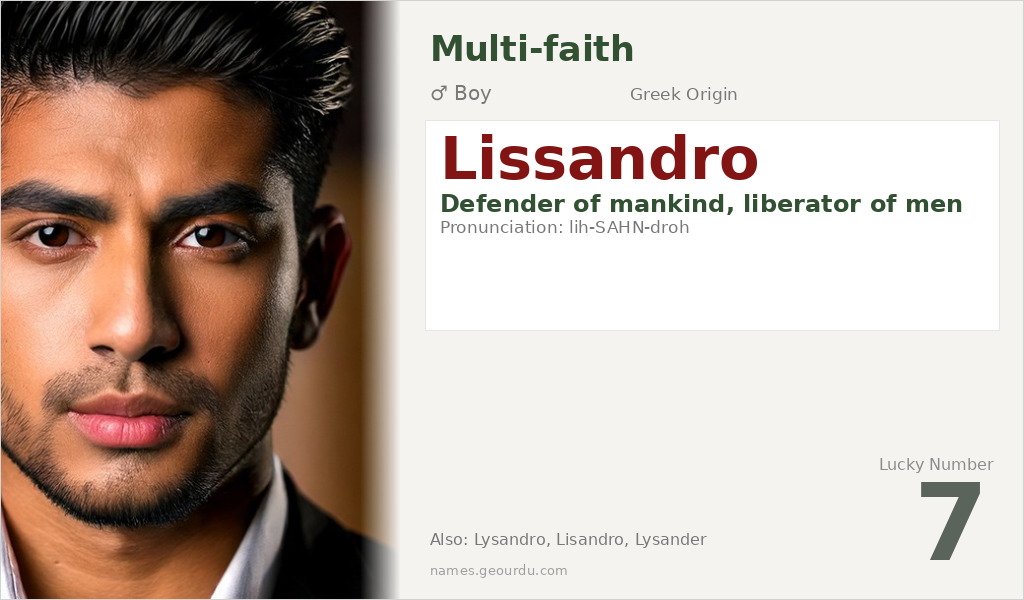
| 📛 Name | Lissandro |
| 💎 Meaning | Defender of mankind, liberator of men |
| 👤 Gender | Boy |
| 🕌 Religion | Multi-faith |
| 🌍 Origin | Greek |
| 🗣 Pronunciation | lih-SAHN-droh |
| ✍️ Urdu | لیسانڈرو |
| ✍️ Arabic | ليساندرو |
| 🔢 Numerology | 7 |
| ✨ Spellings | Lysandro, Lisandro, Lysander, Lisander |
Origin & Cultural Significance
Lissandro originates from ancient Greece, specifically from the name Lysander borne by the famous Spartan naval commander who played a crucial role in the Peloponnesian War (431–404 BCE). The name spread through the Hellenistic world and was adopted into Latin during the Roman Empire’s expansion. During the Renaissance, classical Greek names experienced revival in Europe, leading to Lysander’s appearance in literature (notably in Shakespeare’s ‘A Midsummer Night’s Dream’). The modern variant Lissandro developed primarily in Romance-speaking countries and has since gained international usage. While not tied to any single religion, the name appears in Christian, Muslim, and secular contexts across different cultures where Greek names have been adopted.
Personality Traits
Those named Lissandro are often associated with leadership qualities, strategic thinking, and protective instincts rooted in the name’s meaning of ‘defender of mankind’. They may exhibit natural authority combined with a sense of responsibility toward others. The historical association with the Spartan commander suggests traits of determination, tactical intelligence, and the ability to inspire loyalty in challenging situations.
Similar Names
If you like Lissandro, consider: Alexander, Leander, Cassander, Evander, Sander
Famous People Named Lissandro
- Lysander — Spartan naval commander and statesman (5th century BCE)
- Lisandro López — Argentine professional footballer
Frequently Asked Questions About Lissandro
What does Lissandro mean?
Lissandro means 'defender of mankind' or 'liberator of men', derived from the ancient Greek elements 'lysis' (freeing) and 'andros' (of man).
Is Lissandro a boy or girl name?
Lissandro is exclusively a masculine name, originating from the Greek male name Lysander and maintaining male gender association across all cultures where it's used.
What is the origin of Lissandro?
Lissandro originates from ancient Greece as a variant of Lysander (Λύσανδρος), which spread through Latin transmission to various European languages and cultures.





