
Table of Contents
Loki is a name steeped in ancient Norse mythology, evoking images of cunning, transformation, and legendary tales. As a trickster god in Old Norse stories, Loki represents complexity and intrigue, making this name a powerful choice with deep historical roots. In modern times, it has gained popularity through cultural references, particularly in literature and film. This guide explores the true meaning, origin, and personality traits associated with the name Loki.
Meaning of Loki
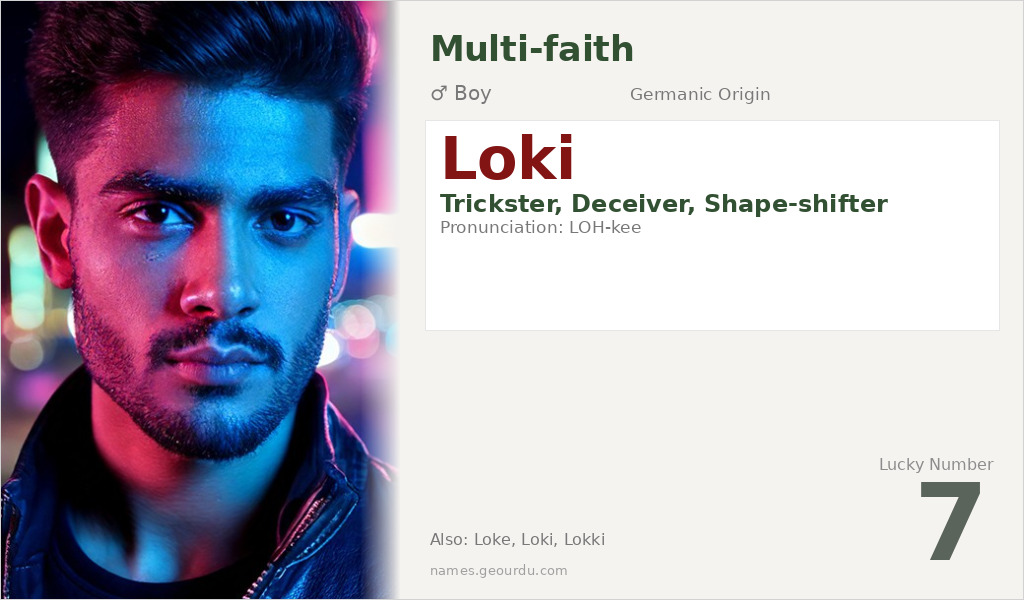
The name Loki derives from Old Norse, with its meaning closely tied to the mythological figure known as a trickster, deceiver, and shape-shifter. Etymologically, it may come from ‘loka,’ meaning ‘to close’ or ‘lock,’ possibly alluding to his role in sealing fates in Norse myths, or from ‘luka-‘ meaning ‘knot,’ symbolizing his entangled and deceptive nature. In Norse mythology, Loki is not a traditional deity to be worshipped but a central character who often disrupts the order of the gods while occasionally aiding them, embodying chaos and cleverness. This name has no verified meanings in languages like Arabic, Persian, or Urdu, as it is uniquely Germanic in origin, reflecting its specific cultural context.
| 📛 Name | Loki |
| 💎 Meaning | Trickster, Deceiver, Shape-shifter |
| 👤 Gender | Boy |
| 🕌 Religion | Multi-faith |
| 🌍 Origin | Germanic |
| 🗣 Pronunciation | LOH-kee |
| ✍️ Urdu | لوکی |
| ✍️ Arabic | لوكي |
| 🔢 Numerology | 7 |
| ✨ Spellings | Loke, Loki, Lokki |
Origin & Cultural Significance
Loki originates from Germanic languages, specifically Old Norse, where it is deeply embedded in Norse mythology and Scandinavian folklore. Historically, Loki appears in texts like the Poetic Edda and Prose Edda, composed in medieval Iceland, depicting him as a complex figure among the Æsir gods. The name has been used in Nordic regions for centuries, though more commonly in mythological contexts rather than as a personal name until recent times. In contemporary culture, Loki has seen a resurgence due to its portrayal in Marvel comics and films, broadening its appeal globally while retaining its mythological roots.
Personality Traits
People named Loki often exhibit traits of intelligence, adaptability, and a mischievous charm, mirroring the mythological character’s clever and unpredictable nature. They may be creative thinkers who enjoy challenges and innovation, but can also display a rebellious streak or a tendency towards unconventional behavior. This name suggests a personality that is both engaging and enigmatic, capable of great ingenuity and occasional turmoil.
Similar Names
If you like Loki, consider: Thor, Odin, Fenrir, Tyr, Baldur
Famous People Named Loki
- Loki (Marvel character) — Fictional character portrayed by Tom Hiddleston in the Marvel Cinematic Universe, based on the Norse mythological figure
- Loki Schmidt — German botanist and wife of former Chancellor Helmut Schmidt
Frequently Asked Questions About Loki
What does Loki mean?
Loki means 'Trickster,' 'Deceiver,' or 'Shape-shifter,' originating from Old Norse mythology, where Loki is a central figure known for his cunning and transformative abilities.
Is Loki a boy or girl name?
Loki is traditionally a boy's name, based on the male mythological figure from Norse legends, though it can be used in modern contexts as a unisex name in some cultures.
What is the origin of Loki?
Loki originates from Germanic languages, specifically Old Norse, and is deeply rooted in Norse mythology and Scandinavian folklore, with no verified connections to other language families like Arabic or Persian.





