
Table of Contents
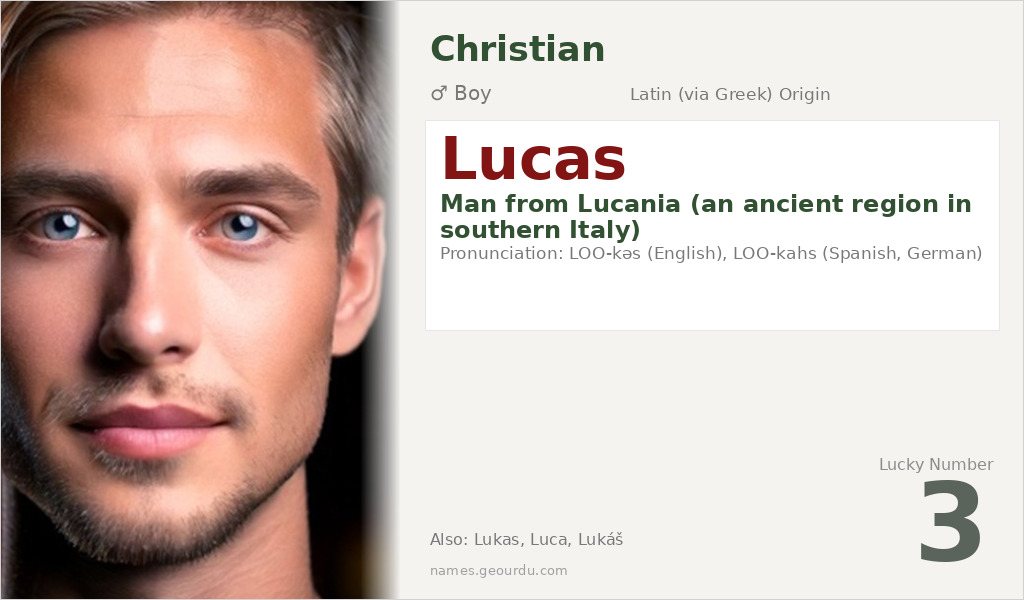
Lucas is a timeless name with deep historical roots that has maintained popularity across centuries and cultures. Derived from the Latin name meaning ‘man from Lucania’, this name carries the legacy of Saint Luke the Evangelist, one of the four Gospel writers. Today, Lucas remains a favored choice for parents seeking a name with classical elegance and spiritual significance. Its international variations and enduring appeal make it a truly global name.
Meaning of Lucas
The name Lucas originates from the Latin ‘Lucas’, which was derived from the Greek name ‘Λουκᾶς’ (Loukas). This Greek form means ‘from Lucania’, referring to an ancient region in southern Italy. The name’s meaning is therefore geographical rather than descriptive of personal qualities. Lucania was known to the Greeks as Λευκανία (Leukania), possibly derived from the Greek word ‘leukos’ meaning ‘white’, though the direct connection to Lucas is through the regional designation. The name gained prominence through Saint Luke, a physician and companion of Paul who authored the third Gospel and Acts of the Apostles in the New Testament.
| 📛 Name | Lucas |
| 💎 Meaning | Man from Lucania (an ancient region in southern Italy) |
| 👤 Gender | Boy |
| 🕌 Religion | Christian |
| 🌍 Origin | Latin (via Greek) |
| 🗣 Pronunciation | LOO-kəs (English), LOO-kahs (Spanish, German) |
| ✍️ Urdu | لوکس |
| ✍️ Arabic | لوكاس |
| 🔢 Numerology | 3 |
| ✨ Spellings | Lukas, Luca, Lukáš, Loukas, Lukács |
Origin & Cultural Significance
Lucas has its origins in ancient Greco-Roman culture, specifically from the region of Lucania in southern Italy. The name entered Christian tradition through Saint Luke, who was likely a Greek-speaking physician from Antioch. As Christianity spread throughout the Roman Empire, the name Lucas became established in Latin-speaking regions. During the Middle Ages, the name was particularly popular in Christian Europe due to veneration of Saint Luke. In modern times, Lucas has seen a resurgence in popularity across English, Spanish, Portuguese, German, and Scandinavian-speaking countries, maintaining its connection to Christian heritage while becoming a secular favorite.
Personality Traits
While personality traits aren’t inherent to names, cultural associations with Lucas often include creativity, intelligence, and compassion—qualities attributed to Saint Luke as a physician and writer. The name’s soft consonants and open vowel sounds contribute to perceptions of approachability and warmth. In various cultures, Lucas is seen as a name for someone who is both thoughtful and expressive, balancing introspection with social engagement.
Similar Names
If you like Lucas, consider: Luke, Lucian, Lucius, Luca, Lukas
Famous People Named Lucas
- Saint Luke — Early Christian evangelist and author of the Gospel of Luke
- Lucas Cranach the Elder — German Renaissance painter and printmaker
- George Lucas — American filmmaker, creator of Star Wars franchise
- Lucas Moura — Brazilian professional footballer
Frequently Asked Questions About Lucas
What does Lucas mean?
Lucas means 'man from Lucania', referring to an ancient region in southern Italy. The name comes from the Latin 'Lucas', derived from Greek 'Λουκᾶς' (Loukas).
Is Lucas a boy or girl name?
Lucas is traditionally and predominantly a masculine name across all cultures where it's used, though the feminine form 'Lucia' exists. There are no significant traditions of Lucas as a girl's name.
What is the origin of Lucas?
Lucas originates from Latin, which borrowed it from Greek 'Λουκᾶς' (Loukas). The Greek name referred to someone from Lucania, an ancient region in southern Italy. The name gained prominence through Saint Luke in Christian tradition.





