
Table of Contents
Lutfi is a classic Arabic name that carries deep spiritual and linguistic significance, rooted in the concept of kindness and gentleness. Often chosen in Muslim communities, this name reflects virtues of compassion and subtle grace, making it a meaningful choice for parents. With a rich history and notable figures like Lutfi Zadeh, it bridges traditional values with modern relevance. Explore the origins, meaning, and cultural context of Lutfi in this detailed guide.
Meaning of Lutfi
Lutfi (لطفي) is derived from the Arabic root ‘ل-ط-ف’ (l-ṭ-f), which encompasses meanings of kindness, gentleness, subtlety, and benevolence. As a nisba (attributive) form, it literally translates to ‘my kindness’ or ‘my gentleness,’ though it is commonly understood as ‘kind’ or ‘gentle’ in a broader sense. This root is also the basis for the divine attribute ‘Al-Latif’ (اللطيف), one of the 99 Names of Allah in Islam, meaning ‘The Subtly Kind’ or ‘The Most Gentle,’ which adds a layer of spiritual resonance to the name. Linguistically, Lutfi functions as an adjective and has been used historically in Arabic literature and poetry to describe someone with a tender and compassionate nature. Its meaning is well-documented in Arabic dictionaries and etymological sources, with no significant variations in other languages like Persian, Urdu, or Turkish, though it is adopted in those cultures through Islamic influence.
| 📛 Name | Lutfi |
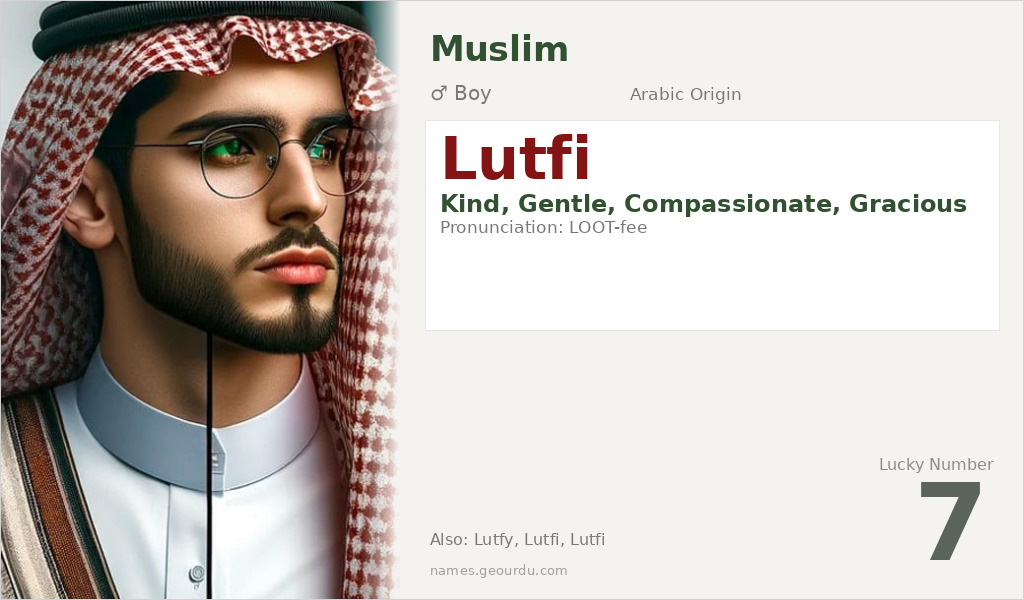
| 💎 Meaning | Kind, Gentle, Compassionate, Gracious |
| 👤 Gender | Boy |
| 🕌 Religion | Muslim |
| 🌍 Origin | Arabic |
| 🗣 Pronunciation | LOOT-fee |
| ✍️ Urdu | لطفی |
| ✍️ Arabic | لطفي |
| 🔢 Numerology | 7 |
| ✨ Spellings | Lutfy, Lutfi, Lutfi, Lootfi |
Origin & Cultural Significance
Lutfi originates from the Arabic language and has been used for centuries across the Arab world and in Muslim-majority regions such as the Middle East, North Africa, and South Asia. Its usage spread through Islamic culture, where names reflecting divine attributes or virtuous qualities are highly valued. Historically, the name appears in classical Arabic texts and has been borne by scholars, poets, and community leaders, emphasizing its cultural depth. In modern times, it remains popular in countries like Egypt, Saudi Arabia, and Pakistan, often chosen for its positive connotations and spiritual undertones. While not native to non-Arabic languages like Pashto or Balochi, it is sometimes used in those communities due to religious and cultural exchanges, maintaining its Arabic linguistic integrity.
Personality Traits
People named Lutfi are often associated with traits of kindness, empathy, and a gentle demeanor, reflecting the name’s etymological roots. They tend to approach life with a thoughtful and compassionate perspective, valuing harmony in relationships and seeking to uplift others through subtle acts of grace. This name may inspire a diplomatic and analytical mindset, making Lutfi individuals effective in roles that require sensitivity and understanding.
Similar Names
If you like Lutfi, consider: Latif, Lutfullah, Rahim, Karim, Raheem
Famous People Named Lutfi
- Lutfi al-Khuli — Egyptian journalist and political activist known for his leftist writings in the 20th century
- Lutfi Zadeh — Azerbaijani-American mathematician and computer scientist, founder of fuzzy logic and fuzzy set theory
Frequently Asked Questions About Lutfi
What does Lutfi mean?
Lutfi means 'Kind, Gentle, Compassionate, or Gracious' in Arabic, derived from the root 'ل-ط-ف' (l-ṭ-f) associated with subtlety and benevolence.
Is Lutfi a boy or girl name?
Lutfi is traditionally a boy's name in Arabic and Muslim cultures, though it is rarely used for girls; it is considered masculine due to its grammatical form and historical usage.
What is the origin of Lutfi?
Lutfi originates from the Arabic language, with deep roots in Islamic tradition, and is used widely in Muslim communities across the Middle East, South Asia, and beyond.





