
Table of Contents
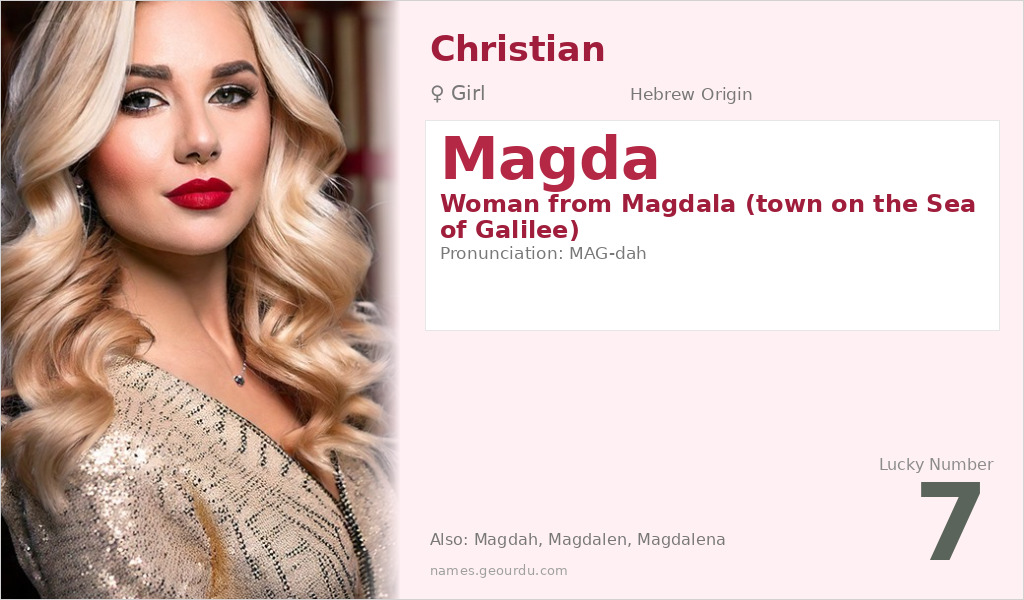
Magda is a timeless feminine name with deep roots in biblical history and Christian tradition. As a diminutive of Magdalene, it carries the legacy of Mary Magdalene, one of Jesus’ most devoted followers. This name has spread across Europe and beyond, maintaining its spiritual resonance while adapting to various cultures. Today, Magda remains a classic choice that connects modern bearers to ancient heritage.
Meaning of Magda
Magda originates from the Hebrew place name Magdala (מִגְדָּלָא), which means ‘tower’ or ‘elevated place’ in Aramaic/Hebrew. This ancient town on the Sea of Galilee gave its name to Mary Magdalene (Mary of Magdala), who appears in all four Gospels as a witness to Jesus’ crucifixion and resurrection. The name entered European languages through Latin ‘Magdalena’ and developed various vernacular forms. While ‘tower’ is the literal meaning, the name specifically denotes connection to the Galilean town, carrying geographical and historical significance beyond the simple translation.
| 📛 Name | Magda |
| 💎 Meaning | Woman from Magdala (town on the Sea of Galilee) |
| 👤 Gender | Girl |
| 🕌 Religion | Christian |
| 🌍 Origin | Hebrew |
| 🗣 Pronunciation | MAG-dah |
| ✍️ Urdu | میگڈا |
| ✍️ Arabic | ماجدا |
| 🔢 Numerology | 7 |
| ✨ Spellings | Magdah, Magdalen, Magdalena, Magdalene, Magdaline |
Origin & Cultural Significance
Magda emerged as a standalone name in medieval Europe, derived from the biblical Magdalene tradition. It became particularly popular in Central and Eastern Europe (Poland, Hungary, Czech Republic) as well as in Scandinavian countries. The name’s spread followed Christianization patterns across the continent. In the 20th century, Magda gained international recognition through notable figures in literature, politics, and the arts. While fundamentally Christian in association due to its biblical origins, the name has been adopted in secular contexts across various cultures without religious requirement.
Personality Traits
Those named Magda often embody strength and spiritual depth, reflecting the name’s ‘tower’ etymology and its association with steadfast biblical figures. They tend to be perceptive, with an ability to see situations from elevated perspectives. Many Magdas display a balance of traditional values and independent thinking, making them both grounded and visionary in their approach to life’s challenges.
Similar Names
If you like Magda, consider: Magdalena, Magdalene, Madeleine, Madeline, Maud
Famous People Named Magda
- Magda Szabó — Hungarian novelist and poet, author of 'The Door'
- Magda Goebbels — wife of Nazi propaganda minister Joseph Goebbels
Frequently Asked Questions About Magda
What does Magda mean?
Magda means 'woman from Magdala,' referring to the ancient town on the Sea of Galilee whose name means 'tower' in Hebrew/Aramaic.
Is Magda a boy or girl name?
Magda is exclusively a feminine name, derived from Mary Magdalene and used for girls across European cultures for centuries.
What is the origin of Magda?
Magda originates from Hebrew through Christian tradition, specifically from the place name Magdala in ancient Israel, popularized via Mary Magdalene in the New Testament.





