
Table of Contents
Magh is a name deeply rooted in Hindu tradition and Sanskrit language, carrying both temporal and spiritual significance. While not commonly used as a personal name today, it represents an important concept in Hindu calendrical systems and religious practice. This name connects to ancient Vedic traditions and continues to hold cultural importance in South Asian communities. Understanding Magh requires exploring its dual meaning as both a specific time period and a verb denoting reverence.
Meaning of Magh
The name Magh originates from Sanskrit, where it serves two distinct but related purposes. Primarily, Magh (माघ) refers to the eleventh month in the Hindu lunar calendar, corresponding approximately to January-February in the Gregorian system. This month is considered highly auspicious in Hindu tradition, marked by important festivals like Magha Purnima. Linguistically, the root ‘magh’ in Sanskrit means ‘to worship,’ ‘to honor,’ or ‘to give,’ derived from the verb ‘māgh’ which signifies consecration or offering. This etymological connection explains why the month Magh is associated with religious observances and charitable acts. The name appears in ancient texts including the Vedas and Puranas, establishing its deep historical roots in Indian culture.
| 📛 Name | Magh |
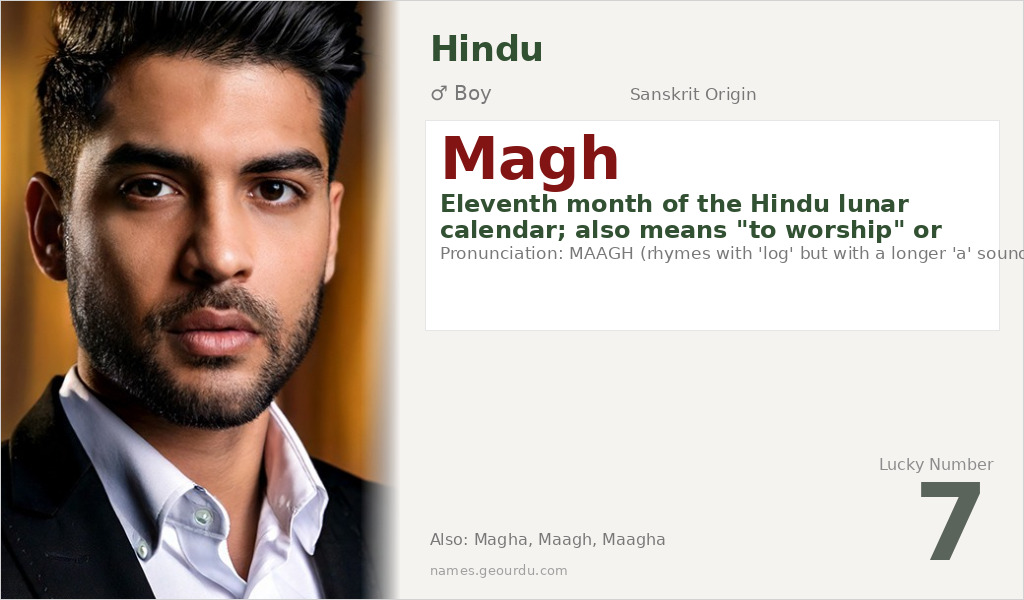
| 💎 Meaning | Eleventh month of the Hindu lunar calendar; also means "to worship" or "to honor" in Sanskrit |
| 👤 Gender | Boy |
| 🕌 Religion | Hindu |
| 🌍 Origin | Sanskrit |
| 🗣 Pronunciation | MAAGH (rhymes with 'log' but with a longer 'a' sound, with the 'gh' as a soft guttural sound) |
| ✍️ Urdu | ماگھ |
| ✍️ Arabic | ماغ |
| 🔢 Numerology | 7 |
| ✨ Spellings | Magha, Maagh, Maagha |
Origin & Cultural Significance
Magh has its origins in ancient Sanskrit language and Hindu calendrical systems dating back thousands of years. The name is intrinsically linked to Hindu religious and cultural practices, particularly those surrounding the lunar calendar used for determining festival dates and auspicious periods. While the month Magh is widely recognized across Hindu communities, its use as a personal given name is relatively uncommon in contemporary times, appearing more frequently in historical or religious contexts. The name’s preservation in modern times occurs primarily through its calendrical function rather than as a popular personal name choice. Cultural associations with Magh include the Magha Mela festival in Prayagraj and various regional observances during this holy month.
Personality Traits
While personality traits associated specifically with individuals named Magh are not extensively documented due to its rarity as a personal name, the name’s meanings suggest certain characteristics. Based on its Sanskrit roots meaning ‘to worship’ and its association with an auspicious month, those named Magh might be perceived as spiritually oriented, traditional, and connected to cultural heritage. The name implies someone who values rituals, ceremonies, and possibly has a contemplative or philosophical nature. These associations are derived from the name’s etymological and cultural context rather than empirical observation of name-bearers.
Similar Names
If you like Magh, consider: Maghavan, Maghava, Maghadeva, Maghish, Maghishtha
Famous People Named Magh
- Magha (Sanskrit poet) — 7th-8th century CE Sanskrit poet known for the epic poem Shishupala Vadha
- Magha (month) — Not a person but the Hindu lunar month associated with the Magha Mela festival at Prayagraj
Frequently Asked Questions About Magh
What does Magh mean?
Magh has two primary meanings in Sanskrit: it refers to the eleventh month in the Hindu lunar calendar (January-February), and the root 'magh' means 'to worship,' 'to honor,' or 'to give.'
Is Magh a boy or girl name?
Magh is traditionally considered a masculine name in Hindu naming conventions, though it is rarely used as a personal given name in contemporary practice.
What is the origin of Magh?
Magh originates from Sanskrit language and Hindu calendrical systems, with documented usage in ancient Vedic texts and continued importance in Hindu religious traditions.





