Table of Contents
Maha is a beautifully evocative name with deep roots in Arabic language and culture. Derived from the word for the majestic Arabian oryx, this name carries centuries of poetic and cultural significance. While particularly popular in Muslim communities, its appeal transcends religious boundaries due to its elegant meaning and melodic sound. Discover the rich history and contemporary relevance of this timeless name.
Meaning of Maha
The name Maha comes directly from the Arabic word ‘مها’ (mahā), which specifically refers to the Arabian oryx (Oryx leucoryx). This elegant desert antelope, with its distinctive white coat and long, straight horns, has been celebrated in Arabic poetry since pre-Islamic times as a symbol of purity, beauty, and nobility. The term appears frequently in classical Arabic literature, where poets would compare the graceful movements of beloved women to those of the oryx. While sometimes loosely translated as ‘wild cow’ in some contexts, this is linguistically imprecise—the Arabic language has distinct words for bovine species, and ‘maha’ specifically denotes the oryx antelope. The name thus carries connotations of natural elegance, desert resilience, and poetic beauty.
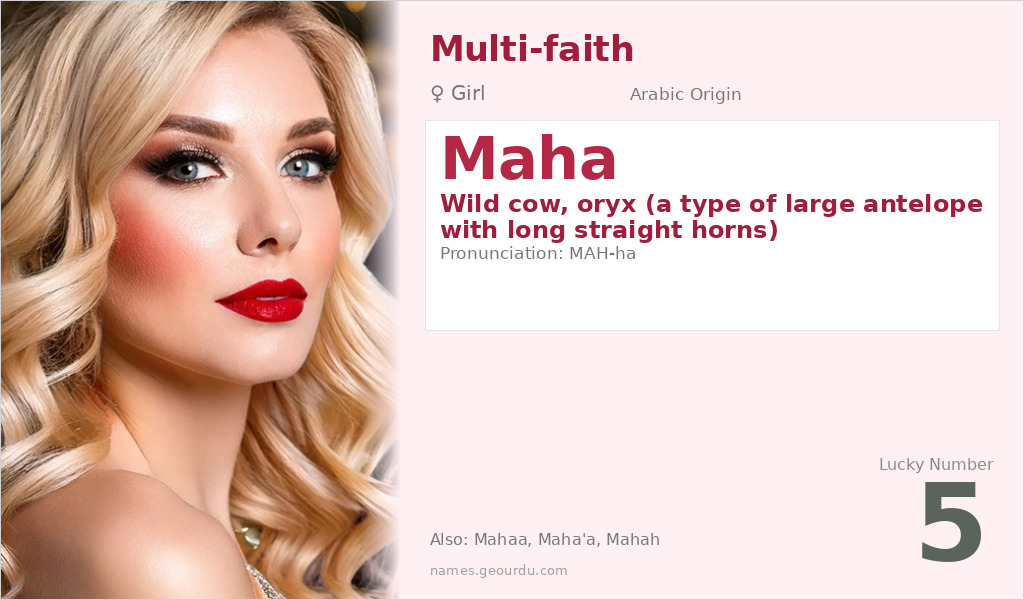
| 📛 Name | Maha |
| 💎 Meaning | Wild cow, oryx (a type of large antelope with long straight horns) |
| 👤 Gender | Girl |
| 🕌 Religion | Multi-faith |
| 🌍 Origin | Arabic |
| 🗣 Pronunciation | MAH-ha |
| ✍️ Urdu | مہا |
| ✍️ Arabic | مها |
| 🔢 Numerology | 5 |
| ✨ Spellings | Mahaa, Maha'a, Mahah |
Origin & Cultural Significance
Maha originates from classical Arabic, with documented usage dating back to pre-Islamic poetry (Jahiliyyah period). The Arabian oryx held significant cultural importance in Bedouin societies, symbolizing purity and survival in harsh desert environments. While the name gained popularity in Muslim communities due to its Arabic linguistic roots and positive connotations, it is not exclusively Islamic—it appears in historical contexts across the Arabian Peninsula regardless of religious affiliation. The name spread through the Islamic Golden Age to Persian, Turkish, and South Asian regions, where it maintained its original meaning while adapting to local pronunciations. Today, Maha remains particularly popular in Arabic-speaking countries but is also found in Muslim communities worldwide.
Personality Traits
Those named Maha are often perceived as possessing the graceful qualities of their namesake—the Arabian oryx. They may exhibit a quiet dignity, natural elegance, and resilience in facing challenges. The name’s poetic heritage suggests an appreciation for beauty, art, and language. Like the oryx that thrives in demanding desert environments, individuals with this name often demonstrate adaptability and inner strength while maintaining their distinctive character.
Similar Names
If you like Maha, consider: Mahaara, Mahasin, Mahira, Mahvash, Mahin
Famous People Named Maha
- Maha Al-Saati — Saudi Arabian actress and television presenter known for her work in Arabic drama series
- Maha Chakri Sirindhorn — Thai princess whose name incorporates the Sanskrit/Pali element 'Maha' meaning 'great' (different etymology)
Frequently Asked Questions About Maha
What does Maha mean?
Maha means 'Arabian oryx' in Arabic—specifically referring to the elegant desert antelope (Oryx leucoryx) known for its beauty and grace in Arabic poetry and culture.
Is Maha a boy or girl name?
Maha is primarily a feminine name in contemporary usage across Arabic-speaking and Muslim communities, though its grammatical form in classical Arabic could theoretically be used for either gender.
What is the origin of Maha?
Maha originates from classical Arabic language, with roots in pre-Islamic poetry where the Arabian oryx was frequently used as a symbol of beauty and nobility in desert culture.