Table of Contents
Mahagauri is a beautiful and powerful Sanskrit name with deep roots in Hindu mythology. Meaning ‘The Great White One’ or ‘The Extremely Fair One’, this name represents the eighth manifestation of Goddess Durga. While uncommon as a personal name, it carries significant spiritual weight for devotees. Understanding its linguistic origins reveals why this name symbolizes purity, radiance, and divine feminine energy.
Meaning of Mahagauri
Mahagauri derives from two Sanskrit words: ‘Maha’ (महा), meaning ‘great’, ‘supreme’, or ‘mighty’, and ‘Gauri’ (गौरी), meaning ‘white’, ‘fair’, ‘radiant’, or ‘brilliant’. The complete compound thus translates to ‘The Great White One’, ‘The Extremely Fair One’, or ‘The Radiant Goddess’. In Hindu scriptures, this name specifically describes Goddess Parvati/Durga in her exceptionally fair-complexioned form, said to be as white as conch shell, moon, or kunda flowers. The ‘Gauri’ component relates to the Sanskrit root ‘go’ meaning ‘light’ or ‘brightness’, emphasizing luminosity rather than merely skin tone. This etymological construction follows classical Sanskrit compounding rules for creating descriptive divine epithets.
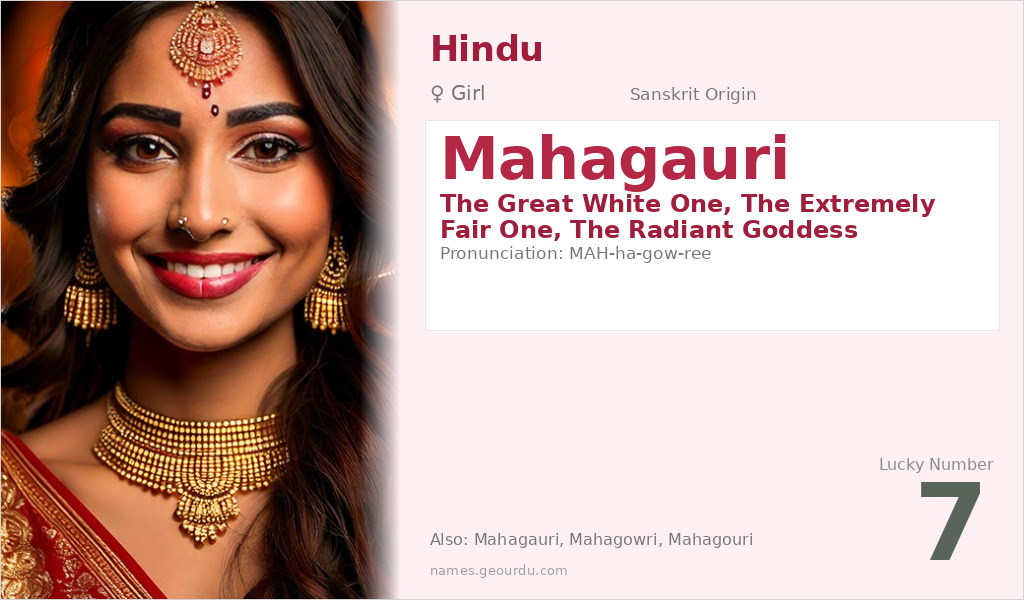
| 📛 Name | Mahagauri |
| 💎 Meaning | The Great White One, The Extremely Fair One, The Radiant Goddess |
| 👤 Gender | Girl |
| 🕌 Religion | Hindu |
| 🌍 Origin | Sanskrit |
| 🗣 Pronunciation | MAH-ha-gow-ree |
| ✍️ Urdu | مہاگوری |
| ✍️ Arabic | ماهاغوري |
| 🔢 Numerology | 7 |
| ✨ Spellings | Mahagauri, Mahagowri, Mahagouri, Mahagaurī |
Origin & Cultural Significance
Mahagauri originates from classical Sanskrit literature and Hindu religious texts, most notably the Devi Mahatmya (part of the Markandeya Purana) and various Puranas. As the eighth form of Navadurga worshipped during the eighth day of Navratri, Mahagauri represents purity, peace, and the power of austerity. According to mythology, Parvati performed severe penance to win Shiva as her husband, darkening her skin, and later regained her fair complexion through Shiva’s grace, becoming Mahagauri. The name is primarily used in religious contexts across India, particularly in Maharashtra, Gujarat, Bengal, and other regions where Durga worship is prominent. While occasionally given to girls in devout Hindu families, it remains more common as a theological epithet than a personal name.
Personality Traits
The name Mahagauri suggests qualities of purity, serenity, and inner strength. Those named after this goddess form are often perceived as having a calm, radiant presence that brings peace to others. The mythological associations with austerity and spiritual discipline imply resilience and determination. These individuals may naturally embody nurturing, protective qualities while maintaining clarity of purpose in their endeavors.
Similar Names
If you like Mahagauri, consider: Gauri, Parvati, Durga, Kali, Saraswati
Famous People Named Mahagauri
- Mahagauri (Hindu goddess) — The eighth form of Goddess Durga in Hindu mythology, worshipped during the eighth day of Navratri
- Various Indian women named Mahagauri — Though uncommon as a personal name, some devotees name their daughters after this goddess form
Frequently Asked Questions About Mahagauri
What does Mahagauri mean?
Mahagauri means 'The Great White One' or 'The Extremely Fair One' in Sanskrit. It's a compound of 'Maha' (great) and 'Gauri' (white/radiant), referring to the eighth form of Goddess Durga.
Is Mahagauri a boy or girl name?
Mahagauri is exclusively a feminine name, as it refers to a goddess form in Hinduism. It's traditionally given to girls, though it's more commonly used as a religious epithet than a personal name.
What is the origin of Mahagauri?
Mahagauri originates from Sanskrit and Hindu mythology. It appears in classical texts like the Devi Mahatmya as one of the nine primary forms of Goddess Durga worshipped during Navratri.