
Table of Contents
Mahatman is a profound Sanskrit name that carries centuries of spiritual and philosophical weight. Meaning ‘great-souled’ or ‘noble-minded,’ this name embodies the highest ideals of character and consciousness in Hindu tradition. While famously associated with Mahatma Gandhi, the name itself represents the aspiration toward spiritual greatness and ethical leadership. Choosing Mahatman for a child connects them to a rich heritage of wisdom and moral excellence.
Meaning of Mahatman
Mahatman derives from the Sanskrit compound ‘mahā’ (great) and ‘ātman’ (soul), literally translating to ‘great-souled’ or ‘possessing a great spirit.’ In Sanskrit linguistics, ‘ātman’ is a fundamental concept referring to the true self or essence of a being, central to Hindu philosophy and Upanishadic thought. The combination creates a term that describes someone of elevated spiritual awareness, moral courage, and magnanimity. This etymological construction follows classical Sanskrit compounding rules where ‘mahā’ serves as an intensifying prefix. The name appears in ancient texts like the Bhagavad Gita (Chapter 2, Verse 45) where Krishna describes the ‘mahatman’ as one established in wisdom. Related forms include ‘mahātmya’ (greatness) and ‘mahāpurusha’ (great person), showing the linguistic family of honorific terms in Sanskrit.
| 📛 Name | Mahatman |
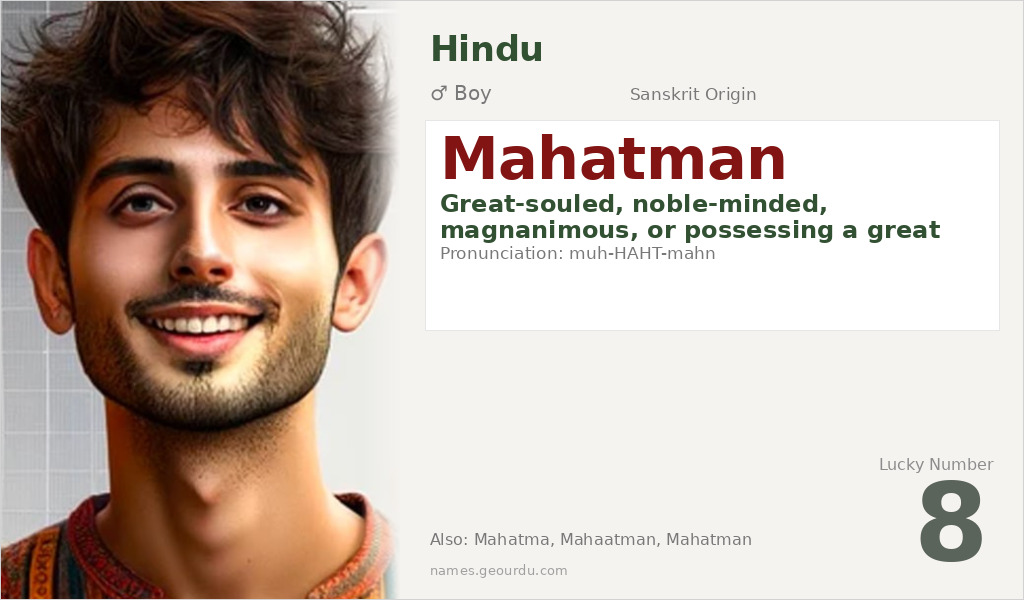
| 💎 Meaning | Great-souled, noble-minded, magnanimous, or possessing a great soul |
| 👤 Gender | Boy |
| 🕌 Religion | Hindu |
| 🌍 Origin | Sanskrit |
| 🗣 Pronunciation | muh-HAHT-mahn |
| ✍️ Urdu | مہاتما |
| ✍️ Arabic | مهاتما |
| 🔢 Numerology | 8 |
| ✨ Spellings | Mahatma, Mahaatman, Mahatman, Mahātmā |
Origin & Cultural Significance
Mahatman originates from classical Sanskrit, the sacred language of Hinduism, Buddhism, and Jainism. Its earliest documented usage appears in Vedic and post-Vedic literature, particularly in philosophical texts discussing spiritual attainment. The name gained particular prominence in Hindu tradition as an honorific title for spiritually advanced individuals, similar to ‘saint’ in Christian contexts. During India’s independence movement, Mahatma Gandhi popularized the term globally, though the name itself predates him by millennia. In contemporary usage, Mahatman remains primarily a Hindu name, though its philosophical resonance makes it appreciated across Indian spiritual traditions. The name reflects the Sanskrit cultural emphasis on spiritual qualities rather than material attributes in naming conventions.
Personality Traits
Those named Mahatman are often associated with wisdom, compassion, and ethical strength. They tend to be natural leaders who inspire others through their integrity rather than authority. Their philosophical nature makes them contemplative and spiritually curious, often seeking deeper meaning in life’s experiences. While they may appear serious, they typically possess a warm generosity that draws people toward their guidance and insight.
Similar Names
If you like Mahatman, consider: Mahavir, Mahadev, Mahindra, Mahajan, Atmanand
Famous People Named Mahatman
- Mahatma Gandhi (Mohandas Karamchand Gandhi) — Indian independence leader and spiritual guide, awarded the title 'Mahatma' meaning 'Great Soul'
- Mahatma Jyotirao Phule — Indian social reformer, writer, and anti-caste activist from Maharashtra
Frequently Asked Questions About Mahatman
What does Mahatman mean?
Mahatman means 'great-souled,' 'noble-minded,' or 'magnanimous' in Sanskrit. It combines 'mahā' (great) and 'ātman' (soul/self) to describe someone of elevated spiritual consciousness.
Is Mahatman a boy or girl name?
Mahatman is traditionally a masculine name in Hindu naming conventions. While Sanskrit nouns have gender, 'ātman' is masculine, making the compound naturally masculine in usage.
What is the origin of Mahatman?
Mahatman originates from classical Sanskrit, the ancient sacred language of India. It has been used for millennia in Hindu philosophical texts and gained global recognition through figures like Mahatma Gandhi.





