
Table of Contents
Mahindar is a powerful and traditional Hindu boy name with deep roots in Sanskrit mythology. Meaning ‘Great Indra’ or ‘Supreme Indra,’ this name carries the grandeur of one of Hinduism’s most important deities. Parents choosing this name often seek to bestow qualities of leadership, strength, and divine protection upon their child. With its rich linguistic heritage, Mahindar remains a meaningful choice in Hindu naming traditions.
Meaning of Mahindar
Mahindar derives from two Sanskrit components: ‘Maha’ meaning ‘great, mighty, or supreme,’ and ‘Indra,’ referring to the king of the gods in Hindu mythology. Indra is the deity associated with rain, thunder, storms, and war, often depicted as a powerful warrior riding the elephant Airavata. The compound name Mahindar thus literally translates to ‘Great Indra’ or ‘Supreme Indra,’ emphasizing the greatness of this divine figure. This naming pattern is common in Sanskrit where ‘Maha-‘ prefixes divine names to denote exceptional status, similar to Mahadev (Great Shiva) or Mahavishnu (Great Vishnu). The name reflects both linguistic precision and religious significance within Hindu tradition.
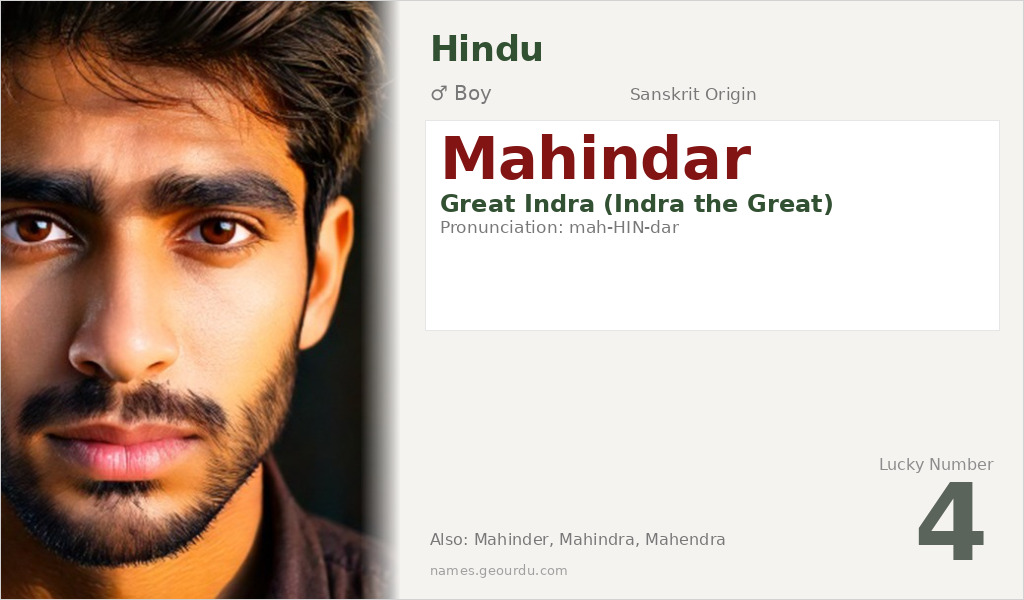
| 📛 Name | Mahindar |
| 💎 Meaning | Great Indra (Indra the Great) |
| 👤 Gender | Boy |
| 🕌 Religion | Hindu |
| 🌍 Origin | Sanskrit |
| 🗣 Pronunciation | mah-HIN-dar |
| ✍️ Urdu | مہندر |
| ✍️ Arabic | مهيندر |
| 🔢 Numerology | 4 |
| ✨ Spellings | Mahinder, Mahindra, Mahendra |
Origin & Cultural Significance
Mahindar originates from classical Sanskrit, the ancient liturgical language of Hinduism. As a compound name, it follows established Sanskrit morphological rules where ‘Maha-‘ serves as an intensifying prefix. The name emerged within Hindu cultural contexts where names referencing deities are common, particularly those honoring Indra who was historically one of the most important Vedic gods. While primarily used in Hindu communities, the name has variations across South Asian regions and among diaspora communities. Its usage reflects the enduring influence of Sanskrit on Indian naming traditions and the continued reverence for Vedic deities in contemporary Hindu practice.
Personality Traits
Those named Mahindar are often associated with leadership qualities, confidence, and protective instincts. The connection to Indra suggests attributes of strength, authority, and the ability to overcome challenges. They may exhibit natural charisma and determination, with a tendency to take initiative in group settings. The name’s meaning implies a capacity for greatness and responsibility, potentially influencing how bearers perceive themselves and are perceived by others.
Similar Names
If you like Mahindar, consider: Mahendra, Mahindra, Indra, Mahadev, Mahavishnu
Famous People Named Mahindar
- Mahindra Singh Dhoni — Indian cricketer and former captain of the Indian national team (name variant Mahindra)
- Mahendra Singh — common name among Indian personalities including politicians and athletes
Frequently Asked Questions About Mahindar
What does Mahindar mean?
Mahindar means 'Great Indra' or 'Supreme Indra,' derived from Sanskrit 'Maha' (great) and 'Indra' (king of gods in Hindu mythology).
Is Mahindar a boy or girl name?
Mahindar is exclusively a boy name in Hindu naming tradition, following the masculine grammatical gender of its Sanskrit components.
What is the origin of Mahindar?
Mahindar originates from Sanskrit, the classical language of Hinduism, specifically as a compound name combining 'Maha' and 'Indra.'





