
Table of Contents
Malcolm is a distinguished name with deep roots in Scottish history and Gaelic tradition. Meaning ‘devotee of Saint Columba’, this name carries centuries of royal heritage, having been borne by four kings of Scotland. From medieval monarchs to modern civil rights leaders, the name Malcolm has maintained its strong, traditional appeal across generations and cultures. Its enduring popularity speaks to its timeless combination of strength, wisdom, and historical significance.
Meaning of Malcolm
The name Malcolm derives from the Scottish Gaelic ‘Maol Choluim’, which literally translates to ‘devotee of Saint Columba’. The first element ‘Maol’ originally meant ‘tonsured one’ or ‘servant’, referring to someone dedicated to religious service, while ‘Choluim’ is the possessive form of ‘Colum’, the Gaelic name for Saint Columba. Saint Columba (521-597 AD) was an Irish abbot and missionary credited with spreading Christianity in Scotland and founding the important monastic community on Iona. The name thus signifies spiritual devotion and connection to this influential saint, evolving from a religious epithet to a proper given name among Scottish nobility and eventually into broader English usage.
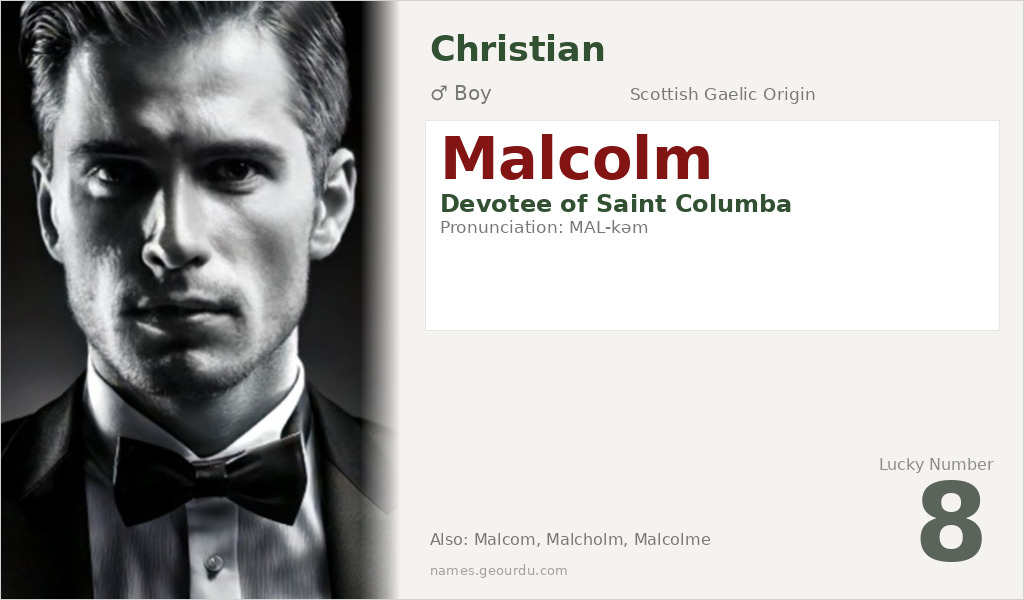
| 📛 Name | Malcolm |
| 💎 Meaning | Devotee of Saint Columba |
| 👤 Gender | Boy |
| 🕌 Religion | Christian |
| 🌍 Origin | Scottish Gaelic |
| 🗣 Pronunciation | MAL-kəm |
| ✍️ Urdu | مالکم |
| ✍️ Arabic | مالكوم |
| 🔢 Numerology | 8 |
| ✨ Spellings | Malcom, Malcholm, Malcolme |
Origin & Cultural Significance
Malcolm originated in medieval Scotland as a Gaelic name that gained prominence through the royal House of Dunkeld. The most famous historical bearer was Malcolm III (c. 1031-1093), also known as Malcolm Canmore (‘Great Chief’), who ruled Scotland for 35 years and appears as a character in Shakespeare’s ‘Macbeth’. The name spread to England after the Norman Conquest and became established in English-speaking countries through Scottish emigration. While fundamentally Christian in origin through its reference to Saint Columba, the name has been adopted across various religious and cultural contexts in modern times, particularly in English-speaking nations. Its royal associations and literary appearances have helped maintain its status as a classic, respectable name choice.
Personality Traits
Those named Malcolm often embody qualities of leadership, tradition, and reliability. The name’s royal Scottish heritage suggests dignity, strength, and a sense of responsibility, while its religious origins imply spiritual depth and moral conviction. Malcolm’s tend to be perceived as steady, thoughtful individuals who value stability and wisdom, combining practical intelligence with determined perseverance. These associations make the name particularly suited for those who appreciate historical continuity and substantial character.
Similar Names
If you like Malcolm, consider: Colin, Callum, Colm, Malachy, Malaki
Famous People Named Malcolm
- Malcolm X (1925-1965) — American Muslim minister and civil rights activist
- Malcolm Gladwell — Canadian journalist and author of 'The Tipping Point'
- Malcolm McDowell — English actor known for 'A Clockwork Orange'
- Malcolm Young (1953-2017) — Scottish-born Australian musician, co-founder of AC/DC
- Malcolm Turnbull — 29th Prime Minister of Australia (2015-2018)
Frequently Asked Questions About Malcolm
What does Malcolm mean?
Malcolm means 'devotee of Saint Columba' in Scottish Gaelic, from 'Maol Choluim' where 'maol' means devotee and 'Choluim' refers to Saint Columba.
Is Malcolm a boy or girl name?
Malcolm is traditionally and almost exclusively a masculine name, with deep roots as a royal Scottish boy's name dating back to medieval times.
What is the origin of Malcolm?
Malcolm originates from Scottish Gaelic and medieval Scotland, specifically from the Gaelic name 'Maol Choluim' meaning 'devotee of Saint Columba', and was borne by several Scottish kings.





