
Table of Contents
Manandhar is a distinctive name with deep roots in Nepali culture and Sanskrit linguistics. Primarily known as a surname within the Newar community, it carries occupational significance related to measurement and standards. This name reflects a rich heritage of traditional professions and community identity in South Asia. Understanding Manandhar offers insight into the interplay between language, occupation, and cultural preservation.
Meaning of Manandhar
The name Manandhar is composed of two Sanskrit elements: ‘māna’ (मान), which translates to ‘measure, standard, honor, or dignity,’ and ‘dhara’ (धर), meaning ‘holder, bearer, or sustainer.’ Together, they suggest meanings such as ‘one who holds measures,’ ‘bearer of standards,’ or ‘sustainer of honor.’ This etymological structure points to occupational origins, likely referring to individuals involved in weighing, measuring, or maintaining quality standards, such as in trade or craftsmanship. In the context of the Newar community in Nepal, Manandhar is associated with the caste traditionally engaged in oil pressing and related measurement activities. While not commonly used as a first name in modern times, its components are well-documented in classical Sanskrit texts, providing a credible linguistic foundation for its interpretation.
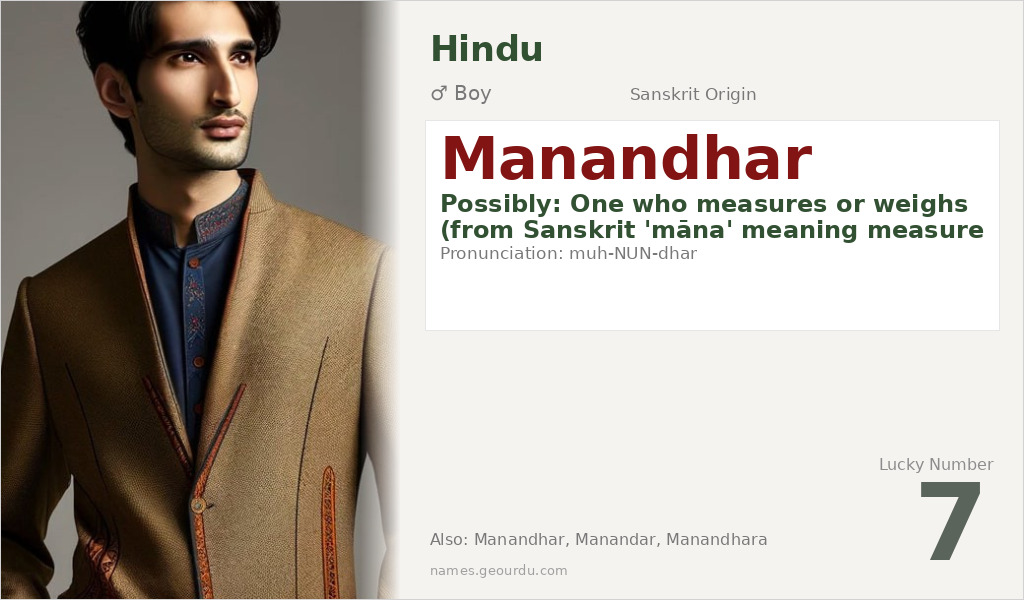
| 📛 Name | Manandhar |
| 💎 Meaning | Possibly: One who measures or weighs (from Sanskrit 'māna' meaning measure + 'dhara' meaning holder/bearer) |
| 👤 Gender | Boy |
| 🕌 Religion | Hindu |
| 🌍 Origin | Sanskrit |
| 🗣 Pronunciation | muh-NUN-dhar |
| ✍️ Urdu | مانندھر |
| ✍️ Arabic | ماناندهار |
| 🔢 Numerology | 7 |
| ✨ Spellings | Manandhar, Manandar, Manandhara |
Origin & Cultural Significance
Manandhar originates from Sanskrit and is predominantly found in Nepal, especially among the Newar people, an ethnic group with a rich cultural and historical presence in the Kathmandu Valley. As a surname, it denotes a specific caste within the Newar social structure, traditionally linked to occupations involving measurement, such as oil pressers or merchants. This reflects the caste-based occupational naming conventions prevalent in South Asian societies. The name’s usage is deeply embedded in Hindu cultural frameworks, though it is more a marker of community and profession than a religious identifier. Over time, Manandhar has been adopted by families beyond its original occupational scope, but it retains strong associations with Newar heritage and Nepali identity.
Personality Traits
Based on its meaning and cultural context, individuals named Manandhar are often associated with traits like precision, reliability, and a strong sense of duty. The name’s connection to measurement and standards suggests a personality that values accuracy, order, and tradition. Such individuals may be perceived as methodical and trustworthy, with an innate ability to maintain balance and fairness in their endeavors. These characteristics align with the occupational history of the name, emphasizing practical skills and community responsibility.
Similar Names
If you like Manandhar, consider: Manohar, Maninder, Mandhar, Dharmendra, Manav
Famous People Named Manandhar
- Various individuals with the surname Manandhar in Nepal — prominent in politics, arts, and business within the Newar community
- Madan Manandhar — Nepalese cricketer who played for the national team
Frequently Asked Questions About Manandhar
What does Manandhar mean?
Manandhar likely means 'one who measures or weighs,' derived from Sanskrit 'māna' (measure) and 'dhara' (holder). It is primarily a Nepali surname with occupational origins in the Newar community.
Is Manandhar a boy or girl name?
Manandhar is traditionally used as a boy's name, though it is more commonly a surname. In its cultural context, it is associated with male lineage and occupational roles within Hindu and Nepali societies.
What is the origin of Manandhar?
Manandhar originates from Sanskrit and is deeply rooted in Nepali culture, specifically among the Newar ethnic group. It functions as a surname denoting a caste traditionally involved in measurement-related occupations, such as oil pressing.





