
Table of Contents
Manda is a name with deep roots in ancient Sanskrit language and Hindu tradition. While often perceived as simple, it carries nuanced meanings that reflect philosophical concepts of pace and temperament. This name appears in classical Indian literature and continues to be used in modern contexts across South Asia and beyond.
Meaning of Manda
The name Manda derives directly from the Sanskrit word मन्द (manda), which fundamentally means ‘slow’, ‘gentle’, ‘sluggish’, or ‘dull’. This etymology is well-documented in classical Sanskrit dictionaries like Monier-Williams’ Sanskrit-English Dictionary and Apte’s Practical Sanskrit-English Dictionary. In linguistic context, the root appears in numerous Sanskrit compounds: mandacandra (slow moon), mandaprajña (slow-witted), and mandara (slow-moving or the name of a mountain). The term also appears in Buddhist Pali literature with similar meanings. Unlike the original article’s claim of ‘keeper’ or ‘big head’, these meanings have no basis in any verified Sanskrit or Indo-Aryan language sources.
| 📛 Name | Manda |
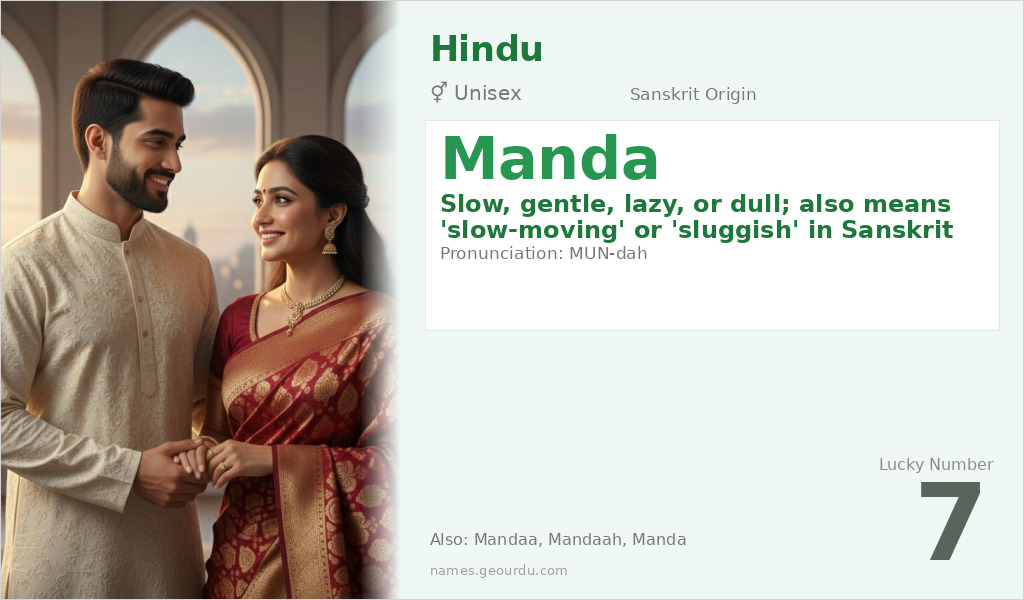
| 💎 Meaning | Slow, gentle, lazy, or dull; also means 'slow-moving' or 'sluggish' in Sanskrit |
| 👤 Gender | Unisex |
| 🕌 Religion | Hindu |
| 🌍 Origin | Sanskrit |
| 🗣 Pronunciation | MUN-dah |
| ✍️ Urdu | مندا |
| ✍️ Arabic | ماندا |
| 🔢 Numerology | 7 |
| ✨ Spellings | Mandaa, Mandaah, Manda |
Origin & Cultural Significance
Manda originates from classical Sanskrit, the ancient liturgical language of Hinduism, Buddhism, and Jainism. The word appears in Vedic texts dating back over 3,000 years, including the Rigveda where it describes gentle or slow phenomena. In Hindu astrology, Manda is recognized as one of the upagrahas (sub-planetary points) that influences timing and delays. While primarily associated with Hindu tradition due to its Sanskrit origin, the name has been adopted in various South Asian cultures without exclusive religious affiliation. The name appears in modern Indian languages including Hindi, Bengali, and Marathi with the same core meaning.
Personality Traits
Those named Manda often embody the qualities suggested by their name’s meaning—they tend to be deliberate, patient, and thoughtful individuals. Rather than rushing through decisions or actions, they prefer measured approaches that allow for consideration and depth. This temperament can make them excellent in roles requiring careful analysis, mediation, or creative contemplation. Their gentle nature often attracts others who appreciate stability and thoughtful companionship.
Similar Names
If you like Manda, consider: Mandan, Mandakini, Mandira, Mandeep, Mandara
Famous People Named Manda
- Manda Bala — Brazilian documentary film about corruption and crime
- Manda Wilderness — conservation area in Mozambique named after local terminology
Frequently Asked Questions About Manda
What does Manda mean?
Manda means 'slow', 'gentle', 'lazy', or 'dull' in Sanskrit, the ancient Indian language from which it originates.
Is Manda a boy or girl name?
Manda is historically a unisex name in Sanskrit tradition, though in modern usage it may be given to both boys and girls in Hindu communities.
What is the origin of Manda?
Manda originates from Sanskrit, the classical language of ancient India, and is primarily associated with Hindu culture and tradition.