
Table of Contents
Mandaara is a beautiful name with deep roots in Hindu mythology and Sanskrit literature. Unlike common misconceptions, it doesn’t refer to a mountain but to a celestial flowering tree that emerged during the churning of the cosmic ocean. This unisex name carries associations with natural beauty, healing properties, and spiritual significance that have made it enduring across generations.
Meaning of Mandaara
Mandaara originates from the Sanskrit word ‘मन्दार’ (mandāra), which specifically denotes the coral tree (Erythrina variegata). This is distinct from Mandara, which refers to the mountain used as the churning rod in the Samudra Manthan myth. The coral tree is celebrated in ancient Indian texts for its vibrant red flowers and medicinal bark. In Hindu mythology, Mandaara is one of the five divine trees (Panchavriksha) that emerged from the cosmic ocean, symbolizing beauty, healing, and celestial abundance. The name appears in classical Sanskrit literature including the Mahabharata and various Puranas, always referring to the tree rather than the mountain.
| 📛 Name | Mandaara |
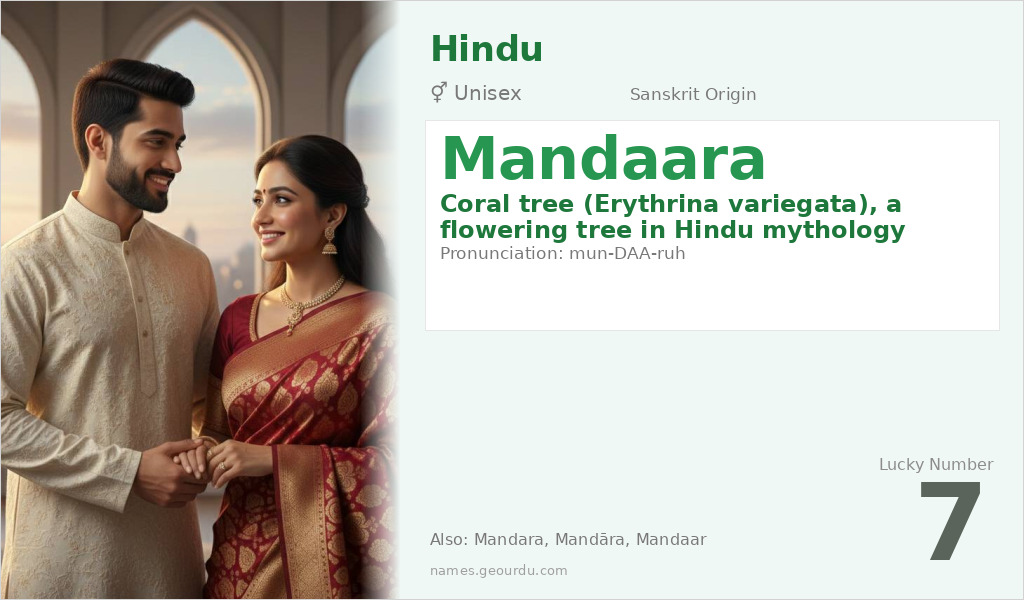
| 💎 Meaning | Coral tree (Erythrina variegata), a flowering tree in Hindu mythology |
| 👤 Gender | Unisex |
| 🕌 Religion | Hindu |
| 🌍 Origin | Sanskrit |
| 🗣 Pronunciation | mun-DAA-ruh |
| ✍️ Urdu | مندارا |
| ✍️ Arabic | مندارا |
| 🔢 Numerology | 7 |
| ✨ Spellings | Mandara, Mandāra, Mandaar |
Origin & Cultural Significance
Mandaara has its origins in ancient Sanskrit, the classical language of Hindu scriptures and Indian literature. The name appears in foundational Hindu texts describing the Samudra Manthan (churning of the cosmic ocean), where it emerged as one of the divine treasures. While occasionally used as a personal name in modern India, it remains more common as a mythological and botanical reference. The confusion with Mandara (the mountain) likely stems from similar pronunciation and shared mythological context, but etymologically and traditionally, they are distinct concepts with different linguistic roots.
Personality Traits
Those named Mandaara are often perceived as having qualities associated with the celestial coral tree: beauty, resilience, and healing presence. The name suggests someone who brings color and vitality to their environment, much like the tree’s vibrant red flowers. There’s an inherent connection to nature, tradition, and spiritual depth, with potential artistic or creative inclinations reflecting the tree’s celebrated aesthetic qualities.
Similar Names
If you like Mandaara, consider: Mandara, Madhava, Madhur, Mandakini, Mandira
Famous People Named Mandaara
- Mandaara — Character in Hindu mythology representing the celestial coral tree
- Mandaara — Occasionally used as a feminine name in modern India
Frequently Asked Questions About Mandaara
What does Mandaara mean?
Mandaara means 'coral tree' (Erythrina variegata) in Sanskrit. It refers specifically to one of the five celestial trees in Hindu mythology, not to be confused with Mandara mountain.
Is Mandaara a boy or girl name?
Mandaara is a unisex name, though it appears more frequently in mythological contexts as a tree name rather than as a common personal name. In modern usage, it can be given to children of any gender.
What is the origin of Mandaara?
Mandaara originates from Sanskrit, the classical language of ancient India. It appears in Hindu scriptures describing the Samudra Manthan (churning of the cosmic ocean) where the coral tree emerged as a divine treasure.