
Table of Contents
Mansur is a powerful Arabic name with deep historical roots and a meaning that resonates across cultures. Derived from the Arabic root for ‘victory,’ this name has been borne by caliphs, mystics, and leaders throughout history. Its significance extends beyond religious boundaries, appearing in both Muslim and Christian Arabic-speaking communities. Discover the rich linguistic heritage and cultural impact of this timeless name.
Meaning of Mansur
Mansur originates from the Arabic triliteral root ن-ص-ر (n-ṣ-r), which conveys concepts of help, support, and victory. As a passive participle of the verb ‘nasara’ (to help), Mansur literally means ‘one who is helped’ or ‘one who is granted victory.’ This grammatical form emphasizes receiving assistance toward triumph, often with divine connotation in religious contexts. The name appears in pre-Islamic poetry and was prominently used during the Islamic Golden Age, most famously as the regnal title of Abbasid Caliph Abu Ja’far al-Mansur. In modern usage across Arabic, Persian, Turkish, Urdu, and other languages influenced by Arabic, it consistently retains this core meaning of being victorious or triumphant.
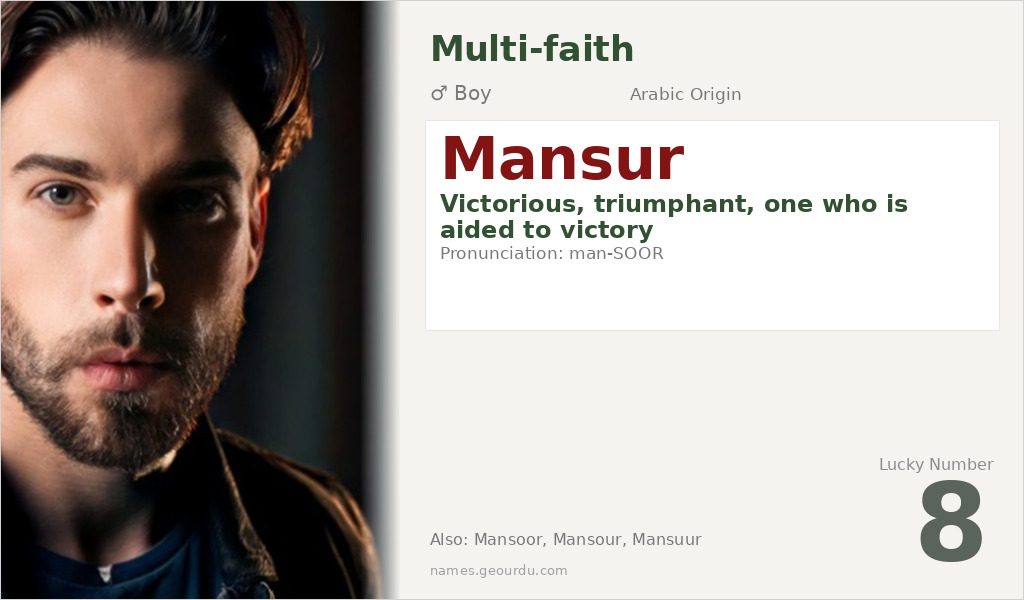
| 📛 Name | Mansur |
| 💎 Meaning | Victorious, triumphant, one who is aided to victory |
| 👤 Gender | Boy |
| 🕌 Religion | Multi-faith |
| 🌍 Origin | Arabic |
| 🗣 Pronunciation | man-SOOR |
| ✍️ Urdu | منصور |
| ✍️ Arabic | منصور |
| 🔢 Numerology | 8 |
| ✨ Spellings | Mansoor, Mansour, Mansuur, Mansor |
Origin & Cultural Significance
Mansur has its origins in classical Arabic language and culture, with documented usage dating back to the 7th century. The name gained particular prominence during the Abbasid Caliphate when Abu Ja’far Abdullah adopted ‘al-Mansur’ (the Victorious) as his regnal name after securing the caliphate in 754 CE. This historical association cemented the name’s connection to leadership and triumph in Islamic history. Beyond the Muslim world, Arabic-speaking Christian communities in the Levant and Egypt have also used Mansur for centuries, making it a multi-faith name. The name spread through Islamic expansion to Persian, Turkish, Urdu, and various South Asian languages, where it maintains its original meaning while adapting to local phonetic patterns.
Personality Traits
Those named Mansur are often associated with qualities of resilience, determination, and strategic thinking. The name’s meaning of ‘victorious’ suggests an inherent ability to overcome obstacles and achieve success. Historically, bearers of this name have frequently been leaders, reformers, or influential figures, reflecting these perceived traits. While personality varies by individual, the name carries cultural expectations of strength and capability.
Similar Names
If you like Mansur, consider: Nasir, Muntasir, Mansaf, Mansour, Nasr, Nasrullah, Mansurah, Mansuriyyah, Mansuruddin
Famous People Named Mansur
- Al-Mansur (Abu Ja'far Abdullah ibn Muhammad al-Mansur) — Second Abbasid Caliph who founded Baghdad in 762 CE
- Mansur al-Hallaj — 10th-century Persian mystic, poet, and teacher of Sufism
Frequently Asked Questions About Mansur
What does Mansur mean?
Mansur means 'victorious,' 'triumphant,' or 'one who is aided to victory' in Arabic, derived from the root ن-ص-ر (n-ṣ-r) meaning 'to help' or 'grant victory.'
Is Mansur a boy or girl name?
Mansur is exclusively a masculine name in all cultures where it is used, from Arabic-speaking regions to South Asia and beyond.
What is the origin of Mansur?
Mansur originates from classical Arabic language and culture, with significant historical usage during the Abbasid Caliphate and spread to Persian, Turkish, Urdu, and other languages through Islamic cultural exchange.





