
Table of Contents
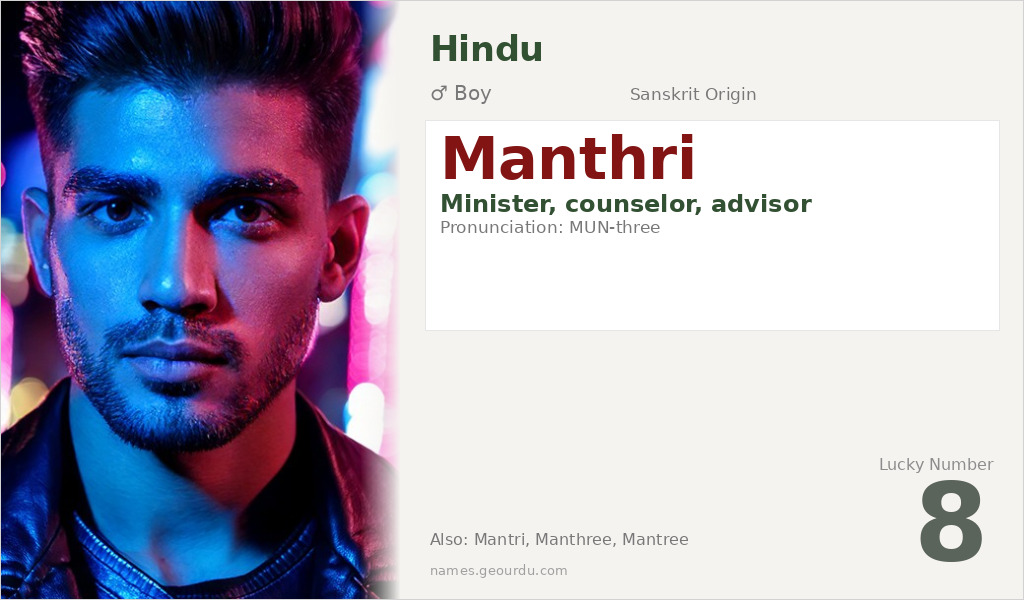
Manthri is a distinctive boy’s name with deep roots in Sanskrit tradition, symbolizing wisdom and guidance. Often chosen for its noble meaning of ‘minister’ or ‘advisor’, this name reflects qualities of leadership and counsel. In Hindu culture, it carries historical significance from ancient texts, making it a meaningful choice for parents seeking a name with intellectual and cultural resonance. Explore the rich etymology and modern usage of Manthri in this comprehensive guide.
Meaning of Manthri
Manthri originates from the Sanskrit word ‘मंत्री’ (mantrī), which directly translates to ‘minister’, ‘counselor’, or ‘advisor’. The term is derived from ‘मन्त्र’ (mantra), meaning ‘counsel’, ‘advice’, or ‘sacred formula’, combined with the suffix ‘-ī’ denoting an agent or doer. In classical Sanskrit literature, such as the Arthashastra by Kautilya, ‘mantrī’ refers to a royal advisor or minister in a court, highlighting its association with governance and wisdom. This etymology is well-documented in Sanskrit dictionaries and linguistic studies, confirming its meaning without ambiguity. The name has been adopted into various Indian languages, including Hindi and Telugu, retaining its original significance. Unlike some names with speculative meanings, Manthri’s definition is firmly established in historical and linguistic sources.
| 📛 Name | Manthri |
| 💎 Meaning | Minister, counselor, advisor |
| 👤 Gender | Boy |
| 🕌 Religion | Hindu |
| 🌍 Origin | Sanskrit |
| 🗣 Pronunciation | MUN-three |
| ✍️ Urdu | منتری |
| ✍️ Arabic | مانتري |
| 🔢 Numerology | 8 |
| ✨ Spellings | Mantri, Manthree, Mantree |
Origin & Cultural Significance
Manthri has its origins in Sanskrit, an ancient Indo-Aryan language central to Hindu scriptures and classical Indian literature. It appears in texts like the Mahabharata and Arthashastra, where ‘mantrī’ denotes advisors to kings, emphasizing its cultural importance in historical governance and diplomacy. As a given name, it is primarily used in Hindu communities across India, particularly in regions like Andhra Pradesh, Telangana, and Karnataka, where Sanskrit-derived names are common. The name reflects traditional values of wisdom and leadership, often chosen to inspire qualities of counsel and responsibility. While it is not widely found in other global languages like Arabic or Persian, its usage remains specific to Indian cultural contexts, with no verified connections to Pashto, Balochi, or tribal languages despite regional diversity in the subcontinent.
Personality Traits
People named Manthri are often associated with traits of intelligence, diplomacy, and reliability, mirroring the name’s meaning of ‘counselor’. They may exhibit strong analytical skills and a calm demeanor, making them effective in advisory or leadership roles. In social settings, they are perceived as trustworthy and thoughtful, with a natural inclination toward problem-solving and strategic planning. These personality attributes align with the name’s etymological roots in Sanskrit, where it symbolizes guidance and wisdom.
Similar Names
If you like Manthri, consider: Mantra, Mantresh, Mantreshwar, Mantreshwara, Mantreshwari
Famous People Named Manthri
- Manthri S. Subramanyam — Indian classical musician and composer
- Manthri Srinivas — Indian film director and screenwriter in Telugu cinema
Frequently Asked Questions About Manthri
What does Manthri mean?
Manthri means 'minister', 'counselor', or 'advisor', derived from the Sanskrit word 'मंत्री' (mantrī).
Is Manthri a boy or girl name?
Manthri is traditionally a boy's name in Hindu culture, though its usage is almost exclusively masculine based on historical and contemporary records.
What is the origin of Manthri?
Manthri originates from Sanskrit, an ancient Indian language, with documented usage in Hindu texts and modern Indian languages like Hindi and Telugu.





