
Table of Contents
Marcus is a timeless name with roots stretching back to ancient Rome. Derived from the Roman god of war, Mars, this name has been borne by emperors, philosophers, and saints throughout history. Its enduring popularity across centuries and cultures speaks to its strong, classic appeal. Today, Marcus remains a favored choice for parents seeking a name with historical depth and masculine strength.
Meaning of Marcus
The name Marcus originates from Latin, specifically from the Roman praenomen (personal name) ‘Marcus’. This name is directly connected to Mars, the Roman god of war, agriculture, and the guardian of Rome. The meaning is best understood as ‘dedicated to Mars’ or ‘belonging to Mars’, indicating a connection to the deity. In Roman naming conventions, Marcus was one of the most common praenomina, used by prominent families and citizens. The name’s association with martial qualities made it particularly popular in Roman society, where military prowess was highly valued. Through Christian tradition, the name gained additional significance via Saint Mark (Marcus in Latin), one of the four evangelists who authored the Gospel of Mark.
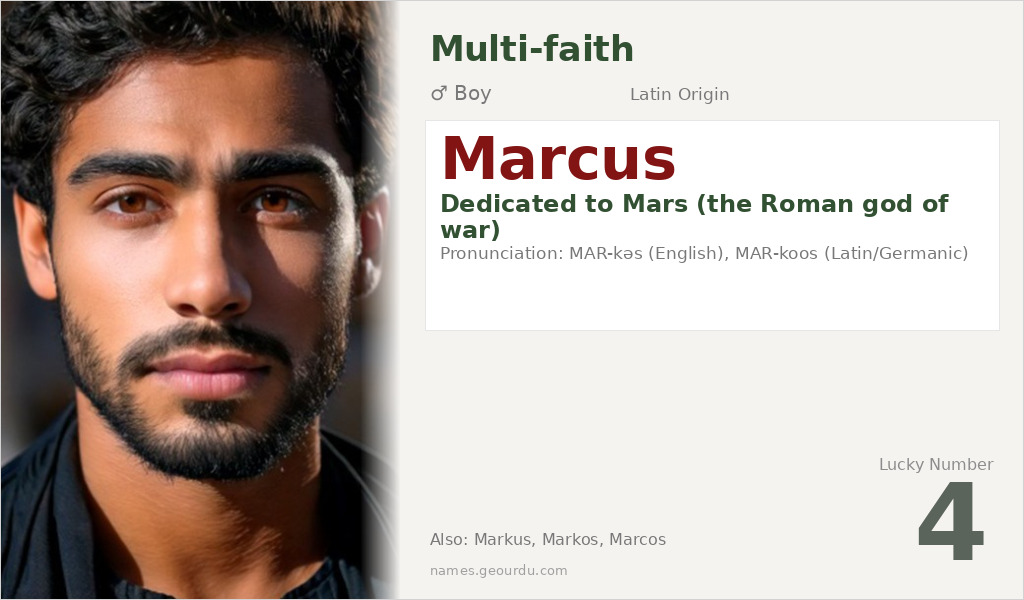
| 📛 Name | Marcus |
| 💎 Meaning | Dedicated to Mars (the Roman god of war) |
| 👤 Gender | Boy |
| 🕌 Religion | Multi-faith |
| 🌍 Origin | Latin |
| 🗣 Pronunciation | MAR-kəs (English), MAR-koos (Latin/Germanic) |
| ✍️ Urdu | مارکس |
| ✍️ Arabic | ماركوس |
| 🔢 Numerology | 4 |
| ✨ Spellings | Markus, Markos, Marcos, Marco, Mark |
Origin & Cultural Significance
Marcus has its origins in ancient Rome, where it functioned as a common praenomen (first name) among Roman citizens. The name’s connection to Mars, one of the most important Roman deities, gave it significant cultural weight. During the Roman Empire’s expansion, the name spread throughout Europe and the Mediterranean world. With the rise of Christianity, the name gained religious significance through Saint Mark the Evangelist, whose Latin name was Marcus. This dual heritage—both pagan Roman and Christian—helped the name survive the fall of the Roman Empire and continue through the Middle Ages to modern times, where it remains popular in many European countries and their diaspora communities.
Personality Traits
Traditionally, those named Marcus are often associated with qualities of strength, leadership, and reliability. The name’s connection to Mars, the god of war, suggests attributes like courage, determination, and protective instincts. Many Marcuses are perceived as practical problem-solvers who value tradition and stability. While these associations are cultural rather than deterministic, they reflect the enduring image the name has maintained across centuries of use.
Similar Names
If you like Marcus, consider: Mark, Martin, Marius, Marco, Marcellus
Famous People Named Marcus
- Marcus Aurelius — Roman Emperor and Stoic philosopher (121-180 AD)
- Marcus Tullius Cicero — Roman statesman, orator and philosopher (106-43 BC)
- Marcus Rashford — English professional footballer (born 1997)
- Marcus Garvey — Jamaican political activist and Pan-Africanist (1887-1940)
Frequently Asked Questions About Marcus
What does Marcus mean?
Marcus means 'dedicated to Mars' or 'belonging to Mars', referring to the Roman god of war. The name originates from Latin and was a common Roman praenomen (personal name).
Is Marcus a boy or girl name?
Marcus is traditionally and overwhelmingly a masculine name. While some names have become unisex over time, Marcus has maintained its masculine identity across cultures and historical periods.
What is the origin of Marcus?
Marcus originates from ancient Rome, specifically from Latin. It derives from the Roman god Mars and was one of the most common praenomina (first names) in Roman society before spreading throughout Europe via the Roman Empire and later Christian tradition.





