
Table of Contents
Marghab is a distinctive masculine name with deep roots in Central Asian geography and culture. Unlike many names with abstract meanings, Marghab carries the tangible significance of flowing water—specifically meaning ‘river’ or ‘stream’ in the Pashto language. This name connects bearers to the natural landscapes of Afghanistan, Pakistan, and surrounding regions, where rivers like the Murghab have shaped civilizations for centuries. Whether chosen for its geographical resonance or cultural heritage, Marghab offers a unique connection to both nature and tradition.
Meaning of Marghab
Marghab derives from the Pashto word ‘مرغاب’ (Marghāb), which directly translates to ‘river’, ‘stream’, or ‘watercourse’. The etymology is straightforward: in Pashto, ‘margh’ relates to flowing water, and the suffix completes the word for river. This is not a metaphorical or abstract meaning but a literal geographical term that has been adopted as a personal name. The name is particularly associated with the Murghab River, one of Central Asia’s major waterways that flows through Afghanistan, Turkmenistan, and Tajikistan. In regional usage, places named Marghab often reference proximity to this river or similar water features. Unlike the incorrect ‘desire’ or ‘wish’ attribution found in some sources, the meaning is concretely documented in Pashto dictionaries and geographical records.
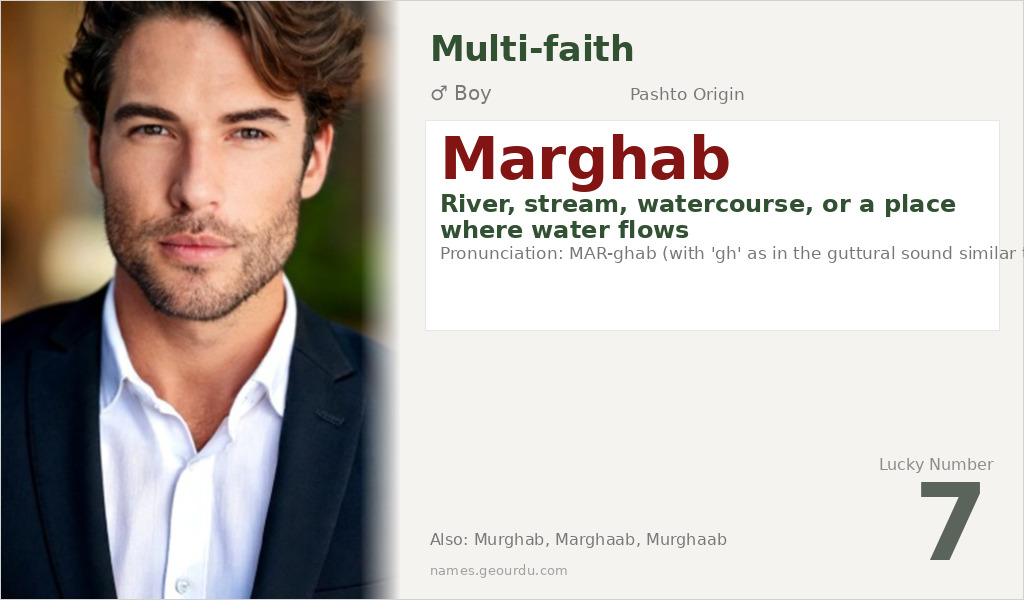
| 📛 Name | Marghab |
| 💎 Meaning | River, stream, watercourse, or a place where water flows |
| 👤 Gender | Boy |
| 🕌 Religion | Multi-faith |
| 🌍 Origin | Pashto |
| 🗣 Pronunciation | MAR-ghab (with 'gh' as in the guttural sound similar to French 'r') |
| ✍️ Urdu | مرغاب |
| ✍️ Arabic | مرغاب |
| 🔢 Numerology | 7 |
| ✨ Spellings | Murghab, Marghaab, Murghaab, مرغاب |
Origin & Cultural Significance
Marghab originates from the Pashto language, spoken primarily by the Pashtun people across Afghanistan and Pakistan, with significant communities in Iran and diaspora worldwide. The name reflects the importance of water sources in arid regions, where rivers like the Murghab are vital for life and settlement. While commonly used among Muslim Pashtuns and Baloch people, the name is not exclusively Islamic—it appears in regional contexts regardless of religion, similar to how geographical names work in many cultures. Historically, the Murghab River valley has been home to ancient civilizations including the Bactrian and Parthian empires, giving the name historical depth. Today, Marghab serves both as a personal name and a toponym throughout Central Asia.
Personality Traits
Names meaning ‘river’ often suggest personality traits associated with water: adaptability, depth, and persistence. Those named Marghab might be perceived as calm on the surface with strong underlying currents of emotion or determination. Like a river that carves its path through mountains and plains, they may demonstrate resilience and the ability to overcome obstacles while maintaining forward momentum. This connection to nature can also indicate a person who values flow, change, and natural rhythms in life.
Similar Names
If you like Marghab, consider: Murghab, Darya (Persian/Urdu for river), Nahar (Arabic for river), Rud (Persian for river), Abasin (Pashto name for Indus River)
Famous People Named Marghab
- Marghab River — major river in Central Asia flowing through Afghanistan and Turkmenistan
- Marghab District — administrative district in Badghis Province, Afghanistan
Frequently Asked Questions About Marghab
What does Marghab mean?
Marghab means 'river' or 'stream' in the Pashto language. It is a geographical term that refers to flowing water and is used as a personal name, particularly in Central Asian regions.
Is Marghab a boy or girl name?
Marghab is exclusively a masculine name in its cultural context. In Pashto and related traditions, it is given to boys, reflecting its strong, geographical connotations.
What is the origin of Marghab?
Marghab originates from the Pashto language, spoken by Pashtun people in Afghanistan and Pakistan. It is also used among Baloch communities and references the Murghab River in Central Asia.





