
Table of Contents
Marko is a timeless masculine name with ancient Roman roots that has traveled across continents and centuries. While particularly popular in Slavic countries like Croatia, Serbia, and Slovenia, this name has found homes in diverse cultures worldwide. With its connection to Mars, the Roman god of war, Marko carries connotations of strength, protection, and martial spirit that have made it enduringly appealing to parents across generations.
Meaning of Marko
The name Marko originates from the Latin name Marcus, which itself derives from the Roman god Mars, the deity of war in classical mythology. The etymological root can be traced to the Latin word ‘martius,’ meaning ‘of Mars’ or ‘warlike.’ As Christianity spread throughout the Roman Empire, the name gained religious significance through Saint Mark the Evangelist, one of the four Gospel writers. In Slavic languages, Marko developed as a diminutive form of Mark, maintaining the original Latin meaning while adapting to local linguistic patterns. The name’s martial connotations have evolved over time to represent general strength and protection rather than literal warfare.
| 📛 Name | Marko |
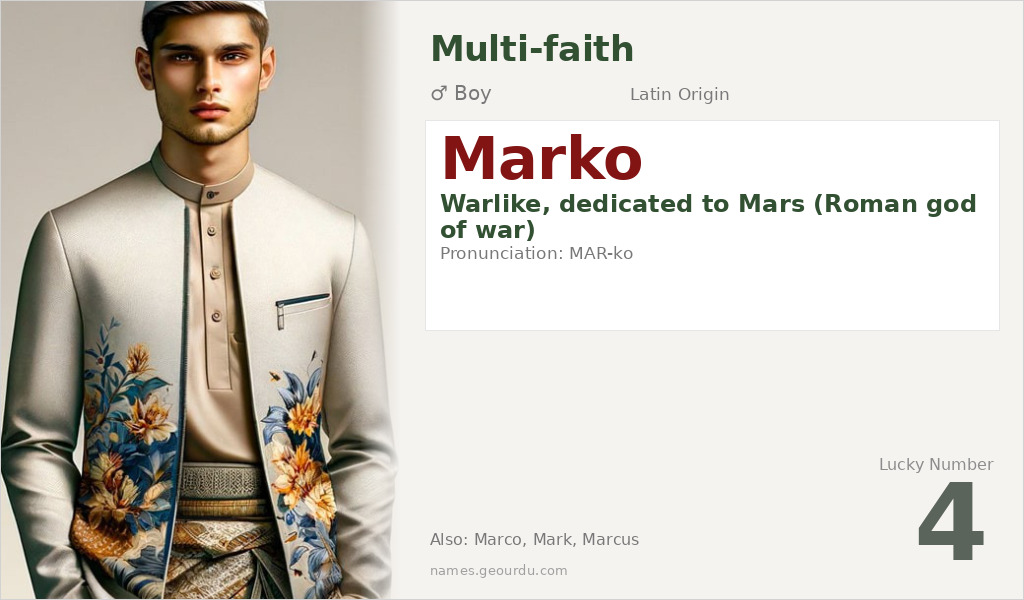
| 💎 Meaning | Warlike, dedicated to Mars (Roman god of war) |
| 👤 Gender | Boy |
| 🕌 Religion | Multi-faith |
| 🌍 Origin | Latin |
| 🗣 Pronunciation | MAR-ko |
| ✍️ Urdu | مارکو |
| ✍️ Arabic | ماركو |
| 🔢 Numerology | 4 |
| ✨ Spellings | Marco, Mark, Marcus, Marcos, Márkó |
Origin & Cultural Significance
Marko has its primary origins in ancient Rome, where Marcus was a common praenomen (first name) among Roman citizens. The name gained Christian significance through Saint Mark the Evangelist in the 1st century CE. During the Middle Ages, the name spread throughout Europe via Christian missionaries and Roman cultural influence. It became particularly established in Slavic regions, where it developed as the diminutive form Marko. Today, the name remains most popular in Croatia, Serbia, Slovenia, and other Balkan countries, though it has global recognition. The name’s journey from Roman temples to Christian churches to modern birth certificates demonstrates how names evolve while retaining core meanings.
Personality Traits
People named Marko are often associated with qualities of strength, determination, and leadership. The name’s martial origins suggest someone who is protective, courageous, and willing to stand up for what they believe in. In modern contexts, these traits often manifest as strong work ethic, reliability, and the ability to take charge in challenging situations. While the name carries historical weight, contemporary Markos balance traditional values with modern adaptability.
Similar Names
If you like Marko, consider: Marcus, Marco, Mark, Martin, Marek
Famous People Named Marko
- Marko Polo — Medieval Venetian merchant and explorer who traveled the Silk Road to China
- Marko Marulić — Croatian Renaissance poet and humanist, often called the father of Croatian literature
Frequently Asked Questions About Marko
What does Marko mean?
Marko means 'warlike' or 'dedicated to Mars,' originating from the Latin name Marcus which references the Roman god of war.
Is Marko a boy or girl name?
Marko is exclusively a masculine name across all cultures where it is used, with no feminine variants in common usage.
What is the origin of Marko?
Marko has Latin origins, derived from the Roman name Marcus, and became popular in Slavic countries as a diminutive form of Mark.





