
Table of Contents
Markus is a strong, classic name with ancient Roman roots that has remained popular across Northern Europe for centuries. As the German and Scandinavian form of Marcus, this name carries the powerful association with Mars, the Roman god of war. From medieval times to modern day, Markus has been borne by saints, authors, and innovators. Discover the rich history and meaning behind this enduring name.
Meaning of Markus
Markus derives from the Latin name Marcus, which is believed to originate from the Roman god Mars, the deity of war, agriculture, and spring. The name likely comes from the Latin adjective ‘martius’ meaning ‘of Mars’ or ‘warlike’. In ancient Rome, Marcus was one of the most common praenomen (first names) among aristocratic families, including notable figures like Marcus Tullius Cicero and Marcus Aurelius. The name spread throughout Europe with the spread of Christianity, particularly through Saint Mark the Evangelist, one of the four Gospel writers. The Germanic and Scandinavian forms evolved as Markus, maintaining the original Latin meaning while adapting to local linguistic patterns.
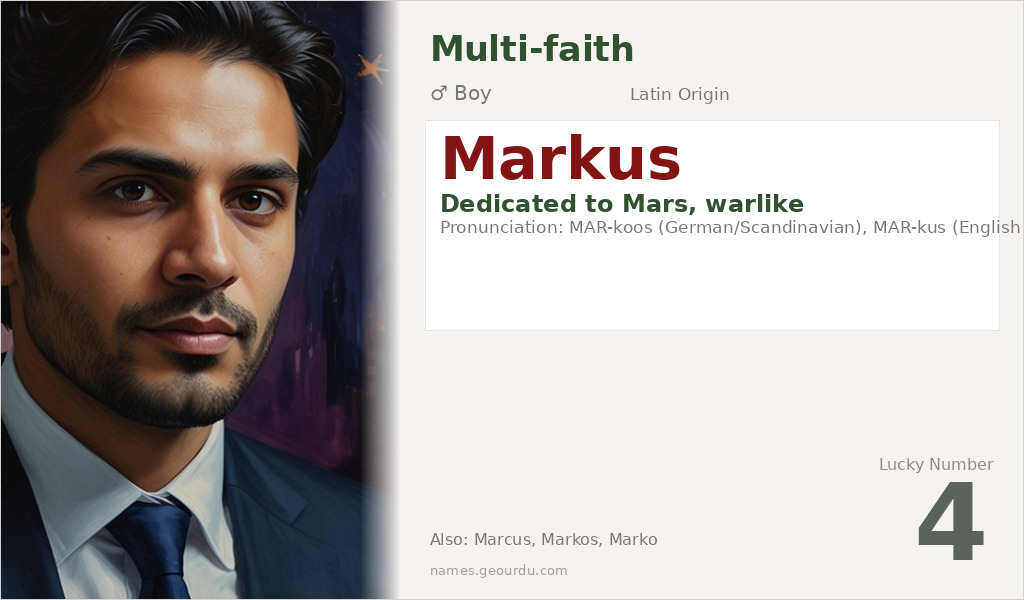
| 📛 Name | Markus |
| 💎 Meaning | Dedicated to Mars, warlike |
| 👤 Gender | Boy |
| 🕌 Religion | Multi-faith |
| 🌍 Origin | Latin |
| 🗣 Pronunciation | MAR-koos (German/Scandinavian), MAR-kus (English variation) |
| ✍️ Urdu | مارکس |
| ✍️ Arabic | ماركوس |
| 🔢 Numerology | 4 |
| ✨ Spellings | Marcus, Markos, Marko, Marcos, Markuss |
Origin & Cultural Significance
Markus has its origins in ancient Rome, where Marcus was a common given name among patrician families. The name gained Christian significance through Saint Mark the Evangelist, author of the second Gospel, which helped spread its use throughout Europe. During the Middle Ages, the name adapted to various European languages, with Markus becoming the standard form in German-speaking regions (Germany, Austria, Switzerland) and Scandinavian countries (Sweden, Norway, Denmark, Finland). Unlike many names that are tied to specific religions, Markus has been used by Christians across denominations as well as secular families, making it a truly multi-faith name with broad cultural acceptance.
Personality Traits
People named Markus are often associated with qualities of strength, reliability, and determination. They tend to be practical problem-solvers who approach challenges with methodical precision. With their disciplined nature and organizational skills, Markus individuals often excel in leadership roles where stability and consistency are valued. Their connection to the warlike Mars suggests a competitive spirit, but this typically manifests as perseverance rather than aggression.
Similar Names
If you like Markus, consider: Marcus, Mark, Martin, Marcel, Marco
Famous People Named Markus
- Markus Zusak — Australian author of 'The Book Thief'
- Markus Persson — Swedish video game programmer, creator of Minecraft
Frequently Asked Questions About Markus
What does Markus mean?
Markus means 'dedicated to Mars' or 'warlike,' deriving from the Latin name Marcus, which references the Roman god of war.
Is Markus a boy or girl name?
Markus is exclusively a masculine name in all cultures where it is used, particularly in German, Scandinavian, and Finnish traditions.
What is the origin of Markus?
Markus originates from Latin as the Germanic/Scandinavian form of Marcus, with roots tracing back to ancient Rome and the god Mars.





