
Table of Contents
Maurice is a classic name with deep historical roots stretching back to ancient Rome. Derived from Latin origins meaning ‘dark-skinned’ or ‘Moorish’, this name has traveled through centuries and cultures while maintaining its distinctive character. From early Christian martyrs to modern artists and athletes, Maurice has been borne by remarkable individuals across diverse fields. Its enduring appeal lies in its strong phonetic presence and rich historical associations.
Meaning of Maurice
The name Maurice has a clear etymological path from the Latin Mauritius, which itself comes from Maurus meaning ‘Moorish’ or ‘dark-skinned’. In ancient Rome, Maurus referred specifically to inhabitants of Mauretania, a region in North Africa corresponding to parts of modern Morocco and Algeria. The term evolved in Late Latin to describe people with darker complexions more generally. This linguistic origin reflects the name’s geographical and descriptive roots, connecting it to the diverse populations of the Mediterranean world during Roman times. The name’s meaning is therefore both geographical (from Mauretania) and descriptive (dark-skinned).
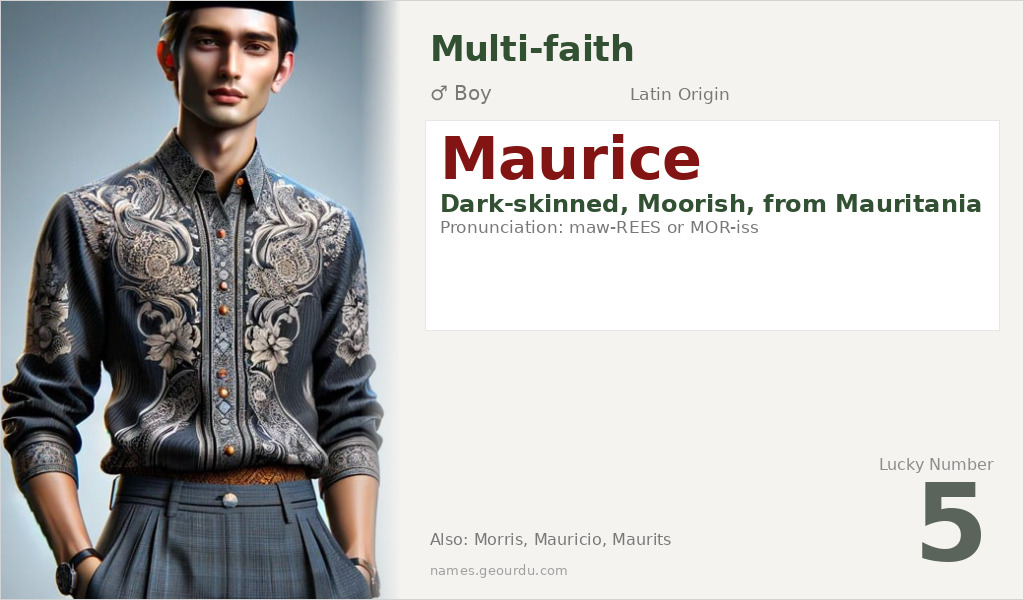
| 📛 Name | Maurice |
| 💎 Meaning | Dark-skinned, Moorish, from Mauritania |
| 👤 Gender | Boy |
| 🕌 Religion | Multi-faith |
| 🌍 Origin | Latin |
| 🗣 Pronunciation | maw-REES or MOR-iss |
| ✍️ Urdu | موریس |
| ✍️ Arabic | موريس |
| 🔢 Numerology | 5 |
| ✨ Spellings | Morris, Mauricio, Maurits, Maurice, Maurizio |
Origin & Cultural Significance
Maurice entered European naming traditions primarily through Saint Maurice, a 3rd-century Egyptian commander of the Theban Legion who was martyred for his Christian faith. His veneration spread throughout Europe, particularly in France and Germany, where many churches and towns were dedicated to him. The name gained royal prestige when adopted by Byzantine emperors and later European nobility. While particularly popular in French-speaking regions (pronounced moh-REES), it also found favor in English, German, and Dutch cultures. Today, Maurice is used across multiple religious traditions, having transcended its initial Christian associations to become a multicultural name.
Personality Traits
People named Maurice often exhibit qualities of adaptability and intellectual curiosity. They tend to approach life with versatility and enjoy exploring new ideas and experiences. Their natural communication skills and social intelligence frequently make them effective in collaborative environments. While maintaining traditional values in some aspects, they typically embrace progress and innovation in others.
Similar Names
If you like Maurice, consider: Mauricio, Morris, Mauro, Mauritz
Famous People Named Maurice
- Maurice Ravel — French composer of Boléro
- Maurice Sendak — American author and illustrator of Where the Wild Things Are
- Maurice Chevalier — French actor and singer
- Maurice Greene — American Olympic sprinter
- Maurice Gibb — British musician, member of the Bee Gees
Frequently Asked Questions About Maurice
What does Maurice mean?
Maurice means 'dark-skinned' or 'Moorish', originating from the Latin Mauritius, which derives from Maurus referring to inhabitants of ancient Mauretania in North Africa.
Is Maurice a boy or girl name?
Maurice is traditionally and predominantly a masculine name, though some feminine variants like Mauricia exist. Across all cultures where it's used, it remains primarily a boy's name.
What is the origin of Maurice?
Maurice originates from Latin, specifically from the name Mauritius meaning 'Moorish'. It entered European naming traditions through Saint Maurice, a 3rd-century Egyptian martyr in the Roman army, and spread through Christian and later secular usage.





