
Table of Contents
Maynard is a distinctive name with deep Germanic roots that has traveled through history from medieval Europe to modern times. While it might sound contemporary, this name carries centuries of linguistic heritage, combining elements meaning ‘strength’ and ‘bravery’. Originally a surname brought to England by Norman conquerors, Maynard has evolved into a respected given name with a rich etymological background.
Meaning of Maynard
The name Maynard originates from Old High German, specifically from the elements ‘magin’ meaning ‘strength, might, power’ and ‘hard’ meaning ‘brave, hardy, strong, courageous’. This combination creates the meaning ‘brave strength’ or ‘hardy strength’. The name entered the English language through Norman French after the 1066 Norman Conquest, where it was initially used as a surname before becoming adopted as a first name. Linguistically, it belongs to the large family of Germanic compound names ending in ‘-hard’, sharing structural similarities with names like Bernard (‘bear-hardy’), Leonard (‘lion-brave’), and Gerard (‘spear-brave’). The name’s components reflect values highly prized in medieval Germanic warrior culture.
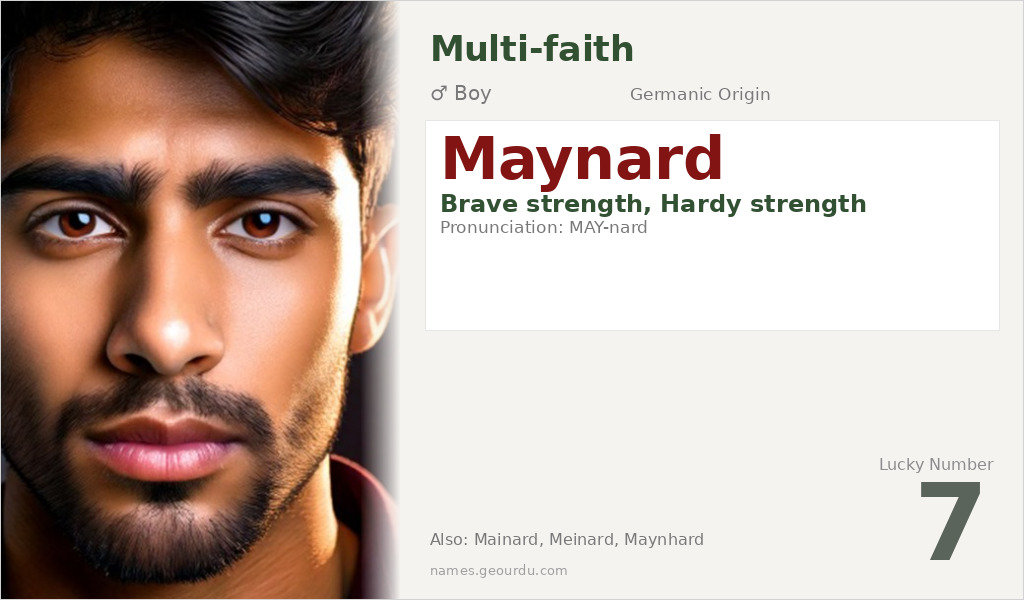
| 📛 Name | Maynard |
| 💎 Meaning | Brave strength, Hardy strength |
| 👤 Gender | Boy |
| 🕌 Religion | Multi-faith |
| 🌍 Origin | Germanic |
| 🗣 Pronunciation | MAY-nard |
| ✍️ Urdu | مینارڈ |
| ✍️ Arabic | مينارد |
| 🔢 Numerology | 7 |
| ✨ Spellings | Mainard, Meinard, Maynhard |
Origin & Cultural Significance
Maynard has its origins in medieval Germanic Europe, specifically from the Old High German language spoken in what is now Germany and surrounding regions. Following the Norman Conquest of England in 1066, the name was brought to Britain by Norman settlers, where it became established as both a surname and eventually a given name. The Normans themselves were of Norse origin but had adopted French language and customs, serving as a bridge between Germanic and Romance language traditions. Historically, the name appears in various forms across Europe, including the French ‘Mainard’, German ‘Meinhard’, and Dutch ‘Meinard’. While particularly associated with English and French naming traditions, Maynard has no exclusive religious affiliation and has been used by people of various faiths throughout history.
Personality Traits
Those named Maynard are often associated with qualities of resilience, intelligence, and quiet determination. The name’s meaning suggests someone who combines mental fortitude with courageous action, approaching challenges with both strength and strategic thinking. While not overtly aggressive, Maynards typically possess an inner confidence that allows them to persevere through difficulties. These traits align with the name’s Germanic warrior origins while adapting to modern contexts where strength is often demonstrated through perseverance and intellectual rigor rather than physical combat.
Similar Names
If you like Maynard, consider: Bernard, Leonard, Raynard, Gerard, Richard
Famous People Named Maynard
- Maynard James Keenan — American musician, lead vocalist of Tool, A Perfect Circle, and Puscifer
- Maynard Ferguson — Canadian jazz trumpeter and bandleader known for his high register playing
Frequently Asked Questions About Maynard
What does Maynard mean?
Maynard means 'brave strength' or 'hardy strength', derived from the Old High German elements 'magin' (strength, might) and 'hard' (brave, hardy, strong).
Is Maynard a boy or girl name?
Maynard is traditionally and almost exclusively a masculine name, with historical usage as both a surname and given name for males across Germanic and English-speaking cultures.
What is the origin of Maynard?
Maynard originates from Old High German (a medieval Germanic language) and entered English through Norman French after the 1066 Norman Conquest. It was initially a surname that later became used as a given name.





