
Table of Contents
Mehandi is a beautiful and culturally rich name that carries centuries of tradition within its syllables. Derived from the Sanskrit word for the henna plant, this name evokes images of intricate body art, celebrations, and natural beauty. Popular primarily in South Asian communities, Mehandi represents more than just a plant – it symbolizes joy, artistry, and cultural heritage. Whether chosen for its melodic sound or deep cultural connections, Mehandi remains a meaningful choice for parents seeking a name with historical roots.
Meaning of Mehandi
The name Mehandi has a very specific and well-documented meaning: it refers to the henna plant (Lawsonia inermis). This meaning originates from the Sanskrit term ‘mendhikā,’ which evolved into ‘mehndī’ in modern Hindi and Urdu. The plant is renowned for its leaves, which produce a reddish-brown dye used for temporary body art, hair coloring, and fabric dyeing. Unlike many names with abstract meanings, Mehandi is directly tied to a specific botanical entity with profound cultural significance across multiple civilizations. The name doesn’t mean ‘flowering plant’ generally, but specifically denotes the henna plant that has been cultivated for over 5,000 years.
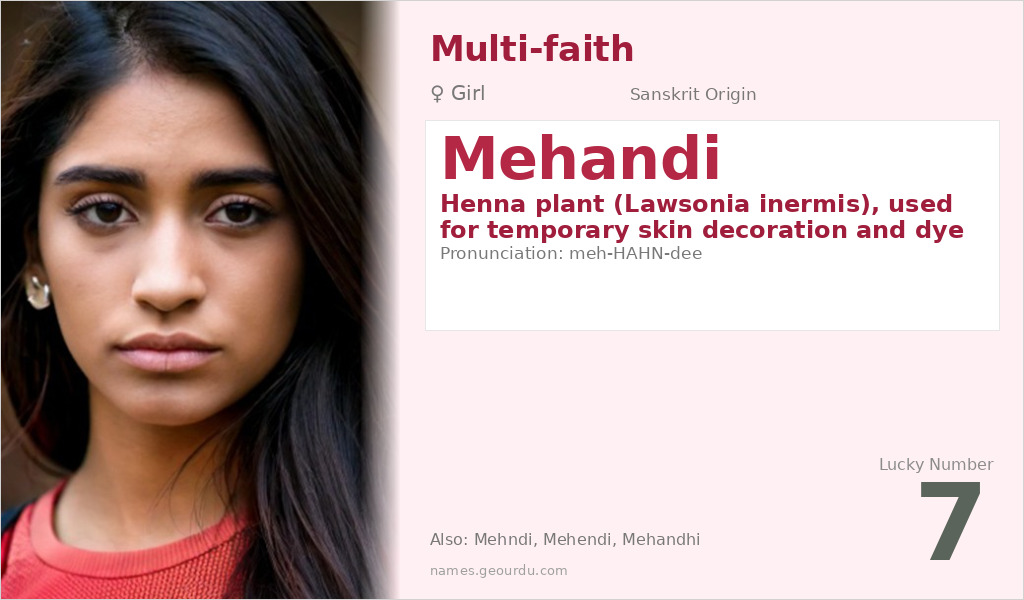
| 📛 Name | Mehandi |
| 💎 Meaning | Henna plant (Lawsonia inermis), used for temporary skin decoration and dye |
| 👤 Gender | Girl |
| 🕌 Religion | Multi-faith |
| 🌍 Origin | Sanskrit |
| 🗣 Pronunciation | meh-HAHN-dee |
| ✍️ Urdu | مہندی |
| ✍️ Arabic | حناء |
| 🔢 Numerology | 7 |
| ✨ Spellings | Mehndi, Mehendi, Mehandhi, Mehndhi |
Origin & Cultural Significance
Mehandi traces its origins to ancient Sanskrit, the classical language of India, where it first appeared as ‘mendhikā.’ The name and the plant it represents have been integral to South Asian, Middle Eastern, and North African cultures for millennia. Archaeological evidence shows henna use dating back to ancient Egypt and the Indus Valley Civilization. While particularly associated with Hindu and Muslim wedding traditions, henna art transcends religious boundaries, appearing in Sikh, Jewish, and various cultural celebrations. The name’s journey from Sanskrit through Prakrit languages to modern Hindi and Urdu demonstrates how botanical terms become personal names through cultural significance.
Personality Traits
Those named Mehandi often embody the artistic and celebratory spirit associated with henna traditions. They tend to be creative individuals with an appreciation for beauty, tradition, and cultural expression. Like the henna plant that leaves a temporary but beautiful mark, people with this name often make lasting impressions through their warmth and artistic sensibilities. Their personality frequently combines traditional values with contemporary creativity, making them bridge-builders between generations and cultures.
Similar Names
If you like Mehandi, consider: Henna, Alta, Rangoli, Sona, Chandni
Famous People Named Mehandi
- Mehandi Circus – 2019 Indian Tamil-language drama film directed by Saravana Rajan
- Mehandi Hasan – Bangladeshi cricketer who played for the national team
Frequently Asked Questions About Mehandi
What does Mehandi mean?
Mehandi specifically means 'henna plant' (Lawsonia inermis), originating from the Sanskrit word 'mendhikā.' It refers to the plant used for temporary body art, hair dye, and medicinal purposes.
Is Mehandi a boy or girl name?
Mehandi is almost exclusively used as a girl's name, particularly in South Asian communities where it's associated with feminine beauty traditions and wedding rituals involving henna application.
What is the origin of Mehandi?
Mehandi originates from Sanskrit, evolving through Prakrit languages into modern Hindi and Urdu. The name and the plant it represents have been culturally significant across South Asia, the Middle East, and North Africa for thousands of years.





