Table of Contents
Mehrana is a beautiful feminine name that carries the warmth of the sun and the dignity of nobility. With roots stretching across Persian, Pashto, and regional languages of South Asia, this name has traveled through cultures while maintaining its elegant essence. Whether meaning ‘magnificent woman’ or deriving from the Persian word for sunlight and affection, Mehrana embodies grace and strength. Its multicultural appeal makes it a meaningful choice for parents seeking a name with historical depth and contemporary resonance.
Meaning of Mehrana
The name Mehrana has a rich linguistic heritage with multiple possible interpretations. In Persian, it likely combines ‘Mehr’ (مهر), which can mean ‘sun’, ‘sunlight’, ‘affection’, or ‘kindness’, with the feminine suffix ‘-ana’. This creates meanings ranging from ‘sun-like woman’ to ‘affectionate one’. In Pashto and related languages spoken in Afghanistan and Pakistan, Mehrana directly translates to ‘great’, ‘magnificent’, or ‘noble woman’, emphasizing dignity and stature. The name appears in various forms across Balochi and regional dialects of South Asia, where it maintains similar connotations of grace and importance. This dual heritage makes Mehrana a name that bridges poetic Persian imagery with the strong cultural values of Pashtun and Baloch traditions.
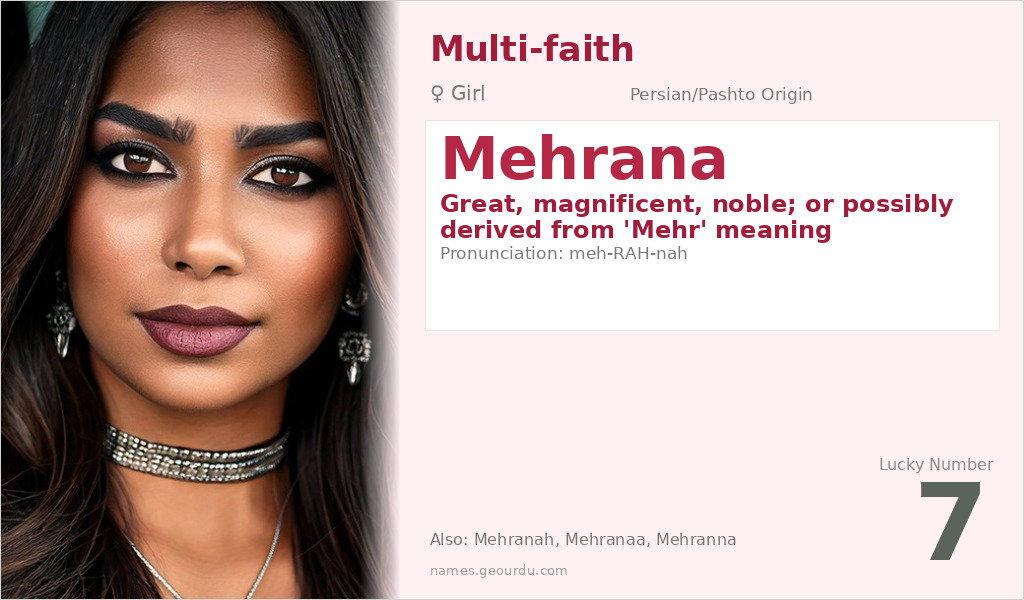
| 📛 Name | Mehrana |
| 💎 Meaning | Great, magnificent, noble; or possibly derived from 'Mehr' meaning sun/sunlight/affection in Persian |
| 👤 Gender | Girl |
| 🕌 Religion | Multi-faith |
| 🌍 Origin | Persian/Pashto |
| 🗣 Pronunciation | meh-RAH-nah |
| ✍️ Urdu | مہرانا |
| ✍️ Arabic | مهرانا |
| 🔢 Numerology | 7 |
| ✨ Spellings | Mehranah, Mehranaa, Mehranna |
Origin & Cultural Significance
Mehrana originates from the Persian cultural sphere, with strong adoption in Pashto-speaking regions of Afghanistan and Pakistan. Historically, names containing ‘Mehr’ have been popular in Zoroastrian and later Islamic cultures, reflecting the sun’s importance in ancient Persian religion. The name spread through the Mughal Empire and subsequent cultural exchanges across South Asia. Today, it’s used by Muslim, Hindu, and Sikh communities in the region, particularly among Pashtun, Baloch, and Punjabi families. Its cross-cultural appeal stems from both its beautiful sound and its positive meanings, allowing it to transcend religious boundaries while maintaining cultural specificity in different regions.
Personality Traits
Those named Mehrana often embody the qualities suggested by their name’s meanings. Like the sun, they may radiate warmth and positivity, naturally drawing people toward them. Their perceived nobility often translates into strong moral character and leadership abilities. Many Mehranas balance traditional values with progressive thinking, making them adaptable yet grounded individuals. Their affectionate nature typically makes them excellent friends and family members who nurture relationships with care and consistency.
Similar Names
If you like Mehrana, consider: Mehr, Mehrangiz, Mehrnaz, Mehrunissa, Mehrbano
Famous People Named Mehrana
- Mehrana Maqsood — Pakistani television actress known for roles in Urdu dramas
- Mehrana Khan — Emerging social media influencer from Afghanistan/Pakistan region
Frequently Asked Questions About Mehrana
What does Mehrana mean?
Mehrana has multiple meanings depending on linguistic context. In Persian, it may mean 'sun-like woman' or 'affectionate one' from 'Mehr' (sun/affection) + '-ana' (feminine suffix). In Pashto, it directly means 'great', 'magnificent', or 'noble woman'.
Is Mehrana a boy or girl name?
Mehrana is exclusively a feminine name across all cultures where it's used. The '-ana' suffix typically indicates femininity in Persian and related languages, and there are no recorded masculine uses of this specific name.
What is the origin of Mehrana?
Mehrana originates from Persian and Pashto languages. It's particularly common in Afghanistan, Pakistan, and Iran, with usage spreading to South Asian diaspora communities worldwide. The name has historical roots in Persian culture with strong adoption in Pashtun and Baloch traditions.