Table of Contents
Mehwish Ikhlaq is a beautiful compound name that combines Persian poetic imagery with Arabic moral depth. Meaning ‘moon-like face with excellent character’, this name reflects the Islamic ideal of balancing physical beauty with inner virtue. Popular in Muslim communities across South Asia and the Middle East, Mehwish Ikhlaq carries both cultural richness and spiritual significance. Let’s explore the fascinating etymology and cultural context of this meaningful name.
Meaning of Mehwish Ikhlaq
Mehwish Ikhlaq is a compound name with two distinct linguistic components, each carrying deep meaning. ‘Mehwish’ originates from Persian, combining ‘Mah’ (ماه) meaning ‘moon’ and the suffix ‘vish’ (ویش) meaning ‘like’ or ‘resembling’, creating the poetic meaning ‘moon-like’ or ‘as beautiful as the moon’. This reflects the Persian cultural tradition of comparing beauty to celestial bodies. ‘Ikhlaq’ comes from Arabic, derived from the triliteral root ‘kh-l-q’ (خ-ل-ق) which relates to creation, molding, and character formation. In Islamic terminology, ‘Ikhlaq’ specifically refers to morals, ethics, virtues, and good character. Together, the name beautifully merges aesthetic appreciation with ethical values, representing the complete ideal of a person in Islamic philosophy.
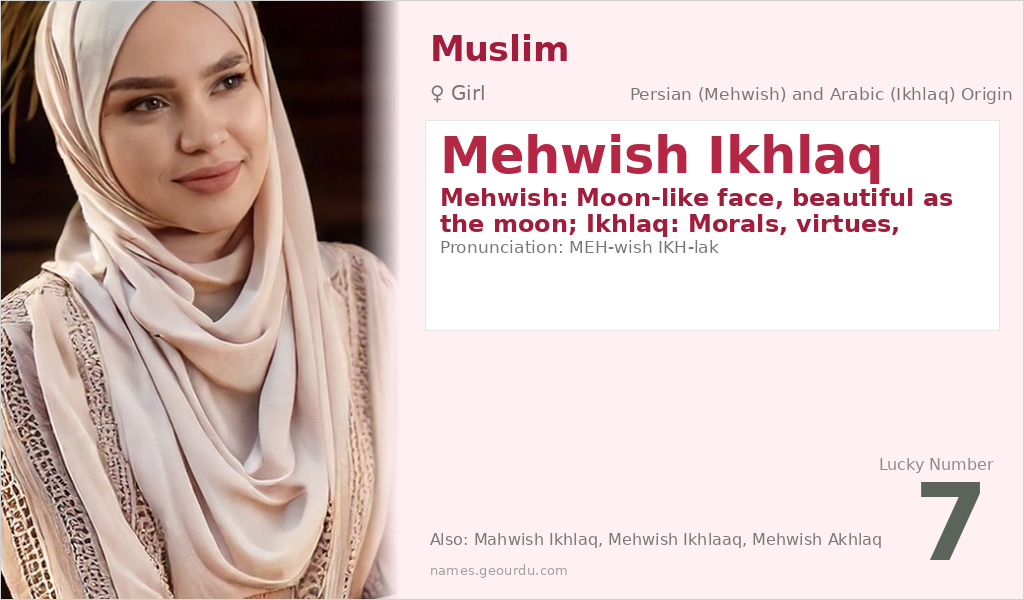
| 📛 Name | Mehwish Ikhlaq |
| 💎 Meaning | Mehwish: Moon-like face, beautiful as the moon; Ikhlaq: Morals, virtues, ethics, good character |
| 👤 Gender | Girl |
| 🕌 Religion | Muslim |
| 🌍 Origin | Persian (Mehwish) and Arabic (Ikhlaq) |
| 🗣 Pronunciation | MEH-wish IKH-lak |
| ✍️ Urdu | مہوش اخلاق |
| ✍️ Arabic | مهوش أخلاق |
| 🔢 Numerology | 7 |
| ✨ Spellings | Mahwish Ikhlaq, Mehwish Ikhlaaq, Mehwish Akhlaq, Mahvish Ikhlaq |
Origin & Cultural Significance
The name Mehwish Ikhlaq has multicultural origins, combining Persian and Arabic linguistic elements that reflect historical cultural exchanges in the Muslim world. Mehwish emerged from Persian poetic traditions where lunar imagery symbolizes beauty, purity, and illumination, popularized in regions influenced by Persian culture including Pakistan, Afghanistan, and parts of India. Ikhlaq has deep roots in Arabic Islamic scholarship, where ethical development (‘tahdhib al-akhlaq’) is a central religious concept. The combination became particularly popular in South Asian Muslim communities where Persian and Arabic naming traditions intersect. This name represents the synthesis of Persian aesthetic sensibility with Arabic moral philosophy that characterizes much of Islamic civilization’s cultural heritage.
Personality Traits
Those named Mehwish Ikhlaq are often perceived as having a balanced personality that reflects their name’s dual meaning. They typically combine aesthetic appreciation with strong moral principles, showing both grace in appearance and integrity in character. Many display intuitive understanding and spiritual depth, with a natural inclination toward ethical behavior and meaningful relationships. The lunar association suggests qualities of reflection, calmness, and illumination in challenging situations.
Similar Names
If you like Mehwish Ikhlaq, consider: Mahwish, Mahira, Meher, Ikhlas, Akhlaq, Mahin, Mahvash, Mehnaz, Iqra, Mahnoor
Famous People Named Mehwish Ikhlaq
- Mehwish Hayat — Pakistani actress and singer known for roles in Lollywood films
- Mehwish Ikhlaq — Not a widely documented public figure, but the name appears in Muslim communities across South Asia and the Middle East
Frequently Asked Questions About Mehwish Ikhlaq
What does Mehwish Ikhlaq mean?
Mehwish Ikhlaq means 'moon-like beauty with morals and virtues'. Mehwish is Persian for 'moon-like' and Ikhlaq is Arabic for 'ethics, character, morals'.
Is Mehwish Ikhlaq a boy or girl name?
Mehwish Ikhlaq is exclusively a girl's name in all cultural contexts where it is used. The feminine form is inherent in both components of the name.
What is the origin of Mehwish Ikhlaq?
Mehwish Ikhlaq has a dual origin: Mehwish comes from Persian language and culture, while Ikhlaq originates from Arabic Islamic tradition. The combination is particularly popular in South Asian Muslim communities.