Table of Contents
Mihri is a beautiful feminine name that shines with historical depth and cross-cultural appeal. Meaning ‘sun’ or ‘radiant’ in Persian, this name carries the warmth and light of ancient solar symbolism. Used from Iran to Turkey and beyond, Mihri connects modern naming traditions to pre-Islamic Zoroastrian heritage. Its luminous meaning makes it a timeless choice for parents seeking a name with both elegance and substance.
Meaning of Mihri
Mihri derives directly from the Persian word ‘Mihr’ (مهر), which means ‘sun’, ‘sunlight’, or ‘radiance’. In Old Persian, Mithra (from which Mihr comes) was a central deity in Zoroastrianism—the god of light, covenant, and the sun. The name evolved through Middle Persian into modern Persian, Turkish, and Kurdish usage, consistently retaining its solar meaning. Linguistically, it shares roots with Sanskrit ‘Mitra’ (meaning ‘friend’ or ‘sun’), showing ancient Indo-Iranian connections. Unlike many names that shift meaning across languages, Mihri has maintained its core association with light and illumination for millennia.
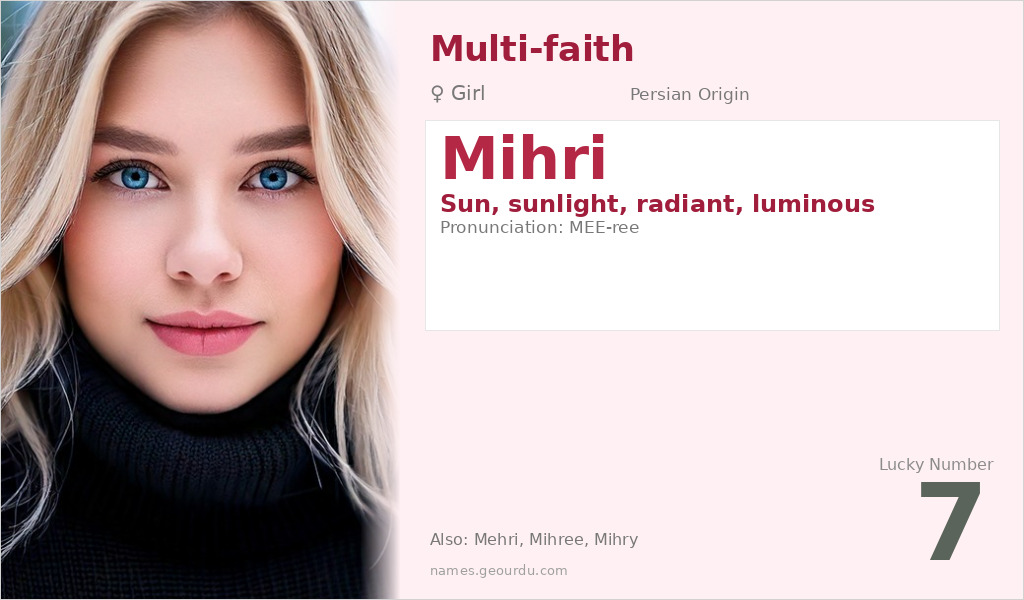
| 📛 Name | Mihri |
| 💎 Meaning | Sun, sunlight, radiant, luminous |
| 👤 Gender | Girl |
| 🕌 Religion | Multi-faith |
| 🌍 Origin | Persian |
| 🗣 Pronunciation | MEE-ree |
| ✍️ Urdu | مہری |
| ✍️ Arabic | ميهري |
| 🔢 Numerology | 7 |
| ✨ Spellings | Mehri, Mihree, Mihry, Mehry |
Origin & Cultural Significance
Mihri originates from Persian culture, with deep roots in pre-Islamic Zoroastrian tradition where Mithra (Mihr) was worshipped as a solar deity. The name spread through the Persianate world, becoming particularly popular in Ottoman Turkey and among Kurdish communities. While often used by Muslims today, it is not exclusively Islamic—it appears in historical Zoroastrian contexts and is used by people of various faiths across Iran, Afghanistan, Turkey, and Central Asia. The name’s journey reflects cultural exchange along the Silk Road, where Persian literary and naming traditions influenced neighboring regions for centuries.
Personality Traits
Those named Mihri are often associated with sunny dispositions—optimistic, energetic, and naturally illuminating their surroundings. They may possess leadership qualities reminiscent of the sun’s central role, guiding others with warmth and clarity. Their radiant personality often makes them social centers, though they can also have a reflective, thoughtful side akin to sunlight’s dual nature of brilliance and subtlety.
Similar Names
If you like Mihri, consider: Mithra, Mitra, Mihriban, Mihrican, Mihrünisa
Famous People Named Mihri
- Mihri Müşfik Hanım — Early 20th century Turkish painter, one of the first female artists in Turkey
- Mihrişah Sultan — 18th century Ottoman Valide Sultan (Queen Mother) of Georgian origin
Frequently Asked Questions About Mihri
What does Mihri mean?
Mihri means 'sun', 'sunlight', or 'radiant' in Persian. It comes from the Persian word 'Mihr', which has Zoroastrian origins as the name for the solar deity Mithra.
Is Mihri a boy or girl name?
Mihri is primarily a feminine name in modern usage, especially in Turkish and Persian contexts. Historically, related forms like 'Mihr' or 'Mithra' were masculine, but 'Mihri' specifically evolved as a feminine variant.
What is the origin of Mihri?
Mihri originates from Persian language and culture, with roots in ancient Zoroastrian tradition. It spread through the Ottoman Empire and Persianate regions, becoming common in Turkey, Iran, Afghanistan, and among Kurdish communities.