Table of Contents
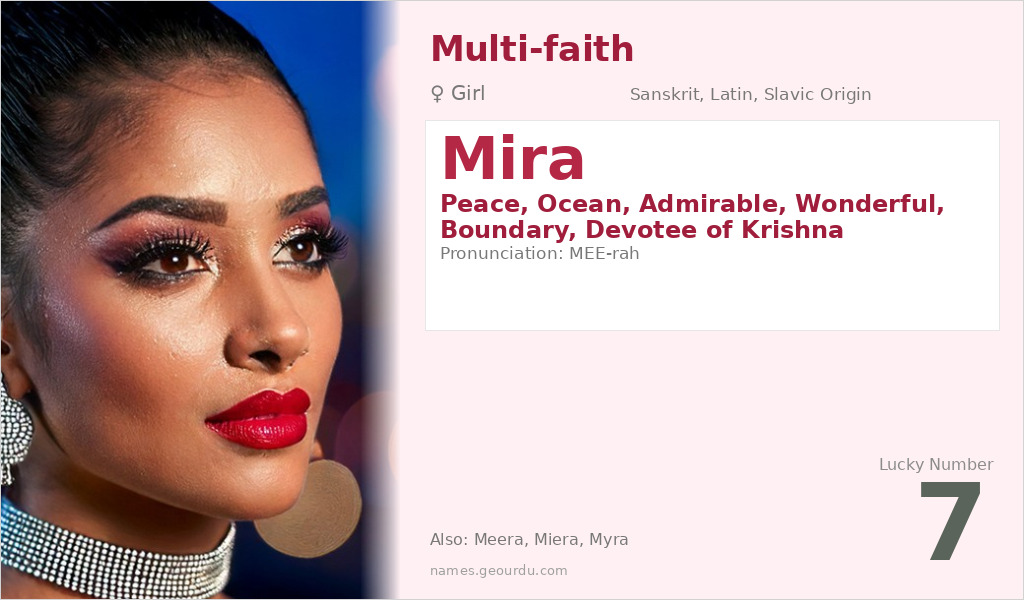
Mira is a beautifully multicultural name with roots spanning continents and centuries. From the Sanskrit word for ‘ocean’ to the Latin term for ‘wonderful’, this name carries layers of meaning that have made it beloved across cultures. Whether inspired by Hindu devotion, Slavic peace, or classical admiration, Mira offers timeless elegance with global appeal.
Meaning of Mira
The name Mira derives from three primary linguistic sources, each with distinct meanings. In Sanskrit, मीरा (Mīrā) comes from the root ‘mīr’ meaning ‘boundary, limit’, evolving to signify ‘ocean’ or ‘sea’ as the earth’s boundary. From Latin, ‘mira’ is the feminine form of ‘mirus’ meaning ‘wonderful, astonishing, admirable’, related to ‘miracle’. In Slavic languages, particularly Serbian, Croatian, and Slovenian, Mira is a short form of names containing the element ‘mir’ meaning ‘peace’. The name gained particular significance in India through the 16th-century poet-saint Mirabai, whose devotion to Krishna added ‘devotee of Krishna’ as an associated meaning, though this is cultural rather than etymological.
| 📛 Name | Mira |
| 💎 Meaning | Peace, Ocean, Admirable, Wonderful, Boundary, Devotee of Krishna |
| 👤 Gender | Girl |
| 🕌 Religion | Multi-faith |
| 🌍 Origin | Sanskrit, Latin, Slavic |
| 🗣 Pronunciation | MEE-rah |
| ✍️ Urdu | میرا |
| ✍️ Arabic | ميرا |
| 🔢 Numerology | 7 |
| ✨ Spellings | Meera, Miera, Myra |
Origin & Cultural Significance
Mira’s origins are truly cross-cultural, appearing independently in different language families. The Sanskrit version has been used in India for millennia, with literary references dating back centuries. The Latin form entered European languages through Roman influence and Christian tradition. The Slavic version developed from Proto-Slavic ‘mirŭ’ meaning ‘peace, world’, becoming popular across Eastern Europe. The name’s global spread accelerated in the 20th century through cultural exchange, with notable bearers like Mirabai in Indian history and Mira Sorvino in contemporary Western culture. Today, it’s considered a multicultural name rather than belonging to any single tradition.
Personality Traits
Those named Mira often exhibit a blend of the qualities associated with the name’s various meanings. The Sanskrit ‘ocean’ suggests depth and mystery, while the Latin ‘wonderful’ implies creativity and admiration. The Slavic ‘peace’ contributes a harmonious, diplomatic nature. Many Miras are drawn to artistic or spiritual pursuits, with strong intuitive abilities and a compassionate outlook. Their multicultural origins often translate into adaptability and openness to different perspectives.
Similar Names
If you like Mira, consider: Maya, Mina, Mirabelle, Miriam, Mirella
Famous People Named Mira
- Mirabai — 16th-century Hindu mystic poet and devotee of Krishna from Rajasthan, India
- Mira Sorvino — American actress and human rights activist
Frequently Asked Questions About Mira
What does Mira mean?
Mira has multiple meanings: 'ocean, sea, boundary' in Sanskrit, 'wonderful, admirable' in Latin, and 'peace' in Slavic languages. It's also associated with devotion to Krishna through the poet Mirabai.
Is Mira a boy or girl name?
Mira is primarily a feminine name across all its cultural origins, though some Slavic diminutives may be used for males. In contemporary usage, it's overwhelmingly feminine.
What is the origin of Mira?
Mira has three independent origins: Sanskrit (Indian), Latin (Roman/European), and Slavic (Eastern European). It's a true multicultural name rather than originating from a single source.