Table of Contents
Mohaddisa is a beautiful and meaningful Arabic name for girls that carries deep religious and academic significance in Islamic tradition. Unlike common names, Mohaddisa specifically denotes a female scholar specializing in Hadith sciences – the preservation and study of Prophet Muhammad’s teachings. This name represents a connection to Islamic scholarship and intellectual heritage, making it a powerful choice for parents valuing knowledge and tradition. With its elegant sound and profound meaning, Mohaddisa stands out as both culturally rich and spiritually significant.
Meaning of Mohaddisa
Mohaddisa derives from the Arabic root ‘ḥ-d-th’ (حدث), which encompasses meanings related to occurrence, narration, and events. Specifically, it is the feminine form of ‘Muhaddith’ (محدث), a term reserved for scholars who have mastered the science of Hadith. In Islamic tradition, a Muhaddith/Mohaddisa is not merely a storyteller but an expert who has studied the chains of transmission (isnad), verified the authenticity of narrations, and understood the context and application of Prophetic traditions. The name therefore signifies a woman of profound religious knowledge, intellectual rigor, and scholarly authority. This distinguishes it from general narrative terms and places it within the specialized vocabulary of Islamic sciences.
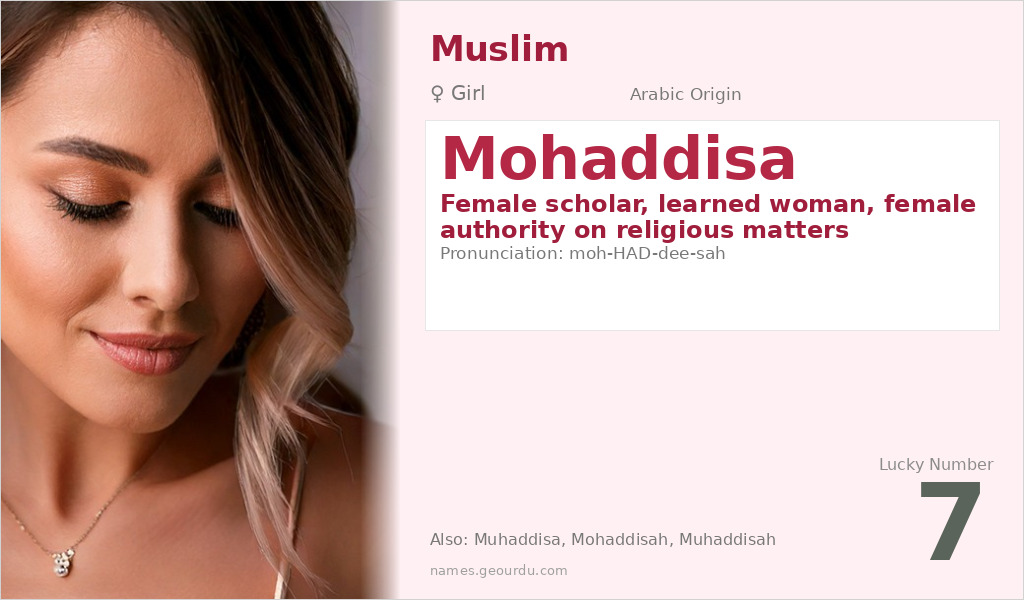
| 📛 Name | Mohaddisa |
| 💎 Meaning | Female scholar, learned woman, female authority on religious matters |
| 👤 Gender | Girl |
| 🕌 Religion | Muslim |
| 🌍 Origin | Arabic |
| 🗣 Pronunciation | moh-HAD-dee-sah |
| ✍️ Urdu | محدثہ |
| ✍️ Arabic | مُحَدِّثَة |
| 🔢 Numerology | 7 |
| ✨ Spellings | Muhaddisa, Mohaddisah, Muhaddisah, Muhadisa |
Origin & Cultural Significance
Mohaddisa originates from classical Arabic and Islamic scholarly tradition, emerging as a title and later a given name within Muslim communities, particularly in South Asia and the Middle East. The name gained prominence during the golden age of Islamic scholarship when women scholars played significant roles in Hadith transmission. Historical records show women scholars being referred to as ‘Mohaddisa’ as an honorific title for their expertise. In contemporary usage, particularly in Pakistan, India, Bangladesh, and Arab countries, it has transitioned to a given name while retaining its scholarly connotations. The name reflects the Islamic tradition of valuing female education and religious scholarship, challenging stereotypes about women’s roles in traditional religious learning.
Personality Traits
A person named Mohaddisa is often associated with intellectual depth, moral integrity, and a commitment to truth. These individuals typically exhibit strong analytical abilities, attention to detail, and respect for tradition while maintaining critical thinking skills. They may naturally gravitate toward educational, religious, or research-oriented pursuits where their love for knowledge and precision can flourish. Their name suggests someone who values authenticity, has strong principles, and serves as a reliable source of wisdom in their community.
Similar Names
If you like Mohaddisa, consider: Muhaddith, Hadith, Hadees, Muhsina, Muhsinaat, Alima, Fatima, Aisha, Zainab
Famous People Named Mohaddisa
- Mohaddisa-e-Kashmir – A 19th century female Islamic scholar from Kashmir known for her knowledge of Hadith
- Contemporary scholars and educators in Islamic studies who use this title professionally
Frequently Asked Questions About Mohaddisa
What does Mohaddisa mean?
Mohaddisa means 'female Hadith scholar' or 'learned woman in Islamic traditions' in Arabic. It specifically refers to a woman who specializes in the science of Hadith (Prophetic traditions), not a general storyteller.
Is Mohaddisa a boy or girl name?
Mohaddisa is exclusively a girl's name. The '-a' ending in Arabic explicitly marks it as feminine, making it the female counterpart to the masculine 'Muhaddith.'
What is the origin of Mohaddisa?
Mohaddisa originates from classical Arabic and Islamic scholarly tradition. It comes from the root 'ḥ-d-th' and specifically developed within the context of Islamic religious scholarship as a title for female experts in Hadith sciences.