Table of Contents
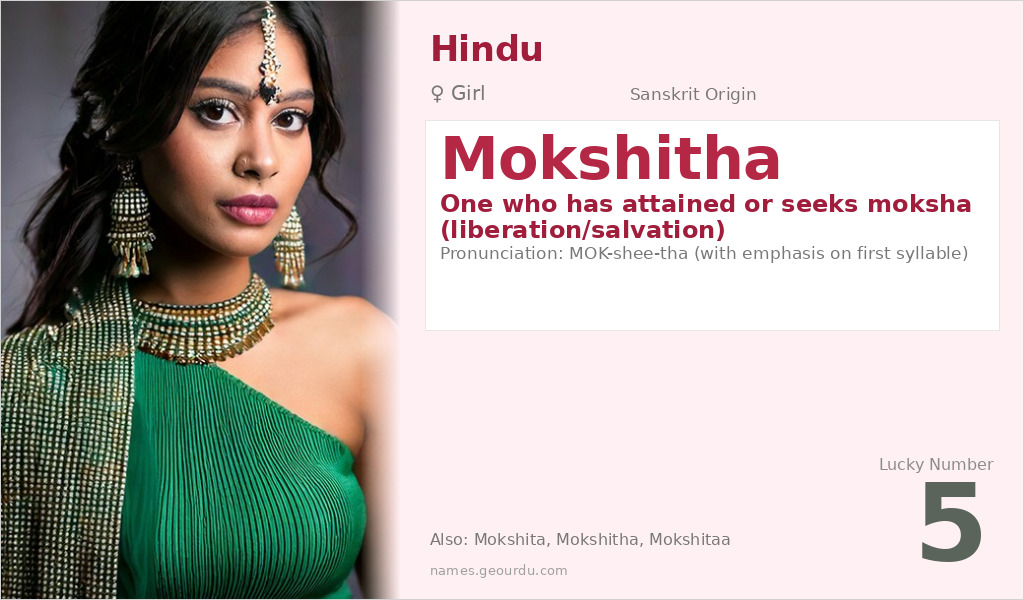
Mokshitha is a beautiful and spiritually significant name of Sanskrit origin, predominantly used for girls in Hindu communities. Meaning ‘one who has attained or seeks moksha (liberation),’ this name carries profound philosophical weight in Hindu tradition. With its roots in ancient Indian spirituality, Mokshitha represents the ultimate goal of human existence according to Hindu philosophy. The name has gained popularity in modern India while maintaining its deep cultural and religious connections.
Meaning of Mokshitha
Mokshitha derives from the Sanskrit word ‘moksha’ (मोक्ष), which refers to liberation, salvation, or release from the cycle of rebirth (samsara) in Hindu, Jain, and Buddhist traditions. The suffix ‘-itha’ (इथा) functions as a feminine agent suffix in Sanskrit grammar, creating a name that literally means ‘she who has attained moksha’ or ‘she who seeks moksha.’ This construction follows common Sanskrit naming patterns where abstract concepts become personal names through suffixation. The name embodies one of the four purusharthas (human goals) in Hinduism—moksha being the ultimate spiritual aim. While the exact name ‘Mokshitha’ appears more frequently in contemporary usage, its components have ancient textual references in Upanishads and other philosophical works.
| 📛 Name | Mokshitha |
| 💎 Meaning | One who has attained or seeks moksha (liberation/salvation) |
| 👤 Gender | Girl |
| 🕌 Religion | Hindu |
| 🌍 Origin | Sanskrit |
| 🗣 Pronunciation | MOK-shee-tha (with emphasis on first syllable) |
| ✍️ Urdu | موکشیتھا |
| ✍️ Arabic | موكشيثا |
| 🔢 Numerology | 5 |
| ✨ Spellings | Mokshita, Mokshitha, Mokshitaa, Mokshithaa |
Origin & Cultural Significance
Mokshitha originates from classical Sanskrit, the liturgical language of Hinduism, Buddhism, and Jainism. The concept of moksha dates back to the Upanishads (800-200 BCE) where it was established as the ultimate spiritual goal. While the specific name ‘Mokshitha’ isn’t found in the most ancient scriptures, its root ‘moksha’ appears extensively in Hindu philosophical texts. The name gained popularity in South India, particularly in Telugu and Kannada-speaking regions, before spreading throughout India. It represents a modern revival of Sanskrit names that carry deep spiritual meaning, reflecting contemporary Hindu parents’ desire to connect their children with traditional values while choosing phonetically appealing names.
Personality Traits
Those named Mokshitha are often perceived as spiritually aware individuals with a natural inclination toward philosophical contemplation. They typically value independence, personal freedom, and intellectual exploration. The numerological association with number 5 suggests they may be adaptable, communicative, and enthusiastic about new experiences. Their name’s meaning often influences their outlook, making them seekers of deeper truths and meaningful connections in life.
Similar Names
If you like Mokshitha, consider: Moksha, Mokshini, Mokshada, Mukti, Muktika
Famous People Named Mokshitha
- Mokshitha — Indian actress known for Telugu television series
- Mokshitha B — Indian playback singer in Kannada cinema
Frequently Asked Questions About Mokshitha
What does Mokshitha mean?
Mokshitha means 'one who has attained or seeks moksha'—referring to liberation from the cycle of rebirth in Hindu philosophy. It originates from Sanskrit, combining 'moksha' (liberation) with the feminine suffix '-itha.'
Is Mokshitha a boy or girl name?
Mokshitha is exclusively a feminine name in Hindu naming tradition. The '-itha' suffix is specifically feminine in Sanskrit grammar, making this a girl's name across all regions where it's used.
What is the origin of Mokshitha?
Mokshitha originates from classical Sanskrit, the ancient liturgical language of India. It's a modern compound name built from the philosophical term 'moksha' (liberation) with a feminine suffix, primarily used in Hindu communities across India.