Table of Contents
Mona is a beautifully versatile name that crosses cultural and linguistic boundaries with grace. From the Gaelic hills of Ireland to the Arabic-speaking world and beyond, this name carries different but equally meaningful interpretations. Whether you’re drawn to its noble Gaelic roots, its aspirational Arabic meaning, or its unique Latin origin, Mona offers a name rich with history and character.
Meaning of Mona
The name Mona derives from several distinct linguistic traditions, each contributing unique meanings. In Arabic, Mona (منى, Munā) comes from the root م ن ي (m-n-y) meaning ‘to wish’ or ‘to desire,’ giving it the meaning of ‘wishes’ or ‘aspirations.’ In Irish and Scottish Gaelic, it originates from Muadhnait, a diminutive of muadh meaning ‘noble’ or ‘good.’ From Latin, ‘mona’ means ‘solitary’ or ‘unique,’ while in Italian it’s often a short form of Simona, meaning ‘God has heard’ from Hebrew origins. The Old English variant relates to ‘moon,’ adding celestial connotations. This multi-origin nature makes Mona particularly rich in semantic depth.
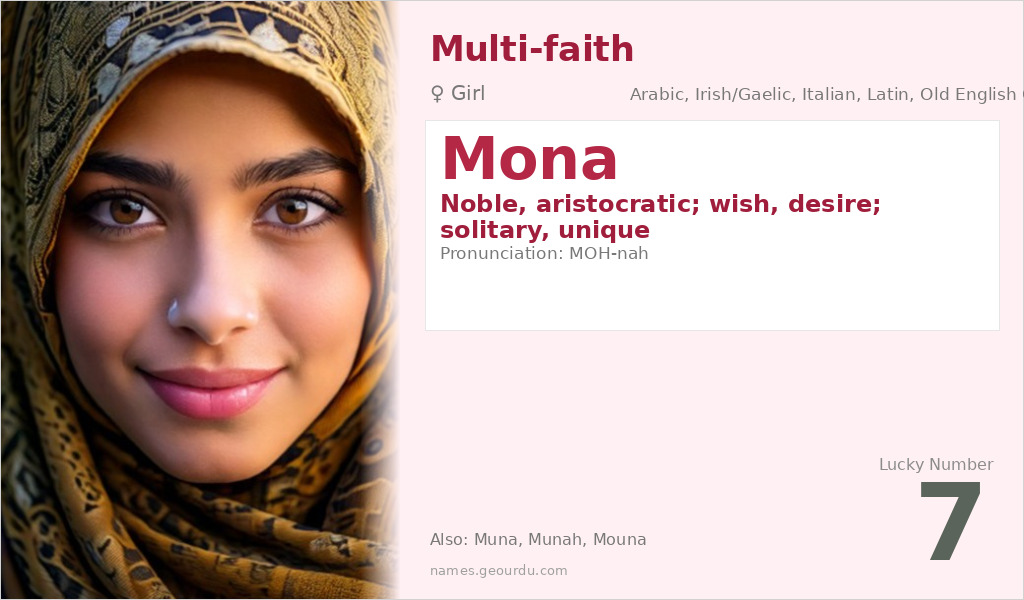
| 📛 Name | Mona |
| 💎 Meaning | Noble, aristocratic; wish, desire; solitary, unique |
| 👤 Gender | Girl |
| 🕌 Religion | Multi-faith |
| 🌍 Origin | Arabic, Irish/Gaelic, Italian, Latin, Old English |
| 🗣 Pronunciation | MOH-nah |
| ✍️ Urdu | مونا |
| ✍️ Arabic | منى |
| 🔢 Numerology | 7 |
| ✨ Spellings | Muna, Munah, Mouna, Monah |
Origin & Cultural Significance
Mona’s origins span multiple continents and historical periods. The Arabic version has been used for centuries across the Middle East and Muslim world, often given to express parents’ hopes for their child. The Gaelic version dates back to medieval Ireland and Scotland, where it was borne by noblewomen. The Italian/Latin version gained popularity during the Renaissance, most famously associated with Leonardo da Vinci’s Mona Lisa. In the 20th century, the name spread globally through literature, film, and migration, becoming popular in India, Europe, and the Americas. Today, it’s truly international, appearing in Muslim, Christian, Hindu, and secular contexts.
Personality Traits
Those named Mona often exhibit a blend of the qualities suggested by the name’s various meanings. They may combine the nobility and grace of the Gaelic interpretation with the aspirational nature of the Arabic meaning. Typically independent and self-contained (reflecting the Latin ‘solitary’), they’re often creative, intuitive individuals who march to their own rhythm. While sometimes reserved, they possess deep emotional reservoirs and strong convictions about their path in life.
Similar Names
If you like Mona, consider: Muna, Mona Lisa, Simona, Ramona, Fiona
Famous People Named Mona
- Mona Lisa — legendary subject of Leonardo da Vinci's painting, name means 'My Lady Lisa' in Italian
- Mona Singh — Indian actress known for TV show 'Jassi Jaissi Koi Nahin'
Frequently Asked Questions About Mona
What does Mona mean?
Mona has multiple meanings depending on origin: 'noble' in Gaelic, 'wishes/desires' in Arabic, and 'solitary/unique' in Latin. It can also mean 'moon' in Old English.
Is Mona a boy or girl name?
Mona is predominantly a feminine name across all its cultural origins, though rare masculine usage exists in some regions.
What is the origin of Mona?
Mona has multiple origins: Arabic (منى), Irish/Scottish Gaelic (Muadhnait), Italian/Latin (from Simona or 'mona'), and Old English. It's truly multi-cultural.