
Table of Contents
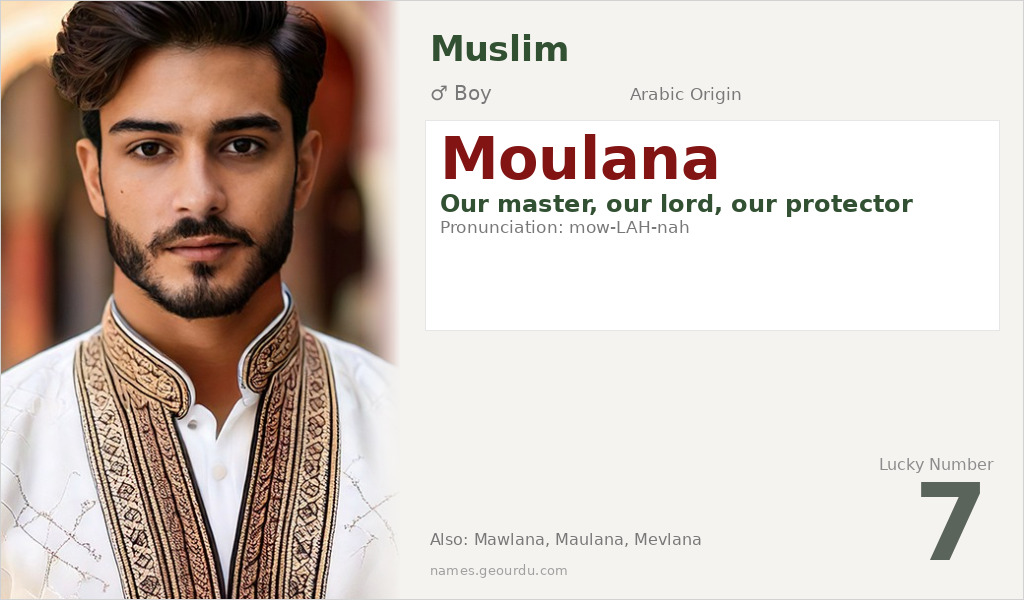
Moulana is a name rich in history and spiritual significance, originating from the Arabic language and widely used across Muslim cultures. Often bestowed upon boys, it carries the profound meaning of ‘Our master’ or ‘Our lord,’ reflecting respect and reverence. This name is most famously associated with the legendary poet and Sufi saint Rumi, whose title ‘Mawlānā’ has inspired generations. Exploring Moulana reveals a legacy of leadership, wisdom, and Islamic heritage that continues to resonate today.
Meaning of Moulana
Moulana derives from the Arabic term ‘Mawlānā’ (مولانا), which is a combination of ‘Mawlā’ meaning ‘master, lord, or protector’ and the suffix ‘-nā’ indicating ‘our.’ The root word ‘Mawlā’ comes from the Arabic triliteral root W-L-Y (و ل ي), associated with concepts of proximity, guardianship, and authority. In linguistic terms, ‘Mawlānā’ is an honorific that literally translates to ‘our master,’ often used to address religious scholars, saints, and leaders in Islamic contexts. This name emphasizes a communal bond, suggesting a figure who is both near and protective of their people. Its usage spans centuries, particularly in Persian, Turkish, Urdu, and other languages influenced by Arabic, where it retains this core meaning of revered leadership.
| 📛 Name | Moulana |
| 💎 Meaning | Our master, our lord, our protector |
| 👤 Gender | Boy |
| 🕌 Religion | Muslim |
| 🌍 Origin | Arabic |
| 🗣 Pronunciation | mow-LAH-nah |
| ✍️ Urdu | مولانا |
| ✍️ Arabic | مولانا |
| 🔢 Numerology | 7 |
| ✨ Spellings | Mawlana, Maulana, Mevlana, Molana |
Origin & Cultural Significance
Moulana has its origins in classical Arabic, emerging as a title of respect within early Islamic societies. It gained prominence in the medieval period through figures like Jalāl ad-Dīn Rūmī, the 13th-century Persian poet whose followers referred to him as ‘Mawlānā,’ cementing the name’s association with Sufism and spiritual guidance. Culturally, it spread across South Asia, the Middle East, and beyond via Islamic scholarship and diaspora communities, becoming a common given name in countries like India, Pakistan, Bangladesh, and Turkey. In modern times, Moulana is used both as a personal name and an honorific for Islamic clerics, reflecting its enduring role in Muslim identity and tradition. Its adaptation into various spellings, such as ‘Maulana’ in Urdu and ‘Mevlana’ in Turkish, showcases its linguistic flexibility while maintaining its original essence.
Personality Traits
Those named Moulana are often seen as natural leaders with a calm, authoritative presence that draws others to them for advice and support. They tend to value knowledge, spirituality, and community, embodying traits of wisdom, protection, and integrity. This name suggests a personality that is both reflective and action-oriented, capable of guiding others through challenges with a sense of purpose and compassion.
Similar Names
If you like Moulana, consider: Mawlood, Mawlid, Mawla, Moulay, Mouloud
Famous People Named Moulana
- Mawlānā Rūmī — 13th-century Persian poet, Islamic scholar, and Sufi mystic whose works like the Masnavi are celebrated worldwide
- Mawlānā Abul Kalam Azad — Indian scholar, Islamic theologian, and independence activist who served as India's first Minister of Education
Frequently Asked Questions About Moulana
What does Moulana mean?
Moulana means 'Our master,' 'Our lord,' or 'Our protector,' derived from the Arabic phrase 'Mawlānā,' which combines 'Mawlā' (master) with the possessive suffix '-nā' (our).
Is Moulana a boy or girl name?
Moulana is traditionally a boy's name, used primarily in Muslim cultures as a masculine given name or honorific title for male religious leaders and scholars.
What is the origin of Moulana?
Moulana originates from Arabic, with deep roots in Islamic tradition. It has been widely adopted in languages like Persian, Urdu, and Turkish, often associated with historical figures such as the poet Rumi.





