
Table of Contents
Muhallul is a distinctive Arabic name with deep religious connotations that resonate within Muslim communities worldwide. Derived from the same linguistic root as the important Islamic concept of ‘ḥalāl’, this name carries meanings of permissibility, lawfulness, and divine allowance. While not among the most common Arabic names, Muhallul holds special significance for families seeking names with clear Islamic theological foundations. Its grammatical structure as a passive participle gives it a unique linguistic character among Arabic names.
Meaning of Muhallul
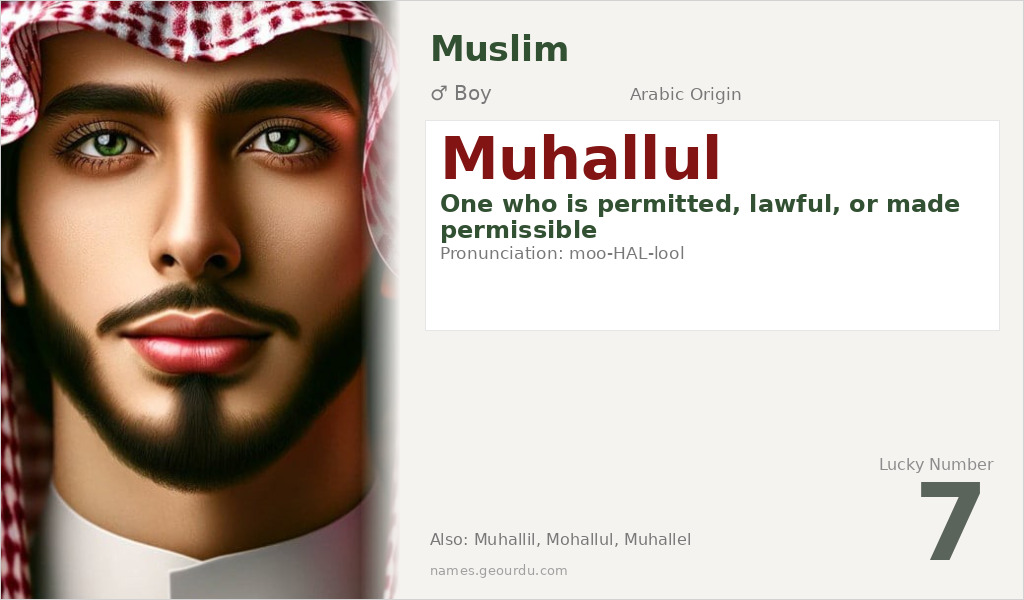
Muhallul is an Arabic name with the precise meaning of ‘one who is permitted, lawful, or made permissible’. It originates from the trilateral root ḥ-l-l (ح-ل-ل), which forms the basis for numerous words related to solving, untying, and making things allowable. The name is specifically the passive participle (ism mafʿūl) of the Form II verb ‘ḥallala’, meaning ‘to make lawful or permissible’. This places Muhallul in the category of names that describe a state or condition—in this case, being in a state of religious permissibility. The connection to ‘ḥalāl’ gives the name significant Islamic theological weight, as ḥalāl represents what is allowed according to Islamic law. Unlike active participle names that describe doers of actions, Muhallul describes someone upon whom an action has been performed—specifically, being made permissible or lawful.
| 📛 Name | Muhallul |
| 💎 Meaning | One who is permitted, lawful, or made permissible |
| 👤 Gender | Boy |
| 🕌 Religion | Muslim |
| 🌍 Origin | Arabic |
| 🗣 Pronunciation | moo-HAL-lool |
| ✍️ Urdu | محلل |
| ✍️ Arabic | مُحَلَّل |
| 🔢 Numerology | 7 |
| ✨ Spellings | Muhallil, Mohallul, Muhallel |
Origin & Cultural Significance
Muhallul originates from Classical Arabic and is primarily used within Muslim communities, particularly in Arabic-speaking regions and among Muslims in South Asia. The name’s formation follows standard Arabic morphological patterns for creating passive participles from verbal roots. While not mentioned in the Quran specifically, its connection to the concept of ḥalāl gives it religious significance in Islamic naming traditions. The name appears occasionally in historical Islamic texts and records, though it has never been among the most popular Arabic names. Its usage reflects the Islamic practice of choosing names with positive meanings and religious connotations, particularly those related to divine attributes, permissible actions, or desirable states of being.
Personality Traits
The name Muhallul suggests personality traits aligned with lawfulness, principle, and structured thinking. Those bearing this name are often perceived as individuals who operate within clear boundaries and ethical frameworks. The linguistic connection to concepts of permissibility and solution-finding implies a personality that seeks clarity and lawful approaches to life’s challenges. While the name doesn’t dictate personality, its meaning culturally associates with someone who values religious or ethical guidelines and approaches decisions with consideration of what is permitted and appropriate.
Similar Names
If you like Muhallul, consider: Halil, Halim, Mahmud, Muhsin, Muhammad
Famous People Named Muhallul
- No widely known historical or contemporary figures with this exact name have been documented in reliable sources
Frequently Asked Questions About Muhallul
What does Muhallul mean?
Muhallul means 'one who is permitted, lawful, or made permissible' in Arabic. It comes from the same root as 'ḥalāl' and is the passive participle form meaning someone upon whom permissibility has been conferred.
Is Muhallul a boy or girl name?
Muhallul is exclusively a boy's name in Arabic naming tradition. The grammatical structure and usage throughout history confirm its masculine gender assignment.
What is the origin of Muhallul?
Muhallul originates from Classical Arabic, specifically from the trilateral root ḥ-l-l. It is primarily used in Muslim communities and has religious significance due to its connection with Islamic concepts of lawfulness and permissibility.





