
Table of Contents
Muizzawi is a distinctive and uncommon name that carries an air of nobility and respect. While not widely documented in mainstream naming references, it appears to have roots in Arabic linguistic traditions, potentially adapted through regional languages. This name evokes qualities of honor and strength, making it a meaningful choice for parents seeking a name with dignified connotations. Exploring Muizzawi reveals the fascinating ways names evolve across cultures and languages.
Meaning of Muizzawi
The name Muizzawi derives from the Arabic triliteral root ‘عزز’ (ʿ-z-z), which conveys concepts of strength, power, honor, and glory. This root gives us words like ‘izza’ (عزة) meaning ‘glory, honor’ and ‘aziz’ (عزيز) meaning ‘dear, precious, powerful’. The suffix ‘-awi’ is a common Arabic morphological pattern used to form adjectives or nouns indicating association or belonging, similar to ‘-i’ in Persian or ‘-ite’ in English. While ‘Mu’izz’ (معز) is a well-established Arabic name meaning ‘honorer’ or ‘one who grants honor’ (and is one of the 99 Names of Allah), ‘Muizzawi’ appears to be an extended or regional variant. The exact meaning remains uncertain as it doesn’t appear in classical Arabic dictionaries, suggesting it may be a modern creation or adaptation in languages like Pashto, Balochi, or Urdu where Arabic elements are frequently incorporated.
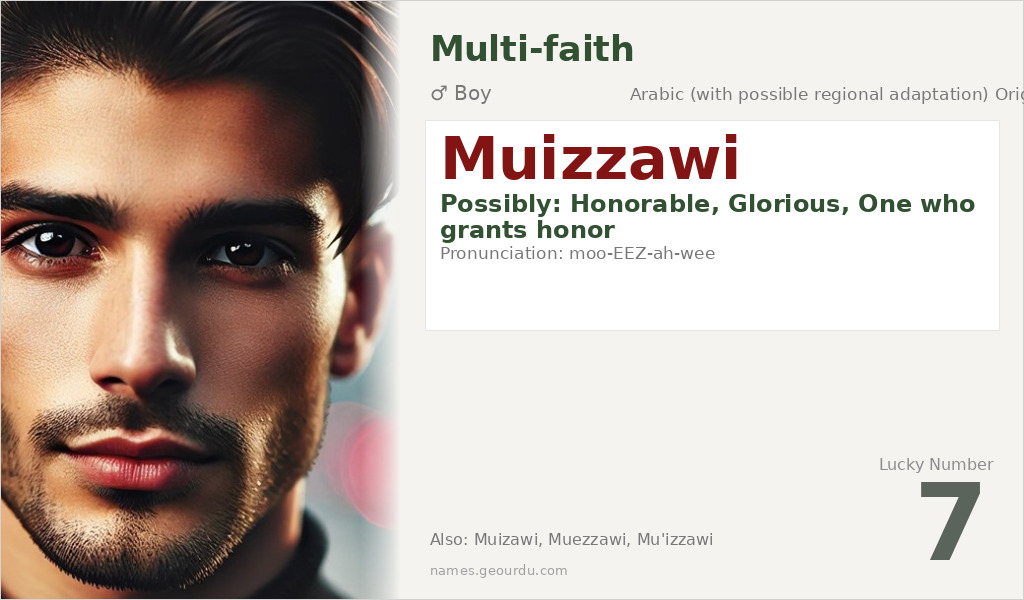
| 📛 Name | Muizzawi |
| 💎 Meaning | Possibly: Honorable, Glorious, One who grants honor |
| 👤 Gender | Boy |
| 🕌 Religion | Multi-faith |
| 🌍 Origin | Arabic (with possible regional adaptation) |
| 🗣 Pronunciation | moo-EEZ-ah-wee |
| ✍️ Urdu | معزوی |
| ✍️ Arabic | معزوي |
| 🔢 Numerology | 7 |
| ✨ Spellings | Muizawi, Muezzawi, Mu'izzawi, Muezzavi |
Origin & Cultural Significance
Muizzawi originates from Arabic linguistic elements, though its exact cultural provenance is unclear. Arabic-derived names are commonly used across the Muslim world and beyond, including in Persian, Urdu, Pashto, Balochi, Turkish, and other languages that have incorporated Arabic vocabulary through Islamic cultural exchange. The ‘-awi’ suffix is particularly common in names from regions like Afghanistan, Pakistan, and Iran, where it often indicates tribal or geographical affiliation. This suggests Muizzawi might have emerged in these contexts as a name emphasizing honorable qualities. Unlike many Arabic names that have centuries of documented usage, Muizzawi appears to be relatively rare or modern, possibly created by combining the root ‘عزز’ with the productive ‘-awi’ suffix to form a unique name with traditional resonance.
Personality Traits
Those named Muizzawi are often associated with characteristics of dignity, respectability, and inner strength. The name’s linguistic roots suggest someone who values honor and integrity, potentially displaying leadership qualities and a commanding presence. In social settings, they might be seen as reliable and authoritative figures who earn respect through their consistent actions and principled approach to life. While these traits are culturally attributed rather than scientifically determined, they reflect the aspirational qualities embedded in the name’s etymology.
Similar Names
If you like Muizzawi, consider: Muizz, Muiz, Aziz, Izzat, Mueen, Muzzammil, Muzammil, Muzzamil, Muezzin, Muzaffar
Famous People Named Muizzawi
- No verified famous individuals with this exact name found in historical or contemporary records
Frequently Asked Questions About Muizzawi
What does Muizzawi mean?
Muizzawi possibly means 'Honorable', 'Glorious', or 'One who grants honor', derived from the Arabic root 'عزز' (ʿ-z-z) meaning strength and honor, though this meaning is not definitively verified in established sources.
Is Muizzawi a boy or girl name?
Muizzawi is exclusively used as a boy's name, consistent with Arabic naming patterns where names with '-awi' suffixes are typically masculine.
What is the origin of Muizzawi?
Muizzawi has Arabic linguistic roots, specifically from the root 'عزز' with the suffix '-awi', but it may be a regional adaptation in languages like Pashto, Balochi, or Urdu rather than classical Arabic.





