
Table of Contents
Mukund is a profound Sanskrit name with rich spiritual significance in Hindu tradition. Meaning ‘one who liberates’ or ‘giver of salvation’, this name carries centuries of theological weight as an epithet for Lord Vishnu and Krishna. Popular among Hindu families, Mukund represents divine grace and spiritual freedom. Its beautiful meaning makes it a meaningful choice for parents seeking a name with deep philosophical roots.
Meaning of Mukund
Mukund originates from the Sanskrit language, combining ‘mukti’ (meaning liberation, salvation, or release from worldly bondage) with the suffix ‘-da’ (meaning giver or bestower). Thus, the name literally translates to ‘giver of liberation’ or ‘one who grants salvation’. In Hindu scriptures, particularly the Vishnu Sahasranama (the thousand names of Vishnu), Mukund appears as a significant epithet describing Vishnu’s role in freeing souls from the cycle of rebirth. The name is also prominently used in the Bhagavata Purana and other Vaishnavite texts to refer to Krishna’s compassionate nature toward devotees. This etymological construction follows classical Sanskrit patterns where divine attributes are formed through compound words describing specific qualities or functions.
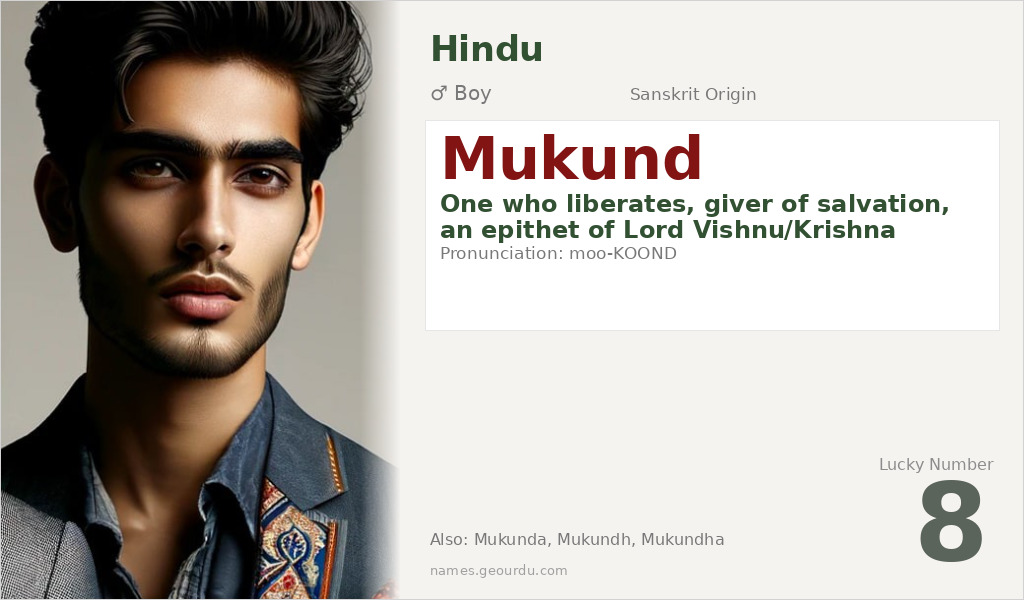
| 📛 Name | Mukund |
| 💎 Meaning | One who liberates, giver of salvation, an epithet of Lord Vishnu/Krishna meaning 'the deliverer from worldly bondage' |
| 👤 Gender | Boy |
| 🕌 Religion | Hindu |
| 🌍 Origin | Sanskrit |
| 🗣 Pronunciation | moo-KOOND |
| ✍️ Urdu | موکند |
| ✍️ Arabic | موكوند |
| 🔢 Numerology | 8 |
| ✨ Spellings | Mukunda, Mukundh, Mukundha |
Origin & Cultural Significance
Mukund has its origins in ancient Sanskrit literature and Hindu religious texts dating back over two millennia. As a theophoric name, it was originally used as an epithet for deities before becoming a given name for boys. The name is particularly significant in Vaishnavism, where it emphasizes Vishnu/Krishna’s role as the liberator who helps devotees achieve moksha (spiritual liberation). While primarily used in Hindu communities across India, the name has spread to Hindu diaspora communities worldwide. Unlike some names that have cross-cultural variations, Mukund remains distinctly rooted in Sanskrit and Hindu tradition without significant adoption or adaptation in other religious or linguistic contexts.
Personality Traits
Those named Mukund are often associated with qualities of guidance, compassion, and spiritual awareness. The name’s meaning as ‘liberator’ suggests personality traits centered around helping others overcome challenges and find better paths. In cultural perception, Mukunds are frequently seen as wise, protective figures who naturally assume leadership roles. These associations stem directly from the name’s theological origins and the divine qualities it represents in Hindu tradition.
Similar Names
If you like Mukund, consider: Madhav, Govind, Hari, Narayan, Vishnu
Famous People Named Mukund
- Mukund S. Sundar — Indian-American engineer and professor at University of Texas at Austin
- Mukund Padmanabhan — Indian journalist and former editor of The Hindu newspaper
Frequently Asked Questions About Mukund
What does Mukund mean?
Mukund means 'one who liberates' or 'giver of salvation' in Sanskrit. It's an epithet for Lord Vishnu and Krishna, referring to their role in freeing devotees from worldly bondage.
Is Mukund a boy or girl name?
Mukund is exclusively a boy name in Hindu naming tradition. It has masculine grammatical forms in Sanskrit and is used only for males in cultural practice.
What is the origin of Mukund?
Mukund originates from Sanskrit, the ancient classical language of India. It comes from Hindu religious texts where it appears as an epithet for deities, particularly Vishnu and Krishna.





