
Table of Contents
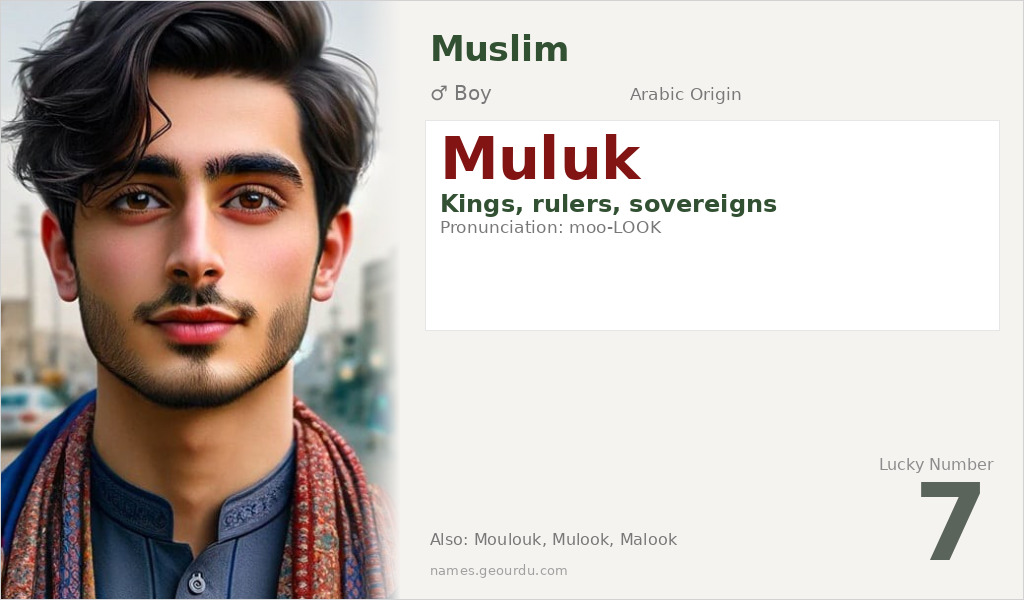
Muluk is a distinctive Arabic name that carries the weight of royalty and leadership. As the plural form of ‘malik’ (king), it evokes images of sovereignty and authority across Islamic history and literature. This name is traditionally given to boys in Muslim communities, symbolizing aspirations for strength and nobility. Its deep roots in Arabic language and culture make it a meaningful choice for parents seeking a name with historical resonance.
Meaning of Muluk
Muluk (ملوك) is an Arabic name meaning ‘kings’ or ‘rulers’, derived from the root M-L-K (م-ل-ك), which signifies possession, dominion, and control. This root appears in numerous Arabic words related to kingship, such as ‘mamlaka’ (kingdom) and ‘malik’ (king). Historically, ‘muluk’ was used to refer to monarchs in pre-Islamic and Islamic eras, including the Muluk al-Tawa’if (Party Kings) in medieval Spain. The name’s plural form emphasizes collective leadership or a lineage of rulers, distinguishing it from the singular ‘Malik’. In contemporary usage, it retains its regal connotations, often chosen to honor heritage and authority.
| 📛 Name | Muluk |
| 💎 Meaning | Kings, rulers, sovereigns |
| 👤 Gender | Boy |
| 🕌 Religion | Muslim |
| 🌍 Origin | Arabic |
| 🗣 Pronunciation | moo-LOOK |
| ✍️ Urdu | ملوک |
| ✍️ Arabic | ملوك |
| 🔢 Numerology | 7 |
| ✨ Spellings | Moulouk, Mulook, Malook, Mluk |
Origin & Cultural Significance
Originating from Classical Arabic, Muluk has been used for centuries across the Arab world and in Muslim-majority regions influenced by Arabic language and culture. It appears in historical texts, such as references to the Muluk Saba (Kings of Sheba) in Yemeni lore and accounts of various dynasties. The name’s usage spread through Islamic expansion, reaching South Asia, Southeast Asia, and Africa, where it is sometimes adapted into local languages. While primarily associated with Arabic, it is not commonly found in Persian, Pashto, or other regional languages as a native term, though it may be used due to Arabic’s religious and cultural influence. Its enduring popularity reflects the value placed on leadership and legacy in many societies.
Personality Traits
People named Muluk are often seen as authoritative and commanding, with a natural inclination toward leadership roles. They may exhibit traits such as confidence, determination, and a protective nature, inspired by their name’s royal meaning. In social interactions, they might be viewed as dignified and traditional, valuing honor and respect. These personality associations, while not scientifically proven, are commonly drawn from the name’s etymological and cultural background.
Similar Names
If you like Muluk, consider: Malik, Malek, Malak, Malika, Malcolm
Famous People Named Muluk
- Muluk al-Tawa'if — historical term for 'Party Kings' referring to petty rulers in Al-Andalus during the 11th century
- Muluk Saba — legendary pre-Islamic kings of Sheba (Saba) in Yemen mentioned in Arabic literature
Frequently Asked Questions About Muluk
What does Muluk mean?
Muluk means 'kings' or 'rulers' in Arabic, derived from the root M-L-K, which relates to ownership and sovereignty.
Is Muluk a boy or girl name?
Muluk is traditionally a boy's name in Arabic and Muslim cultures, reflecting masculine connotations of kingship and authority.
What is the origin of Muluk?
Muluk originates from Arabic, specifically as the plural form of 'malik' (king), with historical usage in Islamic and pre-Islamic contexts across the Middle East and beyond.





