Table of Contents
Munia is a beautiful, nature-inspired name that carries the gentle symbolism of birdsong and freedom. Derived from South Asian languages, this feminine name literally means ‘bird’, specifically referring to the delicate munia or finch species. While particularly popular in Urdu-speaking and Muslim communities, it transcends religious boundaries as a poetic choice celebrating the natural world. The name evokes images of grace, lightness, and melodic beauty.
Meaning of Munia
Munia originates from the Hindi and Urdu word ‘मुनिया’/’منیا’, which directly translates to ‘a small bird’, specifically the munia or finch species belonging to the Estrildidae family. Etymologically, it traces back to Sanskrit ‘मुनि’ (muni) meaning ‘sage’, ‘silent one’, or ‘ascetic’, combined with the diminutive suffix ‘-ia’ to create ‘little sage’ or ‘silent little one’. This metaphorical application to birds likely stems from observations of these quiet, small birds that move with contemplative grace. The name thus carries layered meanings of wisdom, silence, and delicate beauty, reflecting both the bird’s characteristics and the spiritual connotations of its Sanskrit root.
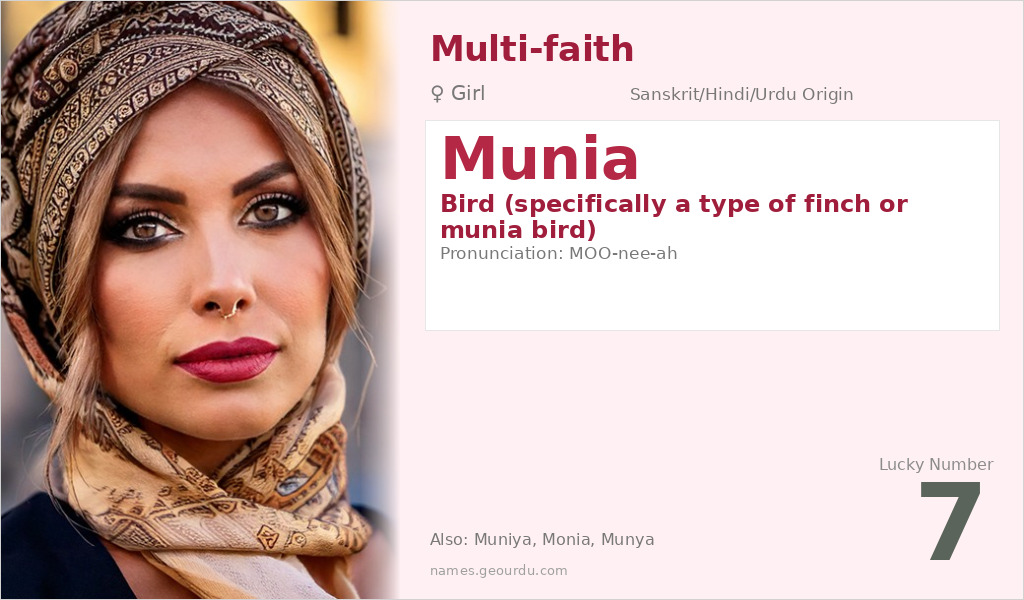
| 📛 Name | Munia |
| 💎 Meaning | Bird (specifically a type of finch or munia bird) |
| 👤 Gender | Girl |
| 🕌 Religion | Multi-faith |
| 🌍 Origin | Sanskrit/Hindi/Urdu |
| 🗣 Pronunciation | MOO-nee-ah |
| ✍️ Urdu | منیا |
| ✍️ Arabic | مونيا |
| 🔢 Numerology | 7 |
| ✨ Spellings | Muniya, Monia, Munya |
Origin & Cultural Significance
The name Munia has its roots in South Asian linguistic traditions, primarily emerging from the Sanskrit-Hindi-Urdu language continuum. While commonly used in Muslim communities across Pakistan, India, and Bangladesh, it’s not exclusively Islamic in origin or usage—it appears in Hindu contexts as well, particularly in Bengal and North India. The name gained popularity as part of a broader trend of nature-inspired names in South Asian naming traditions, where birds, flowers, and natural phenomena are frequently used for their poetic and symbolic value. Its cross-cultural appeal stems from its simple, melodic sound and universal association with birds, creatures celebrated in literature and folklore across the region.
Personality Traits
Those named Munia are often associated with qualities reminiscent of their avian namesake: freedom-loving yet loyal, observant yet gentle. They may possess an artistic or musical inclination, with a natural grace in their demeanor. The name suggests someone who values both independence and deep emotional connections, capable of quiet contemplation as well as joyful expression. Like the finch that adapts to various environments, individuals with this name often demonstrate resilience and versatility in different life circumstances.
Similar Names
If you like Munia, consider: Tota (parrot), Bulbul (nightingale), Koel (cuckoo bird), Chandni (moonlight), Gulab (rose)
Famous People Named Munia
- Munia Khan — Bangladeshi poet known for her romantic poetry in Bengali literature
- Munia — Character in Indian novelist Bankim Chandra Chattopadhyay's works
Frequently Asked Questions About Munia
What does Munia mean?
Munia means 'bird', specifically referring to the munia or finch species. It comes from Hindi/Urdu 'मुनिया'/'منیا' with Sanskrit roots meaning 'little sage' or 'silent one', metaphorically applied to these quiet birds.
Is Munia a boy or girl name?
Munia is primarily a feminine name in South Asian naming traditions, though its usage as a given name is almost exclusively for girls across cultures where it appears.
What is the origin of Munia?
Munia originates from Sanskrit through Hindi and Urdu languages. While popular in Muslim communities, it's a multi-faith name used across South Asia, with its literal meaning of 'bird' making it a nature-inspired choice.