
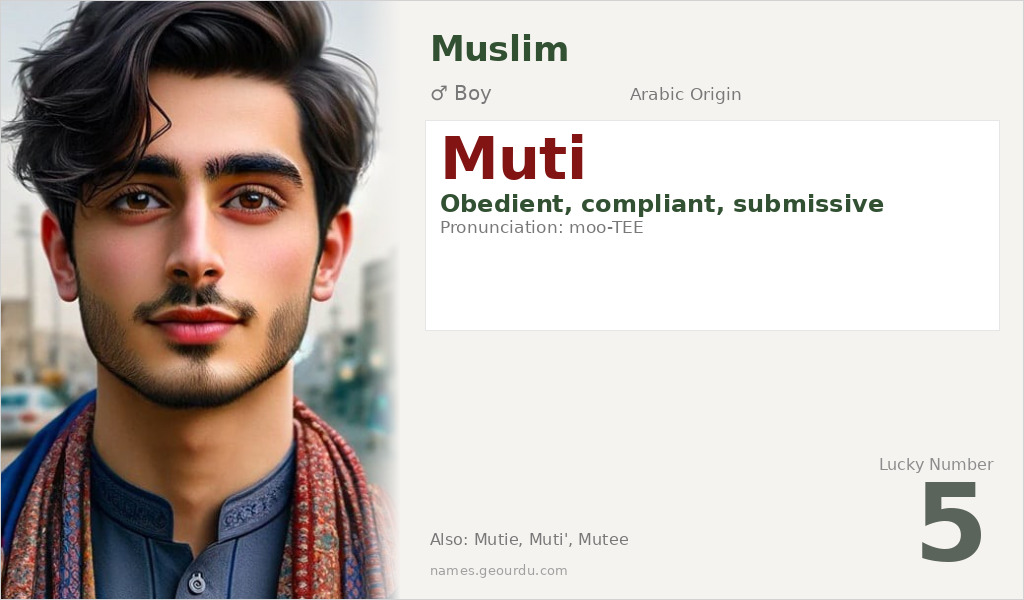
Table of Contents
Muti is a meaningful Arabic name for boys that carries deep religious significance in Islamic culture. Derived from the root meaning ‘to obey,’ this name reflects important virtues in Muslim tradition. While relatively uncommon globally, it maintains cultural relevance in Arabic-speaking communities and among Muslims worldwide. Understanding its linguistic roots provides insight into its enduring appeal.
Meaning of Muti
Muti originates from the classical Arabic word ‘مطيع’ (muṭīʿ), which is the active participle of the verb ‘يطيع’ (yuṭīʿ), meaning ‘he obeys.’ The trilateral root ‘ط و ع’ (ṭ-w-ʿ) forms the basis of obedience-related words in Arabic. This name specifically denotes ‘one who is obedient’ or ‘compliant,’ particularly in the context of religious devotion. In Islamic theology, obedience to Allah is a fundamental principle, making this name spiritually significant. The name appears in historical texts and is documented in authoritative Arabic dictionaries like Lisān al-ʿArab and modern naming references.
| 📛 Name | Muti |
| 💎 Meaning | Obedient, compliant, submissive |
| 👤 Gender | Boy |
| 🕌 Religion | Muslim |
| 🌍 Origin | Arabic |
| 🗣 Pronunciation | moo-TEE |
| ✍️ Urdu | مطیع |
| ✍️ Arabic | مطيع |
| 🔢 Numerology | 5 |
| ✨ Spellings | Mutie, Muti', Mutee, Mutii |
Origin & Cultural Significance
Muti has its origins in pre-Islamic and classical Arabic language, with the concept of obedience being important in Arab tribal society. With the advent of Islam, the name gained religious dimension as obedience to God became central to faith. The name is used primarily in Arabic-speaking countries and Muslim communities worldwide, though it’s less common than some other Arabic names with similar meanings. While sometimes confused with names from South Asian languages, Muti is distinctly Arabic in origin and not derived from Pashto, Balochi, or other regional languages despite phonetic similarities.
Personality Traits
The name Muti suggests personality traits aligned with its meaning of obedience. Those bearing this name are often associated with qualities like respectfulness, discipline, and cooperation. In cultural contexts, the name may imply someone who values harmony, follows guidance willingly, and maintains social and religious obligations. These characteristics reflect the virtuous connotations of obedience in Islamic ethics.
Similar Names
If you like Muti, consider: Mutaz, Mutahhar, Mutawakkil, Mutashim, Mutaman
Famous People Named Muti
- Muti Abdullah — Indonesian Islamic scholar and preacher
- Mutiara — Note: This is a different name meaning 'pearl' in Indonesian/Malay, sometimes confused with Muti
Frequently Asked Questions About Muti
What does Muti mean?
Muti means 'obedient' or 'compliant' in Arabic, derived from the root 'ط و ع' (ṭ-w-ʿ) meaning 'to obey.'
Is Muti a boy or girl name?
Muti is exclusively a boy's name in Arabic and Islamic naming traditions, as it's the masculine form of the adjective meaning 'obedient.'
What is the origin of Muti?
Muti originates from classical Arabic language and Islamic culture, with documented usage in Arabic dictionaries and historical texts.





