
Table of Contents
Naagraj is a powerful Sanskrit name that carries centuries of mythological significance in Hindu tradition. Meaning ‘King of Serpents’ or ‘Lord of Snakes’, this name evokes images of divine protection and cosmic balance. Often associated with Sheshnaag, the primordial serpent who supports the universe, Naagraj represents wisdom, eternity, and spiritual authority. This name continues to be chosen by parents seeking a name with deep cultural roots and majestic connotations.
Meaning of Naagraj
Naagraj is a classical Sanskrit compound name with precise etymological roots. The first component ‘Naag’ (नाग) specifically means ‘serpent’ or ‘snake’, derived from Proto-Indo-European *sneg- indicating crawling motion. The second component ‘Raj’ (राज) means ‘king’, ‘ruler’, or ‘lord’, originating from the Sanskrit verbal root rāj- meaning ‘to shine, to rule’. Together, they form ‘Naagraj’ (नागराज), literally translating to ‘King of Serpents’. In Hindu scriptures, this is primarily an epithet for Sheshnaag (also called Ananta), the thousand-headed serpent who serves as Vishnu’s couch and symbolizes the endless cosmic cycles. The name appears in texts like the Mahabharata where serpent kings (nāgarājas) rule the underworld kingdom of Patala.
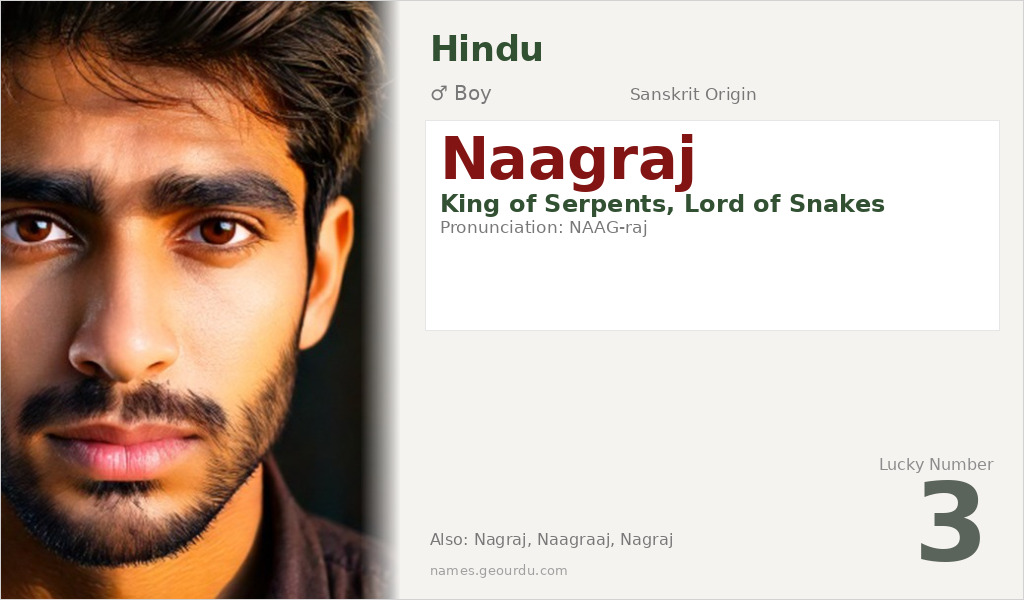
| 📛 Name | Naagraj |
| 💎 Meaning | King of Serpents, Lord of Snakes |
| 👤 Gender | Boy |
| 🕌 Religion | Hindu |
| 🌍 Origin | Sanskrit |
| 🗣 Pronunciation | NAAG-raj |
| ✍️ Urdu | ناگراج |
| ✍️ Arabic | ناجراج |
| 🔢 Numerology | 3 |
| ✨ Spellings | Nagraj, Naagraaj, Nagraj |
Origin & Cultural Significance
Naagraj originates from ancient Sanskrit literature and Hindu mythology, with its earliest documented usage in Vedic and Puranic texts. The concept of Nāgarāja (serpent kings) is deeply embedded in Hindu, Buddhist, and Jain traditions across South Asia. In Hindu cosmology, serpent deities (nāgas) are considered semi-divine beings associated with water, fertility, and protection. The most prominent Naagraj is Sheshnaag, who is depicted as supporting the earth and serving as Vishnu’s resting place. This name reflects the cultural reverence for snakes in Indian tradition, where they are seen as protectors rather than threats. The name remains popular in Hindu communities across India, Nepal, and the diaspora, maintaining its mythological connections while adapting to modern naming practices.
Personality Traits
Those named Naagraj are often associated with protective, transformative, and wise characteristics. Drawing from the serpent symbolism in Hindu tradition, they may exhibit qualities of regeneration, intuition, and hidden knowledge. The ‘king’ component suggests natural leadership abilities and a commanding presence, while the serpent aspect indicates adaptability and spiritual depth. In social contexts, Naagrajs might be seen as guardians of tradition with an innate understanding of life’s cyclical nature.
Similar Names
If you like Naagraj, consider: Shesh, Vasuki, Takshak, Ananta, Karkotak
Famous People Named Naagraj
- Nagraj — Indian comic book superhero character created by Raj Comics, known as the 'serpent king' with shape-shifting abilities
- Nagraj Manjule — Indian film director and actor, though his first name is actually 'Nagraj' without the compound form
Frequently Asked Questions About Naagraj
What does Naagraj mean?
Naagraj means 'King of Serpents' or 'Lord of Snakes'. It's a Sanskrit compound name: 'Naag' (serpent) + 'Raj' (king).
Is Naagraj a boy or girl name?
Naagraj is exclusively a masculine name in Hindu naming tradition, derived from mythological male serpent deities and kings.
What is the origin of Naagraj?
Naagraj originates from Sanskrit and Hindu mythology, specifically referring to Sheshnaag, the divine serpent king who supports the universe in Hindu cosmology.





