
Table of Contents
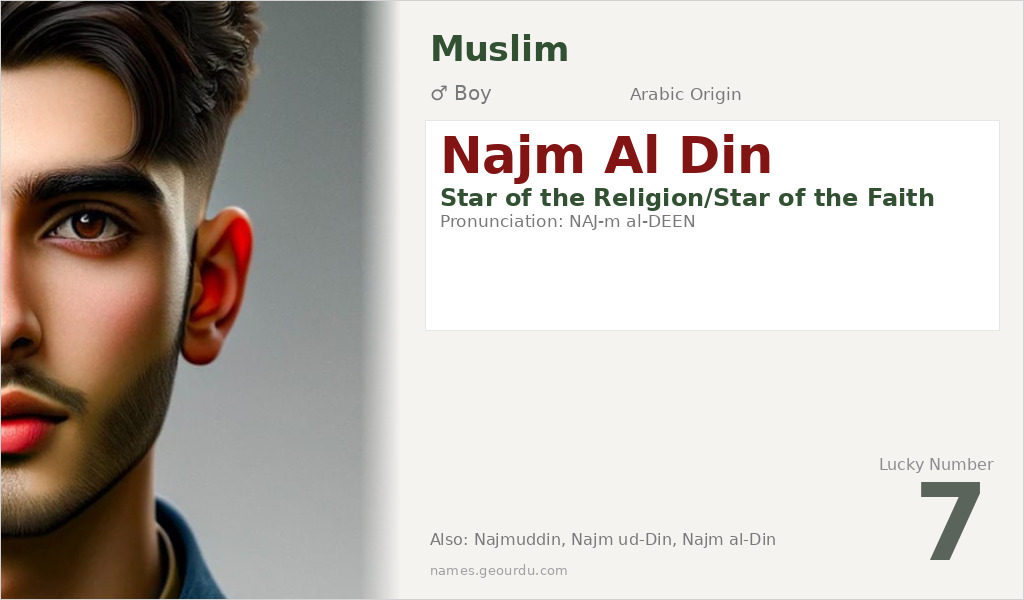
Najm Al Din is a distinguished Arabic name with deep religious and cultural significance in the Muslim world. Meaning ‘Star of the Faith’ or ‘Star of the Religion’, this name has been borne by historical scholars, mystics, and leaders throughout Islamic history. As a compound name combining celestial and religious elements, it represents guidance, enlightenment, and spiritual leadership. Today, it remains a meaningful choice for parents seeking a name with both poetic beauty and religious depth.
Meaning of Najm Al Din
Najm Al Din is a compound Arabic name with clear etymological roots. The first component, ‘Najm’ (نجم), directly translates to ‘star’ in Arabic, derived from the triliteral root n-j-m which relates to celestial bodies and appearing/rising. The second component, ‘Al Din’ (الدين), means ‘the religion’ or ‘the faith’, from the root d-y-n relating to judgment, debt, and religion. Together, they form ‘Star of the Faith’, a metaphorical name suggesting someone who illuminates religious truth or serves as a guiding light in matters of faith. This naming pattern was particularly popular during the medieval Islamic period for religious scholars and Sufi masters. The name appears in various forms across the Muslim world, from Arabic-speaking regions to Persian, Turkish, and South Asian contexts where Arabic religious terminology was adopted.
| 📛 Name | Najm Al Din |
| 💎 Meaning | Star of the Religion/Star of the Faith |
| 👤 Gender | Boy |
| 🕌 Religion | Muslim |
| 🌍 Origin | Arabic |
| 🗣 Pronunciation | NAJ-m al-DEEN |
| ✍️ Urdu | نجم الدین |
| ✍️ Arabic | نجم الدين |
| 🔢 Numerology | 7 |
| ✨ Spellings | Najmuddin, Najm ud-Din, Najm al-Din, Najmaddin, Najm al-Deen |
Origin & Cultural Significance
Najm Al Din originated in the Arabic-speaking world during the early Islamic period and became particularly prominent from the 12th century onward. The name follows a classical Arabic naming convention where honorific titles (laqab) were created by combining natural phenomena with religious terms. It was most commonly bestowed upon religious scholars, Sufi mystics, and sometimes rulers who were seen as defenders of the faith. Historical records show the name was used across the Islamic world from North Africa to South Asia, with notable bearers including Najm al-Din Kubra, founder of the influential Kubrawi Sufi order, and Najm al-Din Ayyub, father of the famous Muslim leader Saladin. The name continues to be used in Muslim communities worldwide, maintaining its religious and cultural significance.
Personality Traits
The name Najm Al Din carries connotations of guidance, wisdom, and spiritual leadership. Those bearing this name are often associated with qualities of illumination—bringing clarity to complex matters, particularly in religious or philosophical contexts. The stellar metaphor suggests someone who stands out in their community, providing direction and inspiration to others. While personality traits cannot be determined by name alone, the cultural associations point toward intellectual depth, moral integrity, and a natural inclination toward teaching or leading in spiritual matters.
Similar Names
If you like Najm Al Din, consider: Najm, Nur al-Din, Shams al-Din, Kamal al-Din, Jalal al-Din
Famous People Named Najm Al Din
- Najm al-Din Kubra — 12th-13th century Persian Sufi mystic and founder of the Kubrawi order
- Najm al-Din Ayyub — 12th century Kurdish ruler and father of Saladin, founder of the Ayyubid dynasty
Frequently Asked Questions About Najm Al Din
What does Najm Al Din mean?
Najm Al Din means 'Star of the Faith' or 'Star of the Religion' in Arabic. It is a compound name where 'Najm' means star and 'Al Din' means the religion/faith.
Is Najm Al Din a boy or girl name?
Najm Al Din is exclusively a boy's name in Arabic and Islamic naming traditions. The masculine form of the components and historical usage confirm this gender assignment.
What is the origin of Najm Al Din?
Najm Al Din originates from Arabic language and Islamic culture. It follows classical Arabic naming patterns and has been used since medieval times across the Muslim world, particularly for religious scholars and leaders.





